Material Guide for Chain Making Jewelry: Wire Properties
Compare the best metals for chain making jewelry. Explore wire properties, work-hardening rates, and gauge tips for perfect jump rings.

Introduction to Wire Metallurgy in Chain Weaving
Creating durable, fluid, and visually striking woven chains requires more than just a pair of pliers and a spool of wire. For artisans dedicated to chain making jewelry, understanding the underlying metallurgy of your materials is the difference between a masterpiece and a tangled, broken mess. Unlike cast or stamped jewelry, chainmaille and woven chain designs rely entirely on the structural integrity of individual jump rings. The metal you choose dictates how the wire will behave when coiled, cut, and manipulated.
In 2026, the market for jewelry wire has expanded significantly, offering everything from traditional precious metals to advanced reactive alloys. However, every metal possesses unique physical properties—specifically regarding tensile strength, work-hardening rates, and springback. According to the Maille Artisans International League (MAIL), failing to account for a metal's specific Aspect Ratio (AR) and hardness can result in rings that either pull apart under minimal tension or refuse to close flush. This guide breaks down the material properties you must consider before starting your next chain project.
The Core Metrics: Hardness, Tensile Strength, and Work-Hardening
Before comparing specific metals, it is crucial to understand the three mechanical properties that govern wire behavior in chain making:
- Temper (Hardness): Wire is sold in various tempers, typically Dead Soft (H00), Half-Hard (H02), and Full-Hard (H04). For coiling jump rings, Dead Soft or Half-Hard is mandatory. Full-Hard wire will snap or severely damage your mandrel when wound.
- Work-Hardening Rate: As you bend, twist, and close jump rings with pliers, the metal's crystalline structure compresses, making it harder and more brittle. Metals like copper work-harden rapidly, meaning you have a limited window to adjust a ring before it snaps. Sterling silver work-hardens more slowly, offering greater forgiveness.
- Springback: When wire is wound around a mandrel, it stores elastic energy. Once removed, the coil expands slightly. High-yield-strength metals like titanium and stainless steel exhibit massive springback, meaning a coil wound on a 5mm mandrel might expand to an Inner Diameter (ID) of 5.8mm.
Material Comparison Chart: Top 6 Metals for Chain Making Jewelry
The following table provides a baseline comparison of the most popular metals used in chain making jewelry, based on standard 20-gauge (0.81mm) wire in a Half-Hard (H02) temper.
| Metal / Alloy | Vickers Hardness (HV) | Springback Factor | Approx. Cost (20ga/ft) | Tarnish Resistance |
|---|---|---|---|---|
| Sterling Silver (925) | 65 - 75 HV | Low (2-4%) | $2.80 - $3.50 | Low (Requires Polishing) |
| Argentium Silver (935) | 70 - 80 HV | Low (2-4%) | $3.60 - $4.20 | High (Germanium Oxide Layer) |
| 14/20 Gold-Filled | 85 - 95 HV | Medium (4-6%) | $4.50 - $6.00 | Very High |
| Enamel Copper | 45 - 55 HV | Very Low (1-2%) | $0.15 - $0.25 | N/A (Coated) |
| Red Brass (85/15) | 90 - 105 HV | Medium (5-7%) | $0.40 - $0.60 | Medium (Develops Patina) |
| Niobium (Reactive) | 60 - 70 HV | Low (2-3%) | $1.20 - $1.80 | Very High (Anodized Layer) |
Note: Pricing reflects early 2026 market averages from major suppliers like Rio Grande and may fluctuate based on spot metal markets.
Deep Dive: Precious vs. Base Metals for Jump Rings
Sterling Silver vs. Argentium
Standard Sterling Silver (92.5% silver, 7.5% copper) remains the gold standard for fine chain making jewelry. Its relatively slow work-hardening rate makes it ideal for complex weaves like the Full Persian or Dragonscale, where rings must be manipulated multiple times. However, the copper content makes it highly susceptible to sulfur-induced tarnish.
Argentium Silver (typically 93.5% silver, with germanium replacing some copper) solves the tarnish issue. The germanium forms a transparent, self-healing oxide layer that resists firescale and environmental tarnish. From a chain-making perspective, Argentium is slightly stiffer than traditional sterling and can be fused without solder, though it requires careful heat management if you are soldering your jump rings shut to prevent melt-through.
Gold-Filled vs. Gold-Plated
For artisans seeking the look of gold without the $60+ per foot price tag of solid 14k gold, 14/20 Gold-Filled wire is the only viable option for chain making. Gold-filled wire consists of a brass core with a thick outer layer of 14k gold (comprising 5% of the total weight) mechanically bonded via heat and pressure. Unlike gold-plated wire, which will flake and peel when subjected to the friction of pliers and the stress of jump ring closure, gold-filled wire can be tumbled, polished, and worn for decades without exposing the brass core.
Base Metals: Copper, Brass, and Bronze
Base metals are the lifeblood of practice, prototyping, and bohemian-style chain making jewelry. Copper is incredibly soft and work-hardens quickly. It is excellent for learning new weaves because it is cheap and easy on your pliers, but it will oxidize rapidly, turning the wearer's skin green if not sealed with a micro-crystalline wax like Renaissance Wax.
Brass and Bronze offer higher tensile strength and a beautiful golden hue. Red Brass (85% copper, 15% zinc) is favored over Yellow Brass for jewelry because its lower zinc content reduces the risk of allergic contact dermatitis. Bronze (copper and tin) is noticeably stiffer and more brittle than brass, making it challenging for tight, small-ID weaves, but it yields incredibly durable, heavy-duty chains suited for pendants and dog collars.
Specialty Metals: Niobium and Titanium
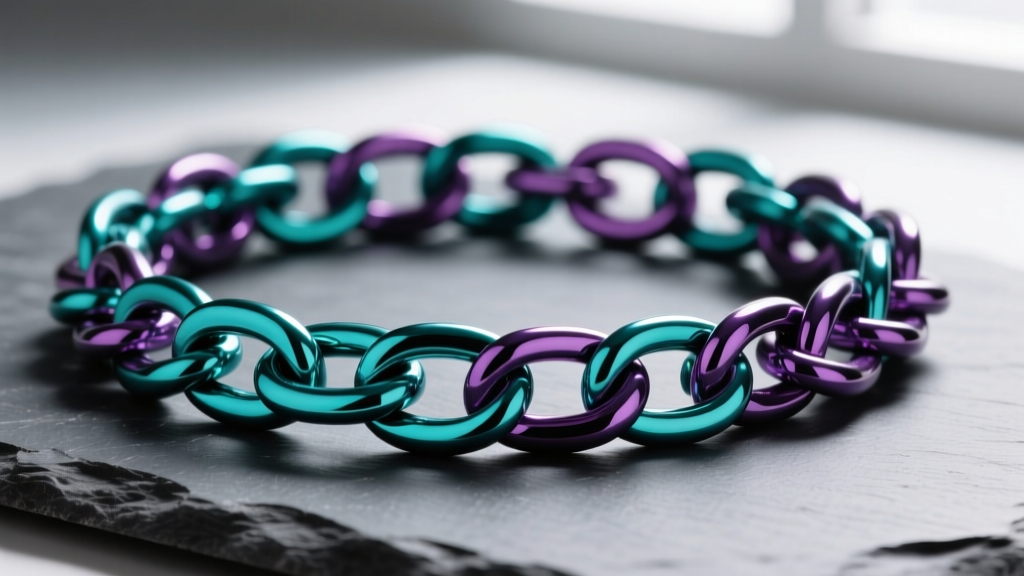
For hypoallergenic chain making jewelry, Niobium and Titanium are unparalleled. Niobium is a reactive metal that is naturally dead soft and highly malleable. Its greatest advantage is anodizing: by applying varying voltages via a simple bench power supply, you can grow an oxide layer that refracts light, producing vibrant, permanent colors without dyes or plating. Niobium jump rings close beautifully and hold their shape well, though they are easily scratched by steel pliers (always use nylon-jaw pliers or tape your tool tips).
Titanium (specifically Grade 1 or Grade 2 commercially pure) offers immense strength-to-weight ratios. However, it is notoriously difficult for chain makers. Titanium has a high springback factor and is incredibly tough on flush cutters. Most professionals use a jeweler's saw with a 2/0 or 3/0 blade to cut titanium coils, as wire cutters will deform the ring ends and leave a sharp burr that will snag the weave. Furthermore, titanium work-hardens rapidly and cannot be easily annealed with a standard propane torch.
Troubleshooting Common Chain Making Failures by Material
Springback and Ring Deformation
If your woven chain feels loose or the rings are gaping, you are likely a victim of springback. When working with high-strength metals like stainless steel or titanium, you must compensate for springback by using a smaller mandrel. For example, if your weave requires a 4.0mm ID, you might need to wind titanium on a 3.5mm mandrel. Always cut a test ring, measure the ID with digital calipers, and adjust your mandrel size accordingly before cutting an entire coil.
Tarnish and Patina Management
When combining different metals in a single chain (e.g., sterling silver and copper), be aware of galvanic corrosion. If the chain is exposed to moisture and salts (sweat), the more anodic metal (copper) will corrode rapidly to protect the cathodic metal (silver). To prevent this, either seal the base metals with a lacquer like ProtectaClear, or stick to metals that are close together on the galvanic series.
Sourcing and Gauge Recommendations for Beginners
Sourcing high-quality, consistently sized wire is critical. Variations in wire diameter will ruin the Aspect Ratio of your chain. Avoid craft-store spools for fine chain making. Instead, rely on specialized suppliers:
- Rio Grande: The industry standard for precious metals. Their wire is precisely drawn and accurately tempered.
- Wire-Sculpture: Excellent for half-hard base metals and gold-filled wire in bulk.
- Blue Mud / Reactive Metals Studio: The premier sources for raw and pre-anodized niobium wire and titanium jump rings.
For beginners, start your chain making jewelry journey with 20-gauge (0.81mm) or 18-gauge (1.02mm) dead soft copper. These gauges are thick enough to handle the mechanical stress of opening and closing without warping, yet thin enough to be manipulated with standard flat-nose and chain-nose pliers. Once you master the tension and tool control required for copper, transition to half-hard sterling silver to elevate your work into fine, heirloom-quality jewelry.


