Permanent Jewelry Training: Technical Welding Guide
Master permanent jewelry training with our expert technical guide on micro-welding pulse settings, argon flow, and chain metallurgy.

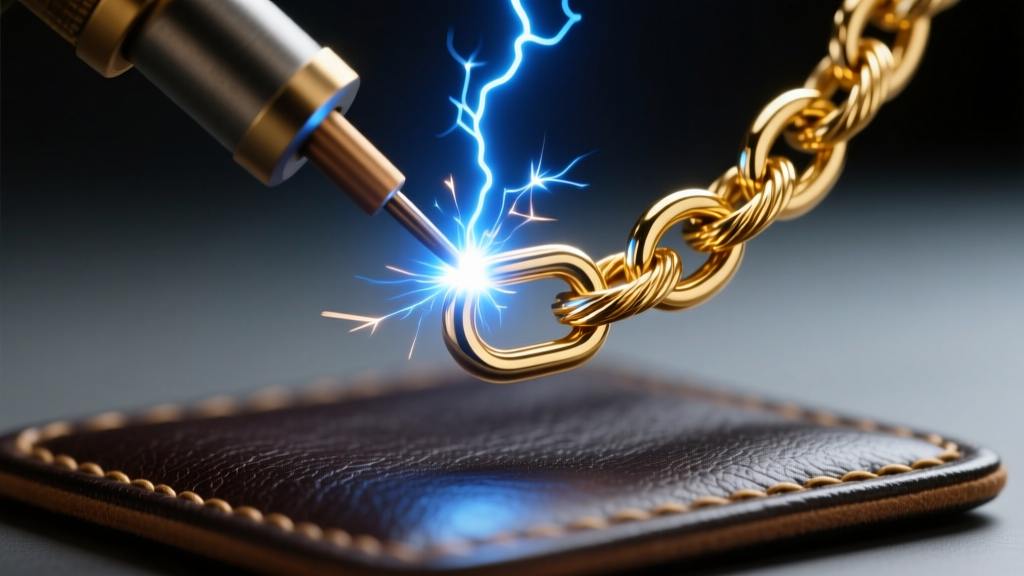
The explosion of the permanent jewelry market has created a gold rush for jewelers and entrepreneurs alike. However, the barrier to entry has been artificially lowered by weekend certification courses that treat micro-welding like a simple party trick. True permanent jewelry training is not merely about touching a wand to a chain and stepping on a foot pedal; it is an exercise in applied metallurgy, electrical engineering, and precision thermal dynamics. If you are looking to elevate your practice from amateur zapping to professional micro-welding, you must understand the science happening at the microscopic level of the weld puddle.
This expert deep dive bypasses the marketing fluff and focuses on the technical realities of permanent jewelry fabrication. We will examine alloy behaviors, precise pulse settings, shielding gas requirements, and the safety protocols necessary to run a compliant, high-end studio.
The Metallurgy of Weldable Chains: What You Can Actually Fuse
Not all precious metals react to a direct current (DC) arc in the same way. The alloying metals mixed with pure gold or silver dictate the melting point, thermal conductivity, and vaporization risks during the microsecond of an arc strike. According to the Gemological Institute of America (GIA), understanding these alloy compositions is critical for preventing structural failure in permanent welds.
Solid Gold (10k, 14k, and 18k)
Pure 24k gold is too soft for permanent chains, so it is alloyed with copper, silver, and zinc. When you strike an arc on 14k gold, you are not just melting gold; you are managing the vaporization points of these secondary metals. Zinc, for instance, has a relatively low boiling point (907°C). If your pulse width is too long, the zinc will vaporize before the gold fully liquefies, causing microscopic porosity and a brittle, weak weld. 18k gold, having less zinc and copper, generally welds cleaner but requires slightly higher energy due to the higher pure gold content.
Sterling Silver (925)
Sterling silver is notoriously tricky for permanent jewelry. Silver possesses the highest thermal conductivity of any precious metal. This means the heat from the arc dissipates rapidly down the chain links rather than pooling at the weld joint. To compensate, welders often mistakenly increase the energy (Watt-seconds), which results in blown-out links or melted adjacent jump rings. The secret to welding 925 silver is a shorter, sharper pulse width that delivers high energy instantaneously before the heat can travel.
The Gold-Filled and Plated Prohibition
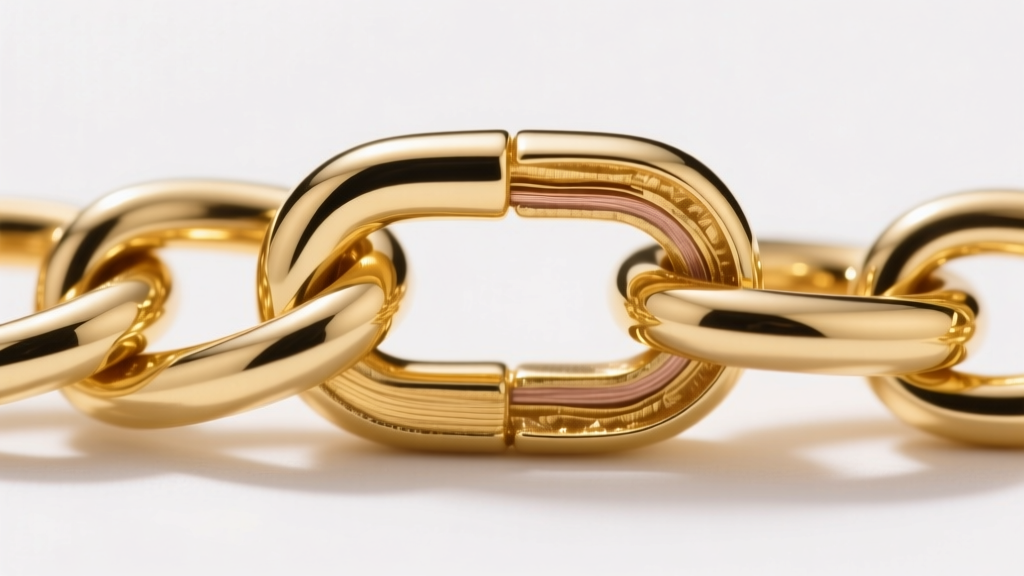
A cardinal rule in advanced permanent jewelry training is the absolute prohibition of arc-welding gold-filled (GF) or gold-plated chains. Gold-filled chains consist of a brass or copper core mechanically bonded to a thin outer layer of karat gold. When a micro-welder's arc hits GF material, the intense heat instantly vaporizes the zinc in the brass core, creating a violent, porous, and structurally compromised weld. Furthermore, vaporized brass releases toxic zinc oxide fumes. Gold-filled chains must only be connected using mechanical closures (like specialized jump rings or crimps) or, in high-end studios, precision laser welders that do not penetrate the core.
Micro-Welder Pulse Settings and Energy Transfer
Professional permanent jewelry studios rely on capacitor-discharge pulse welders, such as those engineered by Sunstone Welders (the makers of the Orion line). These machines allow independent control over Energy (measured in Watt-seconds, or Ws) and Pulse Width (measured in milliseconds, or ms).
Energy dictates the volume of the melt pool, while pulse width dictates how fast that energy is delivered. A high-energy, short-pulse setting creates a deep, narrow penetration ideal for silver. A lower-energy, longer-pulse setting creates a wide, shallow pool better suited for delicate 14k gold chains.
Baseline Settings for Popular Chain Gauges
The following table provides baseline starting parameters for a standard 110v pulse welder using a 0.5mm ceriated tungsten electrode. Always test on a scrap piece of the exact chain batch before welding on a client.
| Chain Gauge / Thickness | Material | Energy (Ws) | Pulse Width (ms) | Welding Mode |
|---|---|---|---|---|
| 0.8mm - 1.0mm (Delicate) | 14k Yellow Gold | 12 - 16 Ws | 4.0 - 6.0 ms | Standard Pulse |
| 1.2mm - 1.5mm (Medium) | 14k Yellow Gold | 20 - 25 Ws | 6.0 - 8.0 ms | Standard Pulse |
| 0.9mm - 1.2mm (Delicate) | Sterling Silver 925 | 18 - 22 Ws | 2.0 - 3.5 ms | High-Peak Pulse |
| 1.5mm - 2.0mm (Heavy) | Sterling Silver 925 | 30 - 40 Ws | 4.0 - 5.0 ms | High-Peak Pulse |
| 1.0mm (Jump Ring) | 18k Gold | 15 - 18 Ws | 5.0 ms | Standard Pulse |
Tungsten Electrodes and Argon Gas Shielding
The physical connection between your welder and the jewelry is the tungsten electrode. For permanent jewelry, you should exclusively use 2% Ceriated (Grey) or 1.5% Lanthanated (Gold) tungsten electrodes. Avoid 2% Thoriated (Red) tungsten, as it contains radioactive thorium oxide, which poses unnecessary health risks during the grinding and sharpening process.
The tip of the electrode must be ground to a precise needle point using a diamond grinding wheel. A blunt tip will cause the arc to wander, resulting in asymmetrical welds and potential damage to adjacent chain links. The electrode should extend exactly 1.5mm to 2.0mm past the gas cup to ensure the arc is fully enveloped by the shielding gas.
The Invisible Necessity of Argon
When the arc strikes, it reaches temperatures exceeding 10,000°F. At this temperature, atmospheric oxygen and nitrogen will instantly react with the molten precious metal, creating heavy fire scale, oxidation, and microscopic bubbles that weaken the joint. Argon is an inert gas that displaces the atmosphere around the weld puddle.
- Gas Purity: You must use 99.995% pure argon (often labeled as Grade 5 or welding-grade). Impure argon will introduce moisture and oxygen into the weld zone.
- Flow Rate: Set your regulator to a flow rate of 5 to 8 Cubic Feet per Hour (CFH). Too low, and the shield is incomplete; too high, and the turbulent gas flow will actually pull atmospheric air into the weld zone (the Venturi effect).
- Post-Flow: Advanced welders feature a post-flow setting that continues to bathe the weld in argon for 1 to 2 seconds after the arc stops. This is critical, as the metal remains susceptible to oxidation until it drops below 400°C.
Safety Protocols: Optical Radiation and Fume Extraction
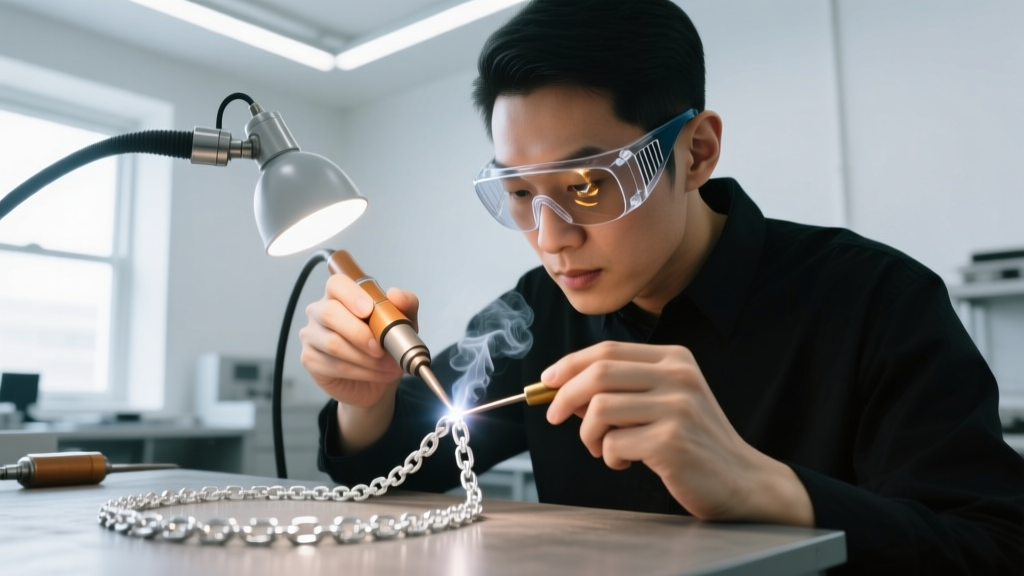
Permanent jewelry training must heavily emphasize studio safety. A micro-welder's arc emits intense ultraviolet (UV) and infrared (IR) radiation. Staring at the arc without protection will cause "arc eye" (photokeratitis), a painful condition akin to a sunburn on the cornea.
Optical Protection
Standard jeweler's magnifying loupes are entirely insufficient for welding. You must use welding-specific eyewear. For the low-amperage arcs used in permanent jewelry (typically 15 to 40 amps equivalent), a Shade 8 to Shade 10 lens is required. Auto-darkening welding glasses are highly recommended, as they allow you to position the chain with a clear view (Shade 3) and instantly snap to Shade 10 the millisecond the foot pedal is depressed.
Particulate and Fume Extraction
Vaporized metals are a severe respiratory hazard. When welding sterling silver or lower-karat gold, you are vaporizing copper, zinc, and occasionally nickel. Chronic inhalation of metal fumes can lead to heavy metal toxicity and conditions like metal fume fever. Your studio must be equipped with a localized fume extractor featuring a combination of HEPA filters (for sub-micron particulate matter) and activated carbon filters (for ozone and metallic odors). The extraction nozzle should be positioned no more than 4 inches from the weld point to capture the plume before it disperses into the room.
Evaluating Permanent Jewelry Training Programs
As you seek out advanced certification, scrutinize the curriculum. A legitimate permanent jewelry training program in 2026 should offer far more than a supervised "zap session." Look for courses that provide:
- Metallurgy Modules: Deep dives into alloy compositions, melting points, and the structural limitations of gold-filled versus solid metals.
- Machine Diagnostics: Training on how to maintain, calibrate, and troubleshoot your specific pulse welder, including proper tungsten grinding techniques.
- Business & Liability: Guidance on securing specialized commercial liability insurance. Standard jewelry policies often exclude permanent welding due to the inherent risk of minor thermal burns or chain-snagging injuries.
- Hands-On Failure Analysis: The best courses intentionally have you create bad welds (using too much energy, too little gas) so you can physically test the tensile strength of the failures and understand the consequences of improper settings.
Mastering permanent jewelry is a commitment to technical excellence. By respecting the metallurgy, dialing in your pulse parameters, and maintaining rigorous safety standards, you transition from a trend-chaser to a master micro-welder capable of delivering heirloom-quality, permanent pieces.