Transforming Broken Jewelry Art: Kintsugi & Laser Welding Techniques
Master the technical art of broken jewelry restoration. Explore Kintsugi lacquer applications and sculptural laser welding for shattered fine pieces.

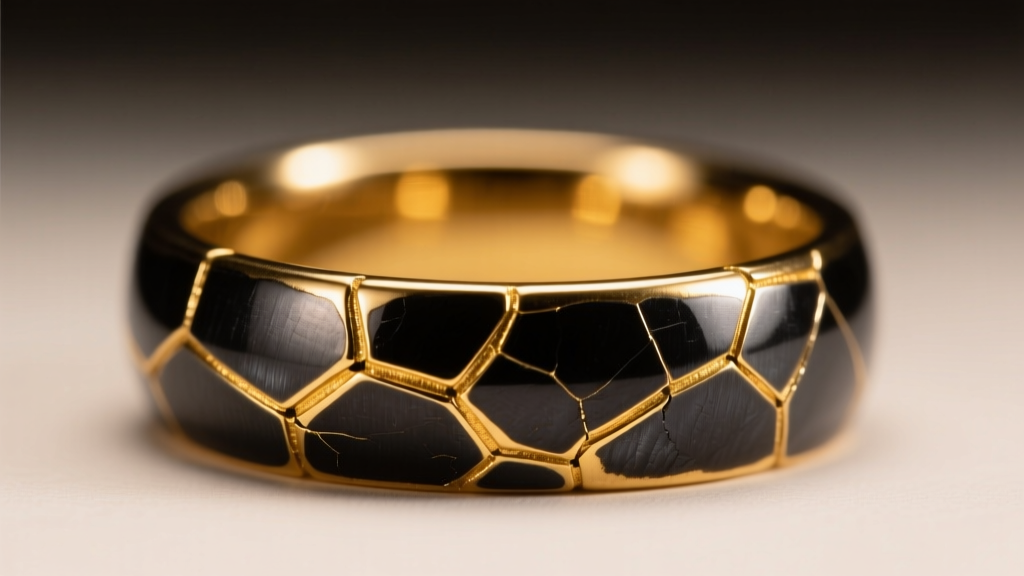
The Evolution of Broken Jewelry Art
The concept of broken jewelry art has evolved from a niche aesthetic trend into a highly technical discipline that merges ancient restoration philosophies with modern bench metallurgy. When a cherished fine jewelry piece suffers catastrophic damage—such as a shattered shank, a crushed bezel, or a fractured gemstone—traditional soldering and prong re-tipping are often insufficient. The piece requires a structural and artistic intervention that acknowledges its history while engineering a new future.
As we navigate the repair landscape in 2026, master jewelers and restoration artists are increasingly turning to hybrid methodologies. By combining the Japanese philosophy of Kintsugi with precision pulse-arc welding and optical-grade resins, artisans can transform irreparably damaged pieces into wearable masterpieces. This deep dive explores the exact materials, metallurgical parameters, and bench techniques required to execute high-end broken jewelry art.
Diagnostic Triage: Assessing Structural Failure
Before applying any artistic repair, a metallurgical assessment is critical. Cast jewelry, particularly in 14k and 18k gold alloys, is prone to micro-porosity and crystalline stress fractures. When a cast shank snaps, the break is rarely clean; it resembles a jagged topographical map.
Identifying the Failure Mode
- Ductile Overload: The metal stretched and thinned before breaking, leaving a tapered, smooth edge. This requires additive metal replacement.
- Brittle Fracture: Common in high-karat gold (22k+) or platinum alloys that have been work-hardened without annealing. The break is crystalline and sharp.
- Galvanic Corrosion: Often seen in mixed-metal antique pieces where solder joints degrade over decades, leaving a powdery, oxidized gap.
Understanding the failure mode dictates whether the piece should be traditionally soldered, laser-welded, or embraced as a candidate for Kintsugi-style artistic repair.
Kintsugi-Style Restoration: Urushi vs. Synthetic Polymers
The traditional Japanese art of Kintsugi (golden joinery) uses urushi, a toxic sap derived from the Toxicodendron vernicifluum tree. While authentic urushi yields unparalleled durability and depth, its application in a modern jewelry workshop requires stringent safety protocols and specialized curing environments.
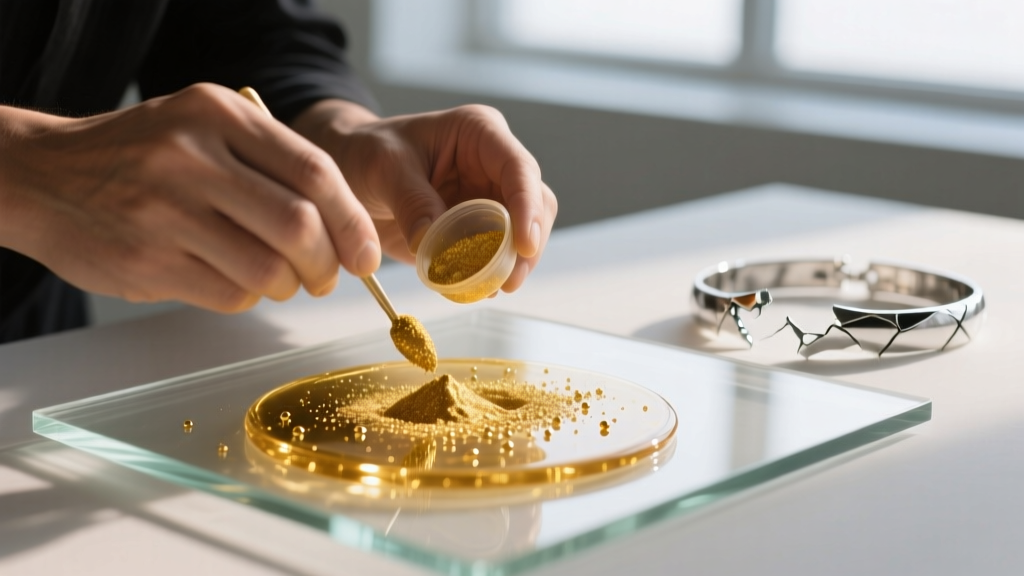
Traditional Urushi Application
Authentic Kintsugi requires a multi-week process. The artisan uses sabi-urushi (a mixture of urushi and polishing clay) to fill gaps larger than 1mm. This must be cured in a furo (humidity chamber) maintained at exactly 75-80% relative humidity and 25°C (77°F). Urushi does not dry by evaporation; it polymerizes by absorbing moisture from the air. Once cured, the seams are sanded with 2000-grit wet paper, coated with bengara-urushi (red iron oxide lacquer), and finally dusted with 23k or 24k keshifun (gold powder) sifted at 400 mesh.
Safety Warning: Uncured urushi contains urushiol, the same compound found in poison ivy. It causes severe allergic contact dermatitis. Bench jewelers must use heavy-duty nitrile gloves, dedicated ventilation, and barrier creams.
The Modern Synthetic Alternative
For high-volume restoration studios, synthetic alternatives offer a 24-hour turnaround. The industry standard is a two-part jeweler's epoxy, such as Epoxy 330 or G-Smith, tinted with 23k mica-infused gold powder. To achieve a raised, tactile seam characteristic of broken jewelry art, the epoxy is applied in stages, allowing each layer to reach a tacky, leather-hard state before adding the next. Final burnishing is done with a polished agate tool to align the metallic flakes, followed by a light polish with 8000-grit micro-mesh.
Sculptural Pulse-Arc Welding for Shattered Frameworks
When a piece of jewelry is missing significant structural material, traditional torch soldering risks melting adjacent details or shattering heat-sensitive gemstones. According to the Gemological Institute of America (GIA), stones like emeralds, opals, and tanzanite can suffer catastrophic thermal shock at temperatures far below the melting point of gold solder.
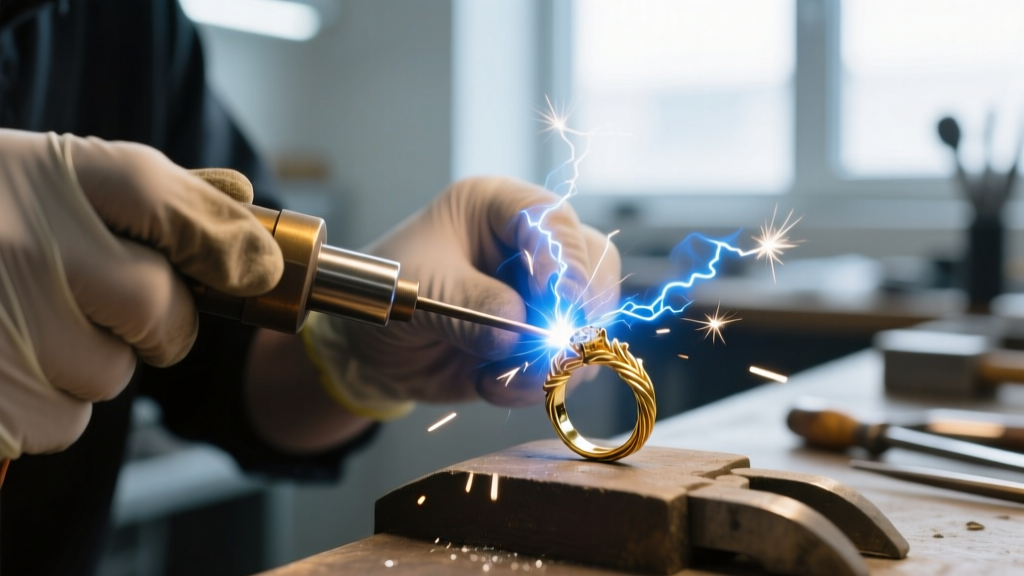
To circumvent this, experts utilize pulse-arc welders, such as the Sunstone Orion series. Unlike continuous lasers, pulse-arc welders use a high-frequency electrical arc to melt metal in milliseconds, confining the heat-affected zone (HAZ) to less than 1.5mm.
Technical Parameters for Additive Sculpting
When building up a shattered ring shank or reconstructing a missing filigree scroll, the jeweler uses a micro-tungsten electrode and fine filler wire (0.25mm to 0.5mm diameter). Shielding gas is non-negotiable; Argon must flow at 2.0 CFH (cubic feet per hour) to prevent oxidation and ensure a porous-free weld.
| Material | Energy Setting | Pulse Width | Spot Size | Argon Flow |
|---|---|---|---|---|
| 14k Yellow Gold | 35% | 3.0 ms | 0.8 mm | 2.0 CFH |
| 18k White Gold | 42% | 3.5 ms | 1.0 mm | 2.5 CFH |
| Platinum (950/50) | 55% | 4.5 ms | 1.2 mm | 3.0 CFH |
| Sterling Silver | 28% | 2.5 ms | 0.8 mm | 2.0 CFH |
By overlapping these micro-welds, the artisan can literally "draw" with gold wire, creating organic, vine-like structures that bridge the broken gaps. This additive manufacturing at the bench level is a cornerstone of contemporary broken jewelry art, allowing the repair itself to become the focal point of the design.
Optical Resin Encapsulation for Fractured Gemstones
What happens when the stone itself is shattered? A cracked sapphire or a chipped opal loses its structural integrity and cannot be held securely by standard prongs. While Gem-A (The Gemmological Association of Great Britain) notes that fracture filling is common in commercial gems, artistic restoration takes a different approach: encapsulation and optical bridging.
Refractive Index Matching
To stabilize a fractured gemstone while maintaining its optical brilliance, restorers use UV-curing optical adhesives like Norland Optical Adhesive 68 (NOA 68). NOA 68 has a refractive index (RI) of 1.54, which closely matches many silicates and beryls. The resin is wicked into the fracture lines via capillary action using a micro-pipette, then cured under a 365nm UV lamp for exactly 12 minutes.
Once stabilized, the stone can be bezel-set. For heavily shattered stones, the artisan may cast a custom transparent resin window over the entire face of the gem, effectively trapping the broken pieces in a state of suspended animation. This technique honors the damage while ensuring the piece is safe for daily wear.
The Artisan's Responsibility
Executing broken jewelry art requires a departure from the traditional jeweler's mandate of "making it look like new." Instead, the goal is to elevate the damage into a feature. Whether you are mixing 400-mesh gold powder with urushi, dialing in the pulse width on an arc welder, or matching the refractive index of a shattered emerald, the technical precision required is immense. By mastering these advanced methodologies, restoration experts do more than fix jewelry; they preserve the emotional weight of the object, wrapping its scars in gold and light.


