How to Solder Jewelry: Torch vs. Laser Repair Techniques
An expert guide on how to solder jewelry, comparing traditional torch methods with laser welding for precise, heat-sensitive metal repairs.

The Metallurgy of the Joint: Understanding Solder Alloys
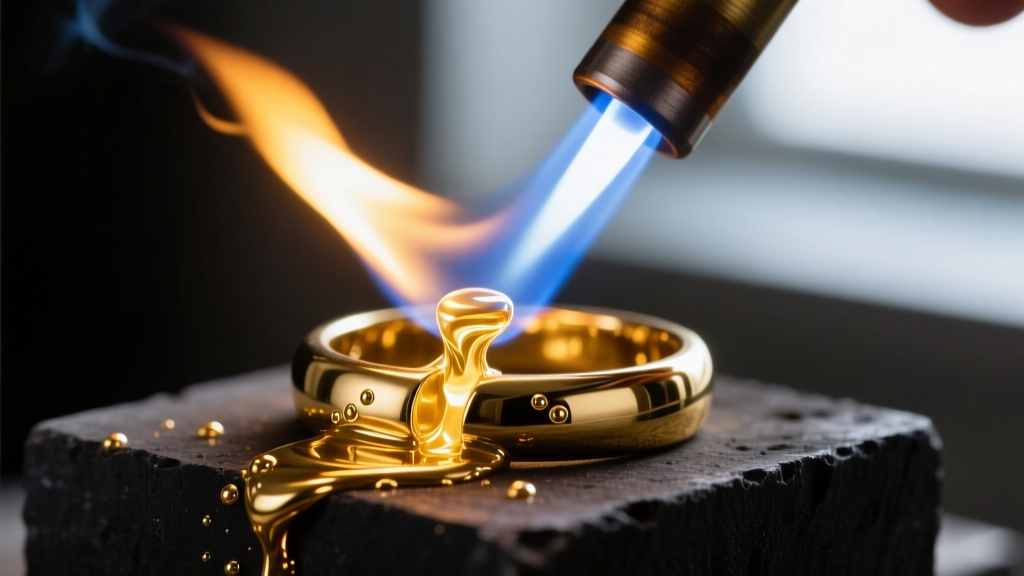
When professionals solder jewelry, they are not welding the base metals together; they are utilizing capillary action to draw a lower-melting-point alloy into a microscopic gap between two components. Understanding the metallurgy of these alloys is the foundation of any successful repair. Modern jewelers predominantly use cadmium-free solders to comply with international health and safety regulations, relying on complex alloys of silver, copper, zinc, and tin to achieve specific flow temperatures and color matches.
For gold alloys, solder is categorized by its flow temperature into three primary grades. According to technical specifications from Rio Grande, a standard 14k yellow gold solder hierarchy looks like this:
- Hard Solder (approx. 745°C / 1373°F): Used for the first joint in a multi-step fabrication or repair. Its high melting point ensures it will not re-flow during subsequent heating.
- Medium Solder (approx. 700°C / 1292°F): The workhorse for secondary joints, such as attaching a bezel to a backplate or closing a ring shank that already has one hard-soldered seam.
- Easy Solder (approx. 650°C / 1202°F): Reserved for final repairs, sizing, or attaching delicate findings where minimal thermal input is required to protect previous joints.
Karat and Color Matching
A critical failure mode in amateur repair is color mismatch. 14k solder will leave a visible, pale seam on 18k yellow gold due to the lower gold content in the solder alloy. Expert bench jewelers always match the solder karat to the base metal. For white gold, nickel-based or palladium-based solders are used to maintain the rhodium-friendly white hue, though palladium solders require significantly higher torch temperatures and specialized fluoride-based fluxes to prevent oxidation.
Pre-Solder Preparation and Joint Geometry
Capillary action demands absolute cleanliness and precise geometry. Before applying heat, the joint must be ultrasonically cleaned or scrubbed with pumice powder to remove organic oils and oxides. The joint geometry must maximize surface area; a simple butt joint (two flat ends meeting) offers minimal structural integrity. Instead, professionals utilize miter joints, lap joints, or V-grooves to increase the bonding surface area by up to 300%. The gap tolerance is equally strict: an optimal capillary gap ranges from 0.05mm to 0.10mm. Anything wider, and the solder will ball up; anything tighter, and flux inclusions will become trapped, creating structural voids.
Traditional Torch Soldering: Capillary Action and Thermal Mass
Torch soldering remains the industry standard for heavy structural repairs, chain sizing, and ring shank soldering. The technique relies on heating the entire thermal mass of the piece evenly until the base metal reaches the solder’s flow point. If the jeweler applies the flame directly to the solder chip, it will melt into a ball before the base metal is hot enough to accept it via capillary action.
Flux Chemistry and Heat Sinking
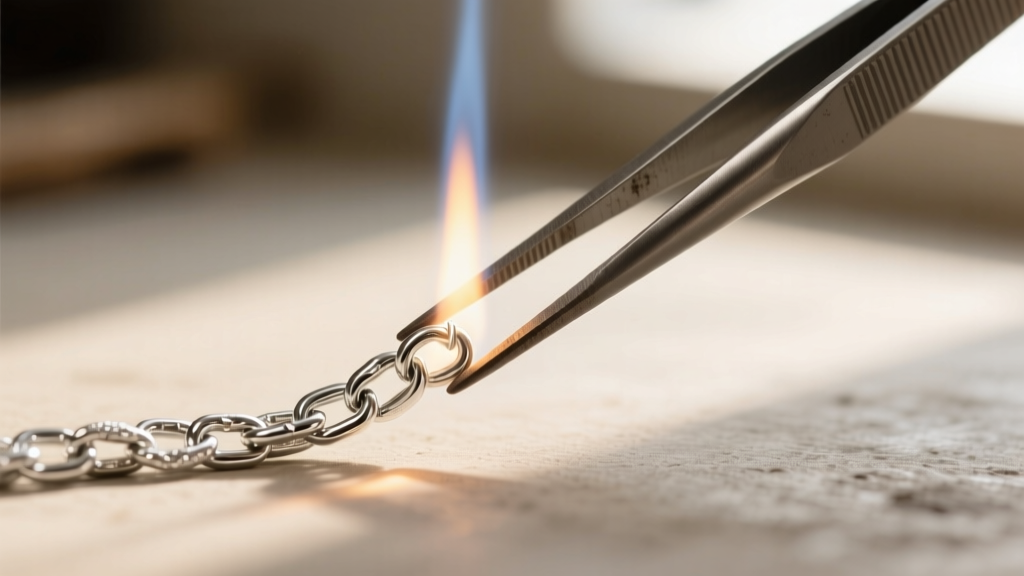
Flux is the chemical gatekeeper of the solder joint. For yellow gold, a simple boric acid and denatured alcohol mixture (bicon flux) creates a glassy barrier that prevents surface oxidation. However, for sterling silver and white gold, copper oxidation (firescale) penetrates deep into the metal grain. As detailed in comprehensive guides by Ganoksin, jewelers must use fluoride-based fluxes (such as Cupronil or Stay-Silv) which actively dissolve copper oxides at high temperatures.
When repairing heat-sensitive areas, thermal management is paramount. Titanium or copper tweezers act as heat sinks, drawing thermal energy away from delicate gemstones or spring rings. For complex pieces, thermally conductive tweezers with water-cooled tips or specialized heat-shielding pastes are applied to protect diamonds and sapphires from thermal shock.
Laser Welding: The Paradigm Shift in Heat-Sensitive Repairs
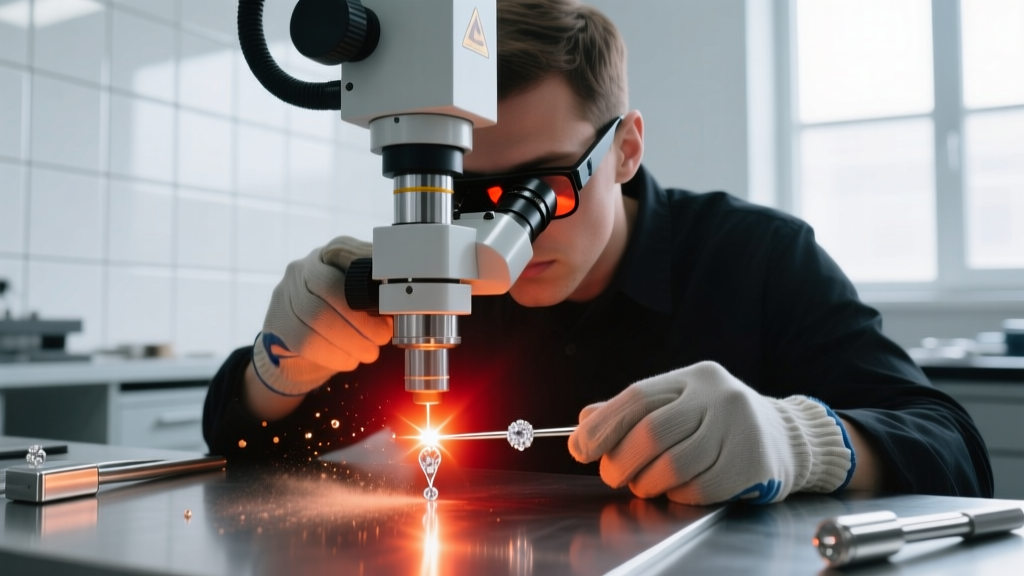
While torch soldering is a macro-thermal process, laser welding is a micro-thermal process. Nd:YAG (Neodymium-doped Yttrium Aluminum Garnet) lasers have revolutionized how bench jewelers approach repairs on heat-sensitive stones like emeralds, opals, and tanzanite, as well as reactive metals like titanium and tungsten carbide. The laser emits highly focused pulses of light energy that melt the metal in a fraction of a millisecond, creating a localized weld pool without raising the ambient temperature of the surrounding jewelry.
Pulse Duration and Peak Power Parameters
Operating a laser welder requires understanding the relationship between pulse width (measured in milliseconds) and peak power (measured in watts).
Expert Insight: When retipping a platinum prong near an emerald, a jeweler will use a short pulse width (1.0 - 2.0 ms) with high peak power. This creates an instantaneous melt pool that solidifies before thermal conductivity can carry the heat down the prong and fracture the emerald's internal inclusions.
Furthermore, laser welding often eliminates the need for flux entirely, as the intense, localized energy vaporizes minor surface contaminants. For highly reactive metals like titanium, an argon gas shield is piped through the laser handpiece to prevent atmospheric oxidation during the microsecond melt phase. The Gemological Institute of America (GIA) frequently highlights laser welding as the safest methodology for repairing antique jewelry with fragile enamel or porous gemstones where torch heat would cause catastrophic, irreversible damage.
Comparative Analysis: Torch vs. Laser for Specific Scenarios
Choosing between torch soldering and laser welding is not a matter of preference, but of metallurgical and structural necessity. Below is a technical matrix comparing the two modalities across critical repair variables.
| Variable | Traditional Torch Soldering | Nd:YAG Laser Welding |
|---|---|---|
| Joint Mechanism | Capillary action (Brazing) | Autogenous fusion (Melting base metal) |
| Thermal Footprint | High (Entire piece heats up) | Micro (Localized to 0.1mm - 2.0mm spot) |
| Stone Safety | Requires removal or heavy heat shielding | Safe for most inclusions/opals/enamel |
| Porosity Risk | Low (if fluxed correctly) | Moderate (requires overlapping pulses) |
| Average Repair Cost | $35 - $75 per joint | $85 - $150+ per joint |
| Ideal Use Case | Ring sizing, heavy chain repair, fabrication | Prong retipping, porous stones, titanium |
Troubleshooting Common Solder Failures
Even master jewelers encounter metallurgical anomalies. Diagnosing the root cause of a failed joint separates the technician from the hobbyist.
Pitting and Voids
If a soldered seam exhibits microscopic pitting after pickling and polishing, the culprit is almost always trapped flux or organic contamination. When the solder flows, it encapsulates the vaporizing flux, leaving voids upon cooling. Solution: Increase the pre-solder ultrasonic cleaning time and ensure the flux is fully dehydrated (turned clear and glassy) before introducing the solder alloy.
Solder Balling (Refusal to Flow)
When solder melts into a perfect sphere but refuses to draw into the joint, the base metal has oxidized, or the joint gap is too wide. Solder will not flow over copper oxide. Solution: Disassemble the joint, re-file to bare metal, apply a fresh coat of aggressive fluoride flux, and ensure the gap is under 0.10mm.
Reticulation and Warping
If the metal surrounding the joint begins to wrinkle or warp, the jeweler has exceeded the annealing temperature of the base metal, causing the surface to melt while the core remains solid. Solution: Use a larger, softer flame to distribute the thermal mass evenly, rather than a pinpoint, high-intensity flame that creates localized hot spots.
When to Outsource: Recognizing Your Technical Limits
Not every repair should be attempted on a standard bench. If a piece features heavily fractured emeralds, heat-treated sapphires with glass-filled fissures, or tension-set diamonds, the thermal dynamics of torch soldering pose an unacceptable risk. In these scenarios, outsourcing to a specialized laser-welding facility or utilizing advanced induction-heating soldering systems with precise thermal cutoffs is the only professional course of action. Understanding exactly how to solder jewelry safely means knowing when to put the torch down and pick up the laser.


