Antique Jewelry Display Case: Technical Preservation Guide
Learn how to choose and restore an antique jewelry display case. Expert tips on material compatibility, off-gassing prevention, and UV protection.

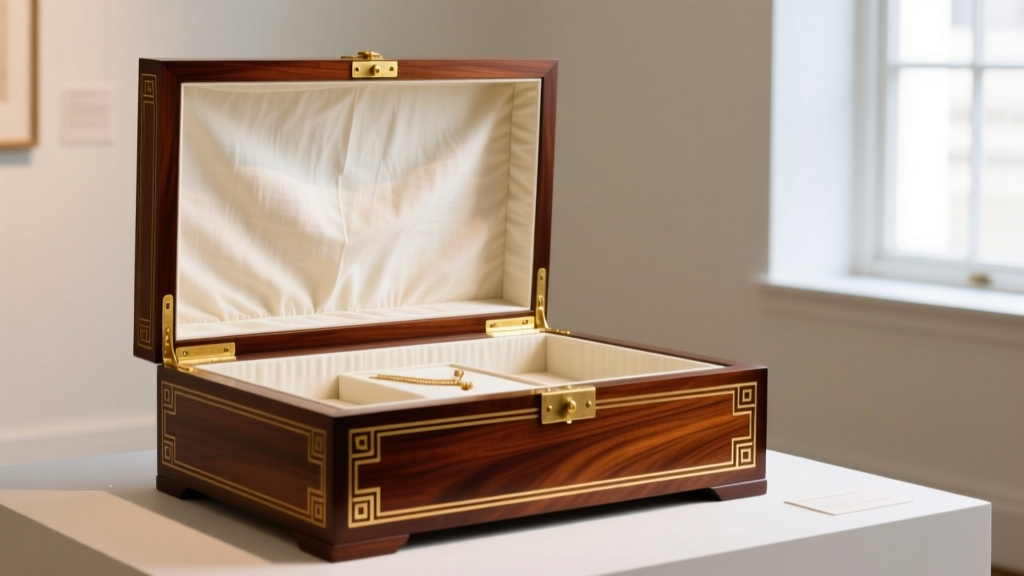
Acquiring an antique jewelry display case is a milestone for any serious collector, curator, or archivist. The craftsmanship of 19th-century mahogany, rosewood, or tortoiseshell veneers offers an unmatched aesthetic that modern manufacturing simply cannot replicate. However, from a conservation perspective, these historical pieces are often fraught with hidden chemical hazards. What makes a beautiful display vessel can simultaneously act as a destructive micro-environment for precious metals, porous gemstones, and organic materials.
This expert deep dive explores the technical realities of utilizing period-appropriate storage. We will examine the chemistry of off-gassing, the mechanics of UV filtration, and the precise micro-climate engineering required to safely house high-value collections inside vintage cabinetry without compromising their historical integrity.
The Chemistry of Off-Gassing and Material Incompatibility
The most significant threat posed by an unmodified antique jewelry display case is chemical off-gassing. Woods naturally emit volatile organic compounds (VOCs), but certain species are particularly aggressive. Oak, cedar, and Douglas fir release high levels of acetic and formic acids. When trapped inside a sealed display environment, these acidic vapors lower the pH, leading to catastrophic failure modes such as the pitting of lead alloys, the corrosion of silver, and the degradation of natural pearls.
Furthermore, the historical finishes used on these cases—such as early polyurethanes, cellulose nitrate lacquers, and certain shellacs—continue to off-gas harmful plasticizers and solvents decades after application. To mitigate this, conservation scientists utilize the Oddy test, a standardized accelerated aging protocol developed by the British Museum. The Oddy test evaluates materials by sealing them in a glass jar with silver, lead, and copper coupons at elevated heat and humidity to observe corrosion over 28 days.
If you are commissioning or restoring a vintage case, you must isolate the interior wood from the collection. This is typically achieved by lining the interior compartments with Marvelseal 360, an aluminized nylon and polyethylene barrier film that is completely impermeable to moisture and acidic gases. A 3-mil thickness is recommended for high-traffic drawer bottoms, while 1-mil is sufficient for lining the interior walls of a glass-topped vitrine.
Material Compatibility Matrix for Antique Cases
Not all materials interact with jewelry in the same way. The table below outlines the risk profiles of common materials found in or added to antique display environments, alongside actionable mitigation strategies.
| Material | Risk Level | Primary Threat | Mitigation Strategy |
|---|---|---|---|
| Oak / Cedar Wood | High | Acetic acid off-gassing | Seal with Marvelseal 360 or avoid entirely |
| Vintage Velvet | High | Sulfur dyes, acidic sizing | Replace with unbleached cotton or Tyvek |
| Rubberized Stops | Critical | Sulfur emission (tarnish) | Replace with archival silicone or felt |
| Brass Hinges | Low | Copper transfer if unsealed | Apply microcrystalline wax (Renaissance) |
| MDF / Plywood | Critical | Formaldehyde resins | Never use in antique case restoration |
Upgrading Glazing: UV Filtration and Optical Clarity
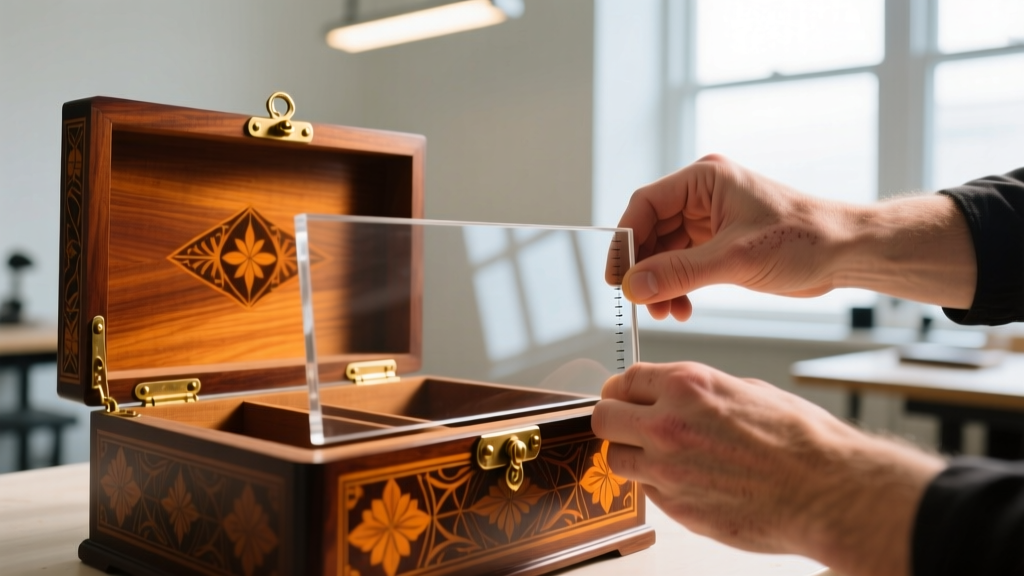
The original glazing in a 19th-century antique jewelry display case is typically crown glass or early cylinder glass. While optically charming, standard silica glass blocks only about 25% to 30% of ultraviolet (UV) radiation, transmitting the rest directly onto the collection. Prolonged UV exposure causes irreversible damage, including the fading of dyed organic gems (like coral and tortoiseshell), the desiccation of ivory, and the structural weakening of silk threads used in antique pearl necklaces.
Sourcing Museum-Grade Glazing
To preserve the collection while maintaining the case's period silhouette, conservators carefully remove the original glass (which should be stored safely for provenance purposes) and retrofit the rabbets with modern museum-grade acrylic. The industry standard is Optium Museum Acrylic by Tru Vue. This material offers several critical advantages:
- 99% UV Filtration: Blocks both UV-A and UV-B wavelengths up to 400 nanometers.
- Anti-Static Properties: Crucial for displaying loose gemstones or enameled pieces, as static charge can attract abrasive dust particles to the surface of the jewelry.
- Anti-Reflective Coating: Reduces glare to less than 1%, allowing for unobstructed viewing and high-resolution photography without polarizing filters.
When retrofitting, ensure the acrylic is cut precisely 1/16th of an inch smaller than the rabbet dimensions to account for thermal expansion. Secure the glazing using an acid-free, neutral-cure silicone adhesive, avoiding any contact with the interior display chamber.
Micro-Climate Engineering: Managing Relative Humidity
An enclosed antique jewelry display case acts as a micro-climate. Without active regulation, fluctuations in ambient room humidity can wreak havoc on mixed-material collections. According to the National Park Service Museum Handbook, the ideal relative humidity (RH) for a mixed collection of metals and gemstones is strictly maintained between 45% and 55%.
Different materials dictate conflicting environmental needs. For example, silver tarnishes rapidly when RH exceeds 60%, especially in the presence of trace sulfur. Conversely, opals are composed of hydrated silica (containing up to 20% water); if the RH drops below 40%, opals can suffer from 'crazing'—a network of fine, irreversible surface cracks. Bronze artifacts are susceptible to 'bronze disease' (a powdery green corrosion caused by cuprous chloride) if RH rises above 46%.
Implementing Passive Climate Control
Because installing active HVAC systems inside a small antique vitrine is impossible, conservators rely on passive silica buffering. Products like Prosorb or Art-Sorb silica cassettes are engineered to maintain a specific RH threshold (typically 40%, 50%, or 60%). These cassettes absorb excess moisture when the environment is humid and release it when the air becomes too dry.
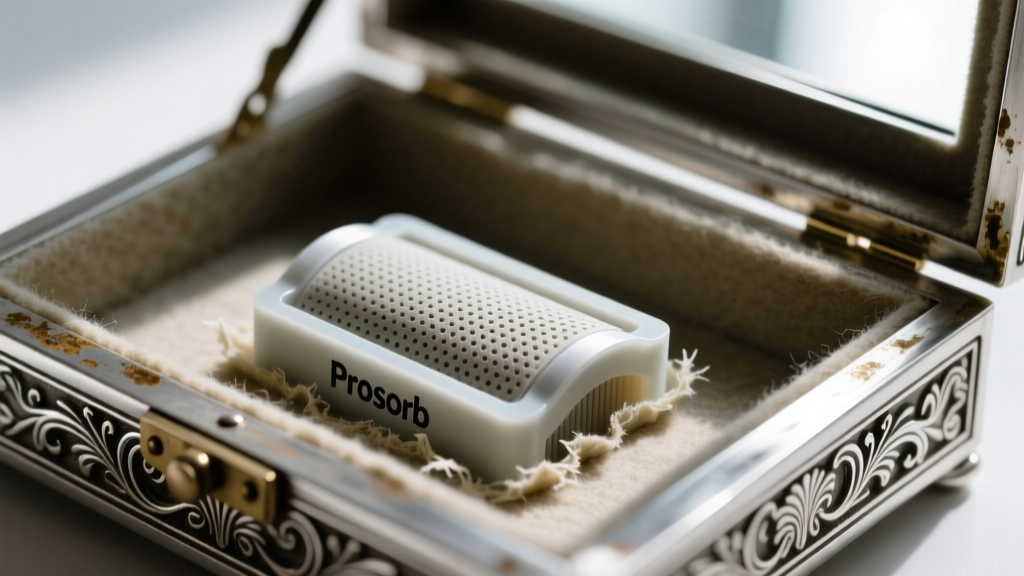
To hide these cassettes without sacrificing display space, fabricators build a 'false floor' within the display compartment. A rigid honeycomb aluminum or archival corrugated plastic base is elevated on small acrylic risers. The silica cassettes are placed in this hidden sub-chamber, and the visible display floor is finished with an archival, unbleached linen or Tyvek fabric. Small, discreet ventilation gaps (covered in fine stainless-steel mesh to deter pests) must be left at the rear of the false floor to allow air circulation between the silica and the display chamber.
Structural Restoration: Hinges, Locks, and Archival Linings
The tactile experience of opening an antique jewelry display case is defined by its hardware and linings. However, original velvet linings are almost universally hazardous. 19th-century velvet was frequently dyed using sulfur-based compounds and treated with acidic sizing agents. When silver jewelry rests against this vintage velvet, it rapidly forms silver sulfide—a heavy, black/purple tarnish that requires abrasive polishing to remove, gradually wearing away the artifact's surface details.
Restoration requires the careful removal of the original fabric (which should be bagged and labeled for the artifact's historical file). The bare wood must then be sealed with Marvelseal, followed by a layer of archival polyester batting (such as Pellon) for cushioning. The final visible layer should be an unbleached, washed cotton muslin, Tyvek, or an archival-grade, sulfur-free polyester knit. These materials are chemically inert and will not react with precious metals or porous gems.
For the exterior hardware, original brass or bronze hinges and locks should never be aggressively polished to a high shine, as this removes the historical patina and microscopic layers of the original metal. Instead, clean them gently with a mild solvent like naphtha to remove surface grime, and seal them with a thin coat of Renaissance Wax. This microcrystalline wax prevents oxidation and protects the user's hands from metal transfer while preserving the authentic, aged appearance of the antique case.
'The goal of integrating an antique jewelry display case into a modern collection is not to force the jewelry to survive the box, but to engineer the box to protect the jewelry. Archival science must always dictate the interior environment, regardless of the exterior aesthetics.'
Conclusion: Balancing Aesthetics with Archival Science
Utilizing an antique jewelry display case requires a meticulous balance between historical appreciation and modern conservation science. By understanding the hidden dangers of acidic off-gassing, upgrading to museum-grade UV-filtering glazing, engineering passive micro-climates with buffered silica, and replacing hazardous vintage linings with inert alternatives, collectors can safely merge 19th-century beauty with 21st-century preservation standards. The result is a display environment that honors the history of the cabinetry while fiercely protecting the irreplaceable treasures housed within.


