Expert Craft Fair Jewelry Display Ideas for Max Sales
Master craft fair jewelry display ideas with our technical guide on structural frameworks, CRI lighting, anti-tarnish materials, and wind mitigation.

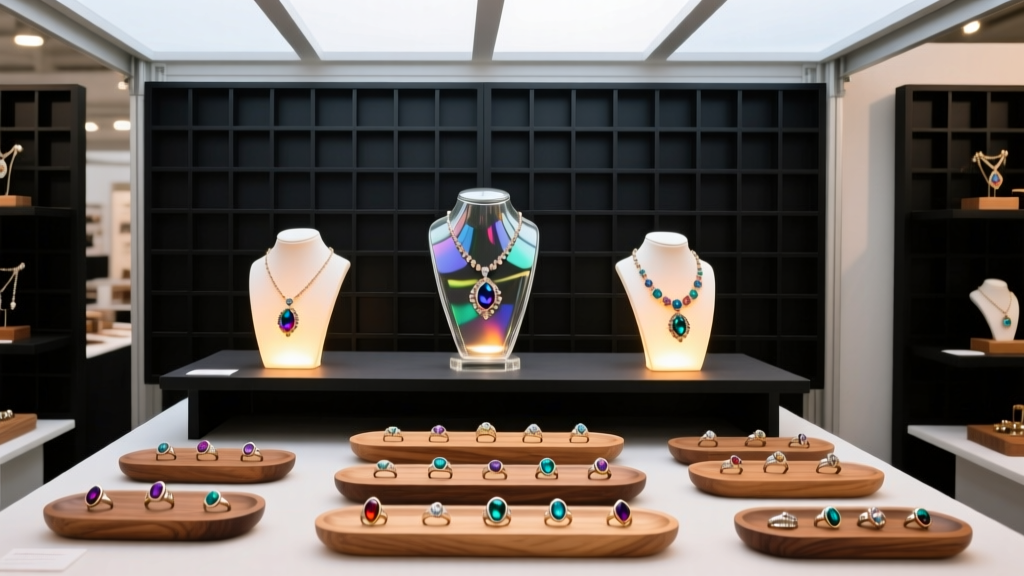
The Engineering of High-Converting Craft Fair Jewelry Display Ideas
When artisans transition from online storefronts to physical markets, the most common point of failure is not the quality of their work, but the structural engineering of their booth. In 2026, the most successful vendors treat their setups not as mere storage, but as precision visual merchandising systems. The modern consumer scans a booth in roughly three seconds; if your layout lacks ergonomic sightlines, proper illumination, and structural stability, you lose the sale before a conversation even begins. Exploring advanced craft fair jewelry display ideas requires moving beyond folding tables and velvet drapes into the realm of material science, lighting metrics, and environmental mitigation.
According to the Etsy Seller Handbook, vendors who invest in modular, multi-tiered display architectures see a significantly higher engagement rate compared to those using flat, single-plane layouts. This deep dive will dissect the exact material grades, gauge sizes, and technical specifications required to build a booth that protects your inventory while maximizing conversion rates.
Structural Frameworks: Gridwall vs. Slatwall vs. Tension Rods
The backbone of any vertical jewelry display is the structural framework. Choosing the wrong material leads to sagging panels, rust transfer onto precious metals, and catastrophic failures in high-traffic aisles.
14-Gauge Steel Gridwall
For hanging necklaces and lightweight drop earrings, powder-coated 14-gauge steel gridwall is the industry standard. Avoid the cheap 18-gauge wire grids found at big-box craft stores; they will visibly bow under the cumulative weight of heavy brass or copper statement pieces. A standard 3x6 foot 14-gauge panel weighs approximately 18 lbs and can support up to 50 lbs of distributed weight. Opt for a 2"x4" rectangular mesh rather than a 3"x3" square mesh, as the rectangular grid provides better horizontal stability for S-hooks and prevents acrylic earring cards from slipping through.
Aluminum-Insert Slatwall
If you prefer a cleaner, boutique-style aesthetic, slatwall panels offer a seamless look. However, standard 3/4" MDF (Medium-Density Fiberboard) slatwall will strip out and fail when hanging anything heavier than 2 lbs per hook. You must source MDF panels routed with anodized aluminum metal inserts in the grooves. These inserts distribute the shear force across the panel, allowing you to hang heavy tiered necklace busts and glass display shelves safely.
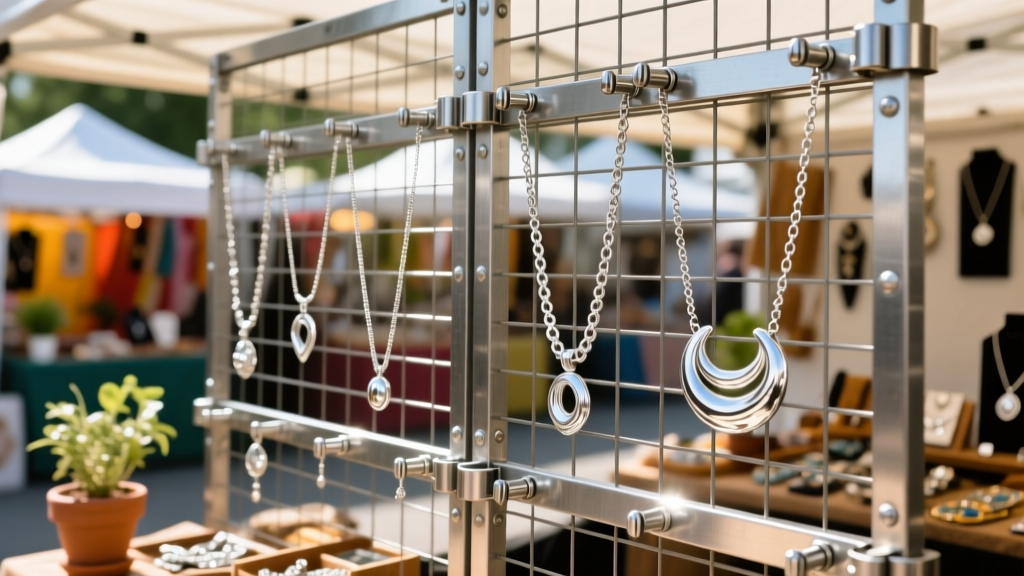
Tension Rod Systems
Aluminum alloy tension rods are excellent for lightweight chains and pearl strands, but they lack the sheer load capacity for heavy pendants. Ensure your tension rods feature internal spring-locking mechanisms rated for at least 15 lbs of lateral pressure to prevent slipping during booth vibrations caused by foot traffic.
Micro-Display Materials: Busts, Trays, and Anti-Tarnish Tech
The materials that physically touch your jewelry can either preserve them or actively destroy them. The most insidious threat at a multi-day craft fair is accelerated tarnishing caused by display materials.
The PVC Off-Gassing Problem
Many budget-friendly necklace busts are constructed from rigid PVC (polyvinyl chloride) wrapped in synthetic suede. PVC contains phthalates and plasticizers that continuously off-gas. When trapped in a humid environment or a sealed travel case post-fair, these chemical vapors react with atmospheric sulfur, causing sterling silver to blacken within 48 hours. Always invest in high-density polyurethane foam busts wrapped in 100% natural linen, cotton, or specialized anti-tarnish fabrics.
Pacific Silvercloth Integration
For high-ticket items like oxidized silver or bright-finish platinum, line your display trays with Pacific Silvercloth. This material embeds thousands of micro-particles of pure silver into a cotton flannel matrix. These particles act as a sacrificial anode, capturing and neutralizing tarnish-causing gases before they reach your actual inventory. While it increases your initial display budget by roughly 30%, it eliminates the need for mid-show polishing, keeping you engaged with customers.
Acrylic Tray Manufacturing
When selecting ring and stud trays, note the difference between injected and laser-cut acrylic. Laser-cut acrylic leaves microscopically sharp edges that can scratch high-polish metals when items are repeatedly slid on and off. Injected acrylic features smooth, rounded radiused edges, making it vastly superior for high-volume handling.
Illumination Metrics: CRI, Lumens, and Color Temperature
Lighting is the single most critical variable in jewelry sales. A poorly lit booth makes diamonds look like glass and gold look like brass. You must evaluate lighting based on three strict metrics: CRI, Lumens, and Kelvin.
"Never use standard hardware store LED strips for jewelry. If the Color Rendering Index (CRI) is below 90, the light spectrum is missing the vital wavelengths required to make gemstones refract and metals gleam."
Color Rendering Index (CRI)
Always source LED strips with a CRI of 95 or higher. High-CRI lighting accurately renders the subtle secondary hues in sapphires, emeralds, and tourmalines, which are flattened and grayed out by standard 80-CRI bulbs.
Color Temperature (Kelvin) Matching
Different metals require different color temperatures to look their best. Using a single temperature across your entire booth is a rookie mistake.
- 3000K (Warm White): Essential for 14k and 18k yellow gold, rose gold, and copper. It enhances the warm, rich undertones of these alloys.
- 4500K - 5000K (Daylight): Mandatory for sterling silver, white gold, platinum, and diamonds. This cooler spectrum mimics natural daylight, providing the crisp, high-contrast sparkle that white metals require.
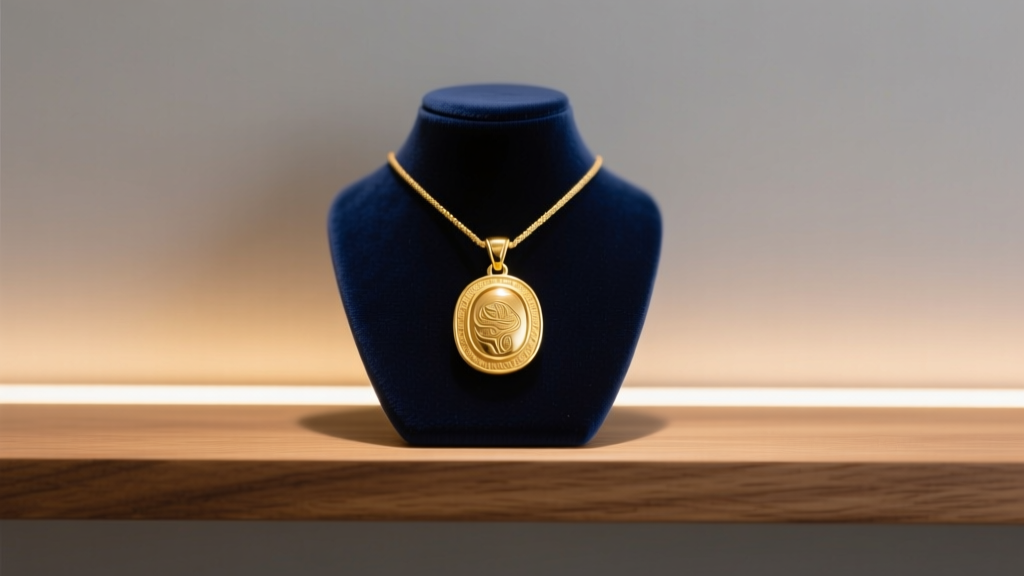
For targeted illumination, aim for 800 to 1,000 lumens per linear foot of display space. Mount your LED strips at a 45-degree downward angle to prevent glare from hitting the customer's eyes while maximizing the refraction across faceted gemstones. For further guidance on booth setup and lighting, the U.S. Small Business Administration offers excellent resources on physical retail optimization for small makers.
Wind Mitigation & Security Protocols for Outdoor Markets
Outdoor artisan markets present severe environmental hazards. A standard 10x10 pop-up canopy can act as a sail, creating localized wind tunnels that easily topple top-heavy gridwall displays.
Dead Weight vs. Shifting Weight
Never use water jugs or plastic buckets filled with gravel to anchor your tent or display walls. Water shifts, creating a pendulum effect that destabilizes the structure. Use cast-iron tent weights or tightly packed canvas sandbags, ensuring a minimum of 40 lbs of dead weight per tent leg.
Display Tethering
Freestanding gridwall panels must be tethered. Use 1/4" bungee cords with steel carabiners to connect the top corners of your gridwall directly to the aluminum frame of your pop-up tent. This transfers the wind load from the display panel to the heavily weighted tent legs, preventing the "domino effect" collapse that destroys thousands of dollars of inventory during sudden squalls.
Budget Allocation & ROI Framework
Investing in technical display systems requires a strategic budget. Below is a framework for scaling your booth infrastructure based on your market tier.
| Tier | Estimated Budget | Key Components | Best Suited For |
|---|---|---|---|
| Starter | $300 - $600 | 18-gauge wire grids, standard polyurethane busts, clamp-on 80 CRI LEDs. | Local holiday markets, low-traffic indoor fairs. |
| Professional | $800 - $1,500 | 14-gauge powder-coated gridwall, linen-wrapped busts, 95 CRI LED strips, sandbag weights. | Regional juried craft shows, weekend outdoor festivals. |
| Elite | $2,500+ | Custom aluminum-insert slatwall, Pacific Silvercloth lining, multi-temperature LED zones, lockable acrylic vitrines. | National fine craft guild shows, high-end boutique pop-ups. |
Conclusion: The Architecture of Sales
Implementing advanced craft fair jewelry display ideas is an exercise in applied physics and material science. By upgrading to 14-gauge frameworks, eliminating PVC off-gassing, and precisely tuning your CRI and Kelvin metrics, you transform your booth from a simple storage space into a high-converting sales engine. Protect your craft, respect your materials, and engineer your space for maximum impact.


