Creative Jewelry Display Ideas: A Step-by-Step DIY Guide
Discover step-by-step creative jewelry display ideas using brass, acrylic, and wood. Build custom, anti-tarnish organizers with our expert DIY guide.

Why Standard Jewelry Boxes Fail Your Collection
Most commercial jewelry boxes are designed for concealment, not curation. The standard velvet-lined compartment system often forces chains into tight, overlapping coils, accelerating micro-scratching on soft metals like 24k gold and high-polish silver. Furthermore, the adhesives used in mass-produced MDF (medium-density fiberboard) boxes frequently off-gas volatile organic compounds (VOCs) and sulfur-based chemicals, which catalyze rapid silver sulfide tarnishing. If you are investing in fine jewelry, your storage must serve as both a functional organizer and a micro-climate preservative.
In this guide, we explore three architectural, creative jewelry display ideas that prioritize material safety, structural integrity, and visual elegance. These step-by-step builds utilize raw, non-off-gassing materials to protect your collection while transforming it into a functional art installation.
3 Architectural Creative Jewelry Display Ideas
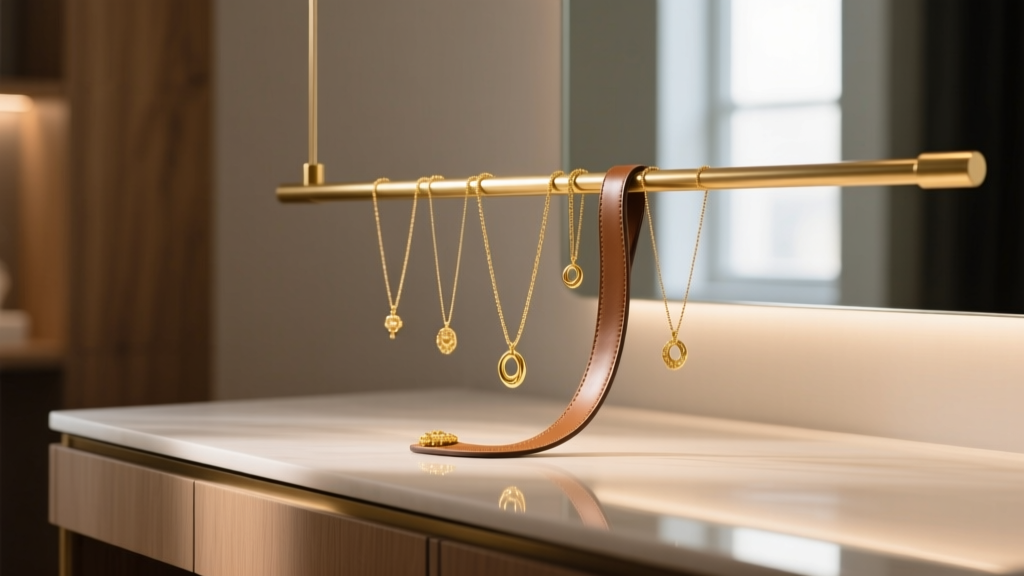
1. The Floating Brass Rod & Leather Strap Wall Mount
This minimalist wall display leverages the tensile strength of solid brass and the chemical neutrality of vegetable-tanned leather. Unlike chrome-tanned leather, which utilizes heavy metals and acidic salts that can pit silver and pearl surfaces, vegetable-tanned leather is pH-neutral and safe for prolonged contact with fine metals.
Materials Required:
- 1/4-inch solid brass rod (cut to 24 inches)
- Two 1-inch wide vegetable-tanned leather straps (cut to 18 inches)
- Four brass masonry or drywall anchors and screws
- Leather hole punch and brass rivets
Step-by-Step Instructions:
- Prep the Leather: Fold each leather strap in half to create a loop. Use the hole punch to create two holes near the open ends, aligning them perfectly.
- Mount the Straps: Mark your wall, ensuring the two straps are spaced exactly 20 inches apart and perfectly level. Secure the open ends of the leather straps to the wall using brass screws, leaving the loops hanging freely.
- Insert the Rod: Thread the 1/4-inch brass rod through both leather loops. The 1/4-inch diameter provides enough rigidity to hold up to 3 pounds of layered chain necklaces without bowing in the center.
- Condition the Leather: Apply a light coat of neatsfoot oil to the leather straps to prevent drying and cracking over time, ensuring no residue transfers to the brass rod.
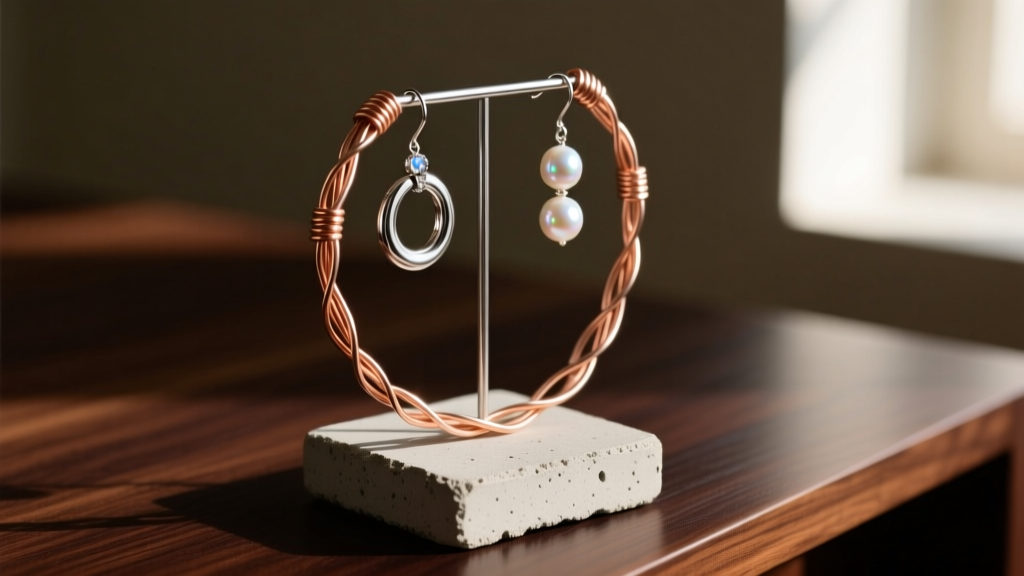
2. The Cast-Concrete & Copper Wire Topography Stand
Concrete provides a heavy, stable base that prevents toppling when loading and unloading heavy statement pieces. However, raw concrete is highly alkaline and can degrade organic gems like pearls or coral. This build incorporates a crucial sealing step to ensure chemical neutrality while utilizing 14-gauge copper wire for structural ring and earring holders.
Materials Required:
- Rapid-set cement mix and a silicone geometric mold
- 14-gauge raw copper wire (for structural rings)
- 18-gauge raw copper wire (for delicate earring hooks)
- Water-based polyurethane sealer (matte finish)
- Jeweler's saw and flush cutters
Step-by-Step Instructions:
- Cast the Base: Mix the rapid-set cement according to the manufacturer's water-to-powder ratio. Pour into the silicone mold and tap vigorously to release trapped air bubbles. Let cure for 48 hours.
- Seal the Concrete: Once fully cured, apply two coats of water-based polyurethane. This step is non-negotiable; it locks in alkaline dust and creates a pH-neutral barrier safe for all gemstones.
- Fabricate the Wire Armature: Using flush cutters, snip the 14-gauge copper wire into 4-inch segments. Bend them into asymmetrical 'U' shapes, leaving one leg slightly longer to act as an anchor.
- Embed the Wire: Using a masonry bit slightly smaller than the wire gauge, drill shallow holes into the topography of the concrete base. Apply a drop of cyanoacrylate (jeweler's glue) into the hole and insert the longer leg of the copper wire. The 14-gauge thickness ensures the wire won't bend under the weight of heavy signet rings.
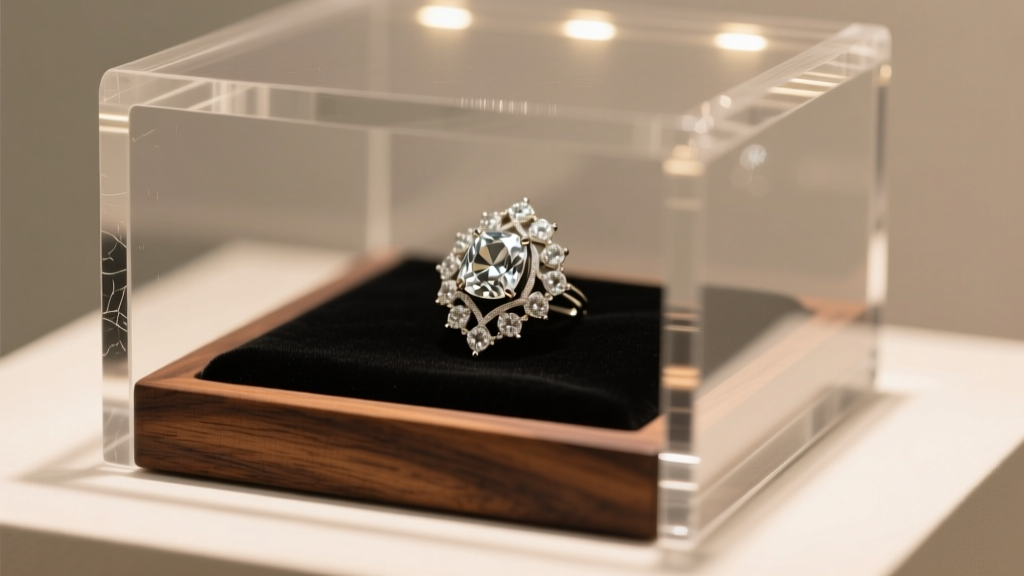
3. The Museum-Grade Acrylic & Walnut Wood Vitrine
For heirloom pieces, brooches, or high-carat diamond jewelry, an enclosed vitrine protects against airborne sulfur and dust while maintaining optical clarity. We use cast acrylic rather than extruded acrylic, as cast acrylic offers superior UV resistance and optical clarity without the internal stress lines that cause yellowing over time.
Materials Required:
- 1/4-inch cast acrylic sheet (cut to custom dimensions)
- Black walnut wood offcuts (for the base)
- Weld-On 4 acrylic adhesive
- 3M Anti-Tarnish Strips
Step-by-Step Instructions:
- Mill the Wood Base: Route a 1/4-inch deep groove into the perimeter of the black walnut base. This groove will seat the acrylic walls, providing structural stability without relying solely on chemical adhesion.
- Assemble the Acrylic Box: Use a syringe to apply Weld-On 4 to the seams of the acrylic panels. This solvent welding process melts the plastic together, creating a seamless, invisible bond that looks like glass but weighs 50% less.
- Install Anti-Tarnish Tech: Before sealing the top lid, adhere a 3M Anti-Tarnish Strip to the inside roof of the acrylic box. These strips utilize proprietary absorbent particles that intercept hydrogen sulfide gas, protecting silver and copper alloys inside the enclosed space for up to 12 months.
- Mount the Vitrine: Slide the assembled acrylic box into the routed groove of the walnut base and secure with a bead of clear, acid-free silicone.
Material Comparison: Tarnish & Scratch Resistance
Choosing the right materials for your creative jewelry display ideas is critical for long-term preservation. Below is a comparison of common DIY display materials and their interaction with fine jewelry.
| Material | Tarnish Risk | Scratch Risk | Best Used For |
|---|---|---|---|
| Vegetable-Tanned Leather | Low (pH Neutral) | Very Low | Necklaces, Bracelets, Cuffs |
| Raw Copper/Brass | Medium (Can transfer patina) | Low | Rings, Structured Earrings |
| Sealed Concrete | None (If properly sealed) | High (If unsealed/rough) | Heavy Statement Rings, Bangles |
| Cast Acrylic | None (Inert) | Medium (Attracts dust) | Heirlooms, Brooches, Diamonds |
| Chrome-Tanned Leather | High (Acidic off-gassing) | Low | Avoid for fine jewelry |
Anti-Tarnish Integration for Open Displays
Open-air displays, like the brass rod or concrete topography stand, expose your jewelry to ambient humidity and sulfur compounds. To mitigate this without hiding your pieces, integrate passive anti-tarnish solutions into your display environment.
Pacific Silvercloth Integration: Instead of using standard felt or velvet as a backing or resting pad, line the base of your displays with Pacific Silvercloth. This specialized fabric is embedded with thousands of microscopic silver particles. These particles act as a sacrificial anode, absorbing and reacting with tarnishing gases before they can reach your actual jewelry. According to conservation guidelines from the Smithsonian Museum Conservation Institute, controlling the micro-environment around silver is vastly superior to relying on post-tarnish chemical polishes, which strip away microscopic layers of the metal.
Activated Charcoal & Silica Gel: For enclosed vitrines or drawer-based extensions of your display, place small, breathable muslin bags filled with activated bamboo charcoal and indicating silica gel. The charcoal adsorbs VOCs and sulfur, while the silica gel maintains the relative humidity (RH) below 45%, a critical threshold for preventing the dehydration of organic gems like opals and emeralds.
Lighting Your Display Without Causing UV Damage
A beautifully crafted display is useless if the lighting degrades the collection. Standard halogen or incandescent bulbs emit excessive heat and UV radiation, which can cause irreversible fading in amethyst, kunzite, and topaz, and dehydrate pearls.
When illuminating your creative jewelry display ideas, exclusively use LED lighting with a Color Rendering Index (CRI) of 95 or higher. A high CRI ensures that the true spectral colors of your gemstones are accurately represented without the muddy color casting of cheap LEDs. Furthermore, keep the illuminance level below 50 lux for organic and porous gems. The Gemological Institute of America (GIA) specifically warns that prolonged exposure to intense light and heat can compromise the structural integrity and luster of delicate pearls. Use hidden, low-profile LED strip channels with frosted diffusers to create a soft, even glow that highlights the metalwork without creating harsh, blinding reflections on faceted stones.
"A well-designed jewelry display does not merely hold your collection; it actively preserves its material integrity while elevating its visual narrative. Treat your storage architecture with the same respect as the gems it houses."


