Beginner Guide: 5 Homemade Jewelry Display Ideas That Work
Discover 5 beginner-friendly homemade jewelry display ideas. Learn how to build affordable, anti-tarnish DIY organizers for rings, necklaces, and earrings.

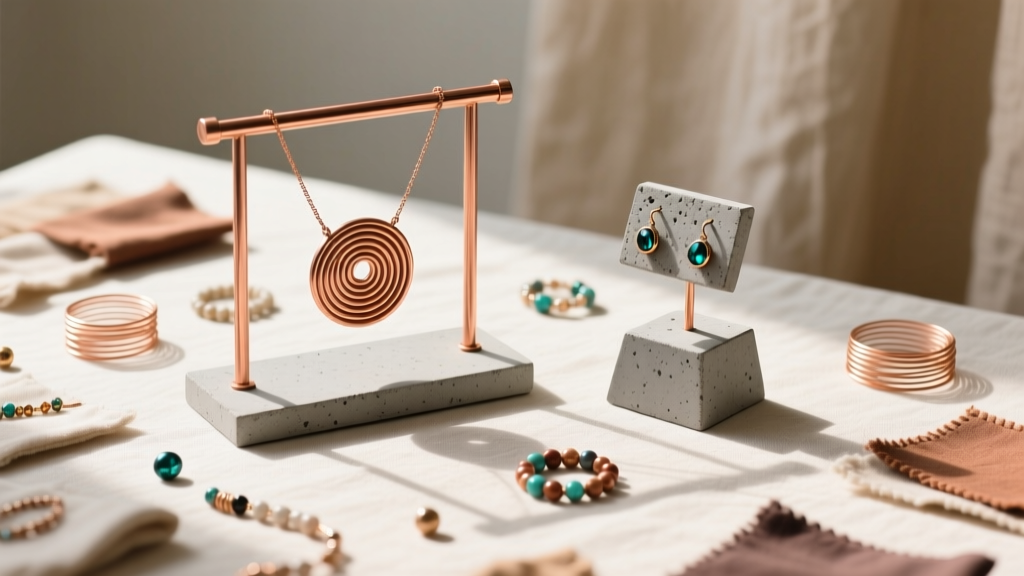
Why Build Your Own Jewelry Display?
When you begin curating a meaningful jewelry collection, commercial storage solutions often fall short. Mass-produced acrylic stands and generic velvet boxes rarely accommodate unique piece dimensions, and they frequently lack proper anti-tarnish properties. More importantly, the markup on commercial displays is staggering; a basic wall-mounted necklace organizer can easily cost between $60 and $120, whereas the raw materials for a superior, custom-fitted alternative often cost under $15.
Exploring homemade jewelry display ideas is not just a budget-friendly exercise—it is an opportunity to engineer storage that actively protects your metals and gemstones. By selecting the correct raw materials and understanding the chemistry of metal oxidation, you can build displays that prevent silver sulfide formation and protect porous gems from environmental damage. This beginner-friendly guide breaks down five highly effective, structurally sound DIY displays, complete with material grades, exact dimensions, and preservation science.
The Science of Display Materials: What to Avoid
Before cutting wood or pouring concrete, you must understand how display materials interact with precious metals. According to the Gemological Institute of America (GIA), silver tarnishes when it reacts with hydrogen sulfide in the air, but this process is drastically accelerated by acidic environments.
- Raw MDF and Particleboard: These engineered woods off-gas formaldehyde and acetic acid. Storing sterling silver or pearls in unsealed MDF drawers will cause rapid tarnishing and can permanently etch the nacre on pearls.
- Unsealed Oak and Cedar: While beautiful, raw oak emits tannins and volatile organic compounds (VOCs) that corrode base metals and degrade silver polish.
- PVC Plastics: Polyvinyl chloride can release chloride ions over time, leading to pitting and localized corrosion on copper and silver alloys.
Expert Rule of Thumb: Always seal natural woods used in jewelry displays with a shellac-based primer (like Zinsser B-I-N) or a water-based polyurethane. Shellac creates an impermeable barrier that locks in wood acids, making the surface completely safe for long-term metal storage.
5 Homemade Jewelry Display Ideas for Every Collection
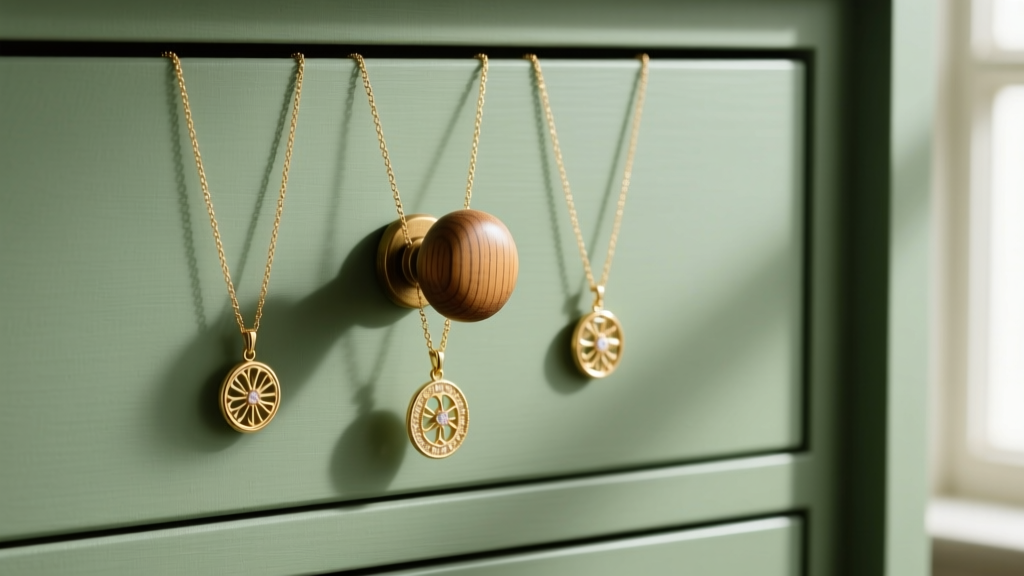
1. The Upcycled Wooden Drawer Knob Wall Mount
This is the most accessible entry point into homemade jewelry display ideas. It utilizes wall space to keep necklaces untangled and visually accessible.
Materials Needed:
- 2-inch unfinished wooden cabinet knobs (pack of 6, approx. $12)
- Zinsser B-I-N shellac-based primer ($8)
- 1.5-inch wood screws and drywall anchors
Execution: Sand the wooden knobs to a smooth 220-grit finish to prevent snagging delicate chains. Apply two coats of the shellac primer, allowing 45 minutes of drying time between coats. This seals the wood acids. Mount the knobs to your wall in a staggered, asymmetrical grid rather than a straight line. Staggering them by at least 4 inches vertically prevents long pendant necklaces from overlapping and tangling when hung side-by-side.
2. Copper Pipe & Leather Strap Hanging Rack
For a more industrial, boutique-style display, copper piping offers exceptional rigidity and a warm aesthetic that complements gold and rose gold jewelry.
Materials Needed:
- 1/2-inch diameter copper pipe, cut to 18 inches ($4)
- Two 1/2-inch copper flanges ($6)
- Vegetable-tanned leather straps, 1-inch wide ($10)
Execution: Avoid using synthetic faux-leather straps, as the polyurethane coatings can trap moisture and promote mildew in humid climates. Vegetable-tanned leather is breathable and ages beautifully. Thread the leather through the copper flanges and mount the flanges to the wall. The 1/2-inch copper pipe provides enough surface area to hang up to 15 standard chains without them sliding off the edges, provided you crimp the very ends of the pipe slightly with a pipe cutter to create a microscopic lip.
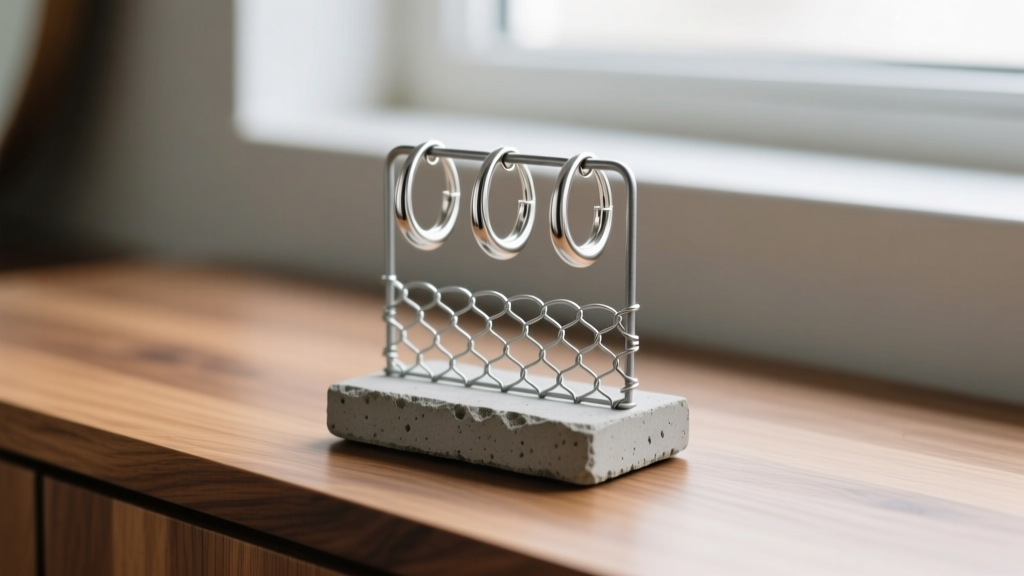
3. Concrete & Wire Mesh Earring Stand
Earrings are notoriously difficult to store without bending the posts or losing the backs. A concrete and mesh stand solves this by utilizing gravity and tension.
Materials Needed:
- Quikrete 5000 concrete mix ($6 for a 50lb bag)
- 1/4-inch galvanized steel wire mesh ($8)
- Water-based acrylic concrete sealer ($12)
Execution: Pour the concrete into a 6x4-inch silicone mold. While wet, press a 5x3-inch piece of the 1/4-inch wire mesh into the top half-inch of the concrete, leaving the grid exposed. Critical Step: Fresh concrete is highly alkaline (pH 12-13), which can degrade the polish on porous stones like turquoise or opals. You must let the concrete cure for a full 28 days, then seal it with two coats of water-based acrylic sealer to neutralize the surface pH and prevent alkaline dust from transferring to your jewelry.
4. Velvet-Wrapped Book Page Ring Holder
Rings require individual slots to prevent gemstones from scratching adjacent metal bands. An upcycled hardcover book provides the perfect structural base.
Materials Needed:
- Thick hardcover book (thrifted, $2)
- 100% cotton velvet fabric (1 yard, $14)
- PVA bookbinding glue ($7)
Execution: Glue the book's pages together in 1-inch thick blocks, leaving 1/2-inch gaps between the blocks. These gaps become the ring slots. Wrap the entire structure in 100% cotton velvet. Avoid polyester velvets; synthetic fibers are hydrophobic and can create static electricity, which attracts dust and micro-abrasives that scratch high-polish gold and platinum. Cotton velvet is breathable, anti-static, and provides a soft, non-abrasive cradle for delicate prongs.
5. Tension-Wired Branch Bracelet Display
Bracelets, especially rigid bangles and cuffs, lose their shape when stored flat in drawers. A vertical tension display maintains their structural integrity.
Materials Needed:
- Foraged hardwood branch (approx. 2 inches in diameter, free)
- 1/8-inch stainless steel aircraft cable ($10)
- Two heavy-duty eye bolts
Execution: Seal the branch with a matte water-based polyurethane to prevent insect infestations and sap leakage. Screw eye bolts into the top and bottom of the branch, and run the stainless steel aircraft cable tautly between them. Slide your bangles and cuffs onto the vertical cable. The 1/8-inch aircraft cable is strong enough to hold up to 30 pounds of solid brass or silver bangles without stretching or bowing, keeping them perfectly aligned and scratch-free.
Material Comparison: Choosing the Right Base
When designing your own homemade jewelry display ideas, selecting the right base material is critical for both aesthetics and preservation. Use the table below to guide your hardware store purchases.
| Material | Tarnish / Damage Risk | Estimated Cost | Best Used For |
|---|---|---|---|
| Sealed Hardwood (Maple/Birch) | Very Low (if sealed with shellac) | $15 - $25 | Wall mounts, ring trays |
| Unsealed Oak / Cedar | High (emits acetic acid & tannins) | $10 - $20 | Avoid for jewelry storage |
| Copper / Brass Piping | Low (may transfer patina if unsealed) | $5 - $12 | Hanging racks, bracelet bars |
| Poured Concrete | Medium (high alkalinity until sealed) | $6 - $10 | Earring stands, heavy bases |
| Acrylic / Lucite Sheets | Low (inert, but scratches easily) | $20 - $40 | Modern risers, drawer dividers |
Troubleshooting Common DIY Display Failures
Even the best homemade jewelry display ideas can fail if the physics of jewelry storage are ignored. Here is how to troubleshoot the most common beginner mistakes:
- Problem: Necklaces slipping off wooden wall knobs.
Solution: Flat knobs lack a lip. When mounting the knob to the wall, place a small 1/8-inch wooden shim behind the top edge of the knob's baseplate. This tilts the knob upward at a 15-degree angle, using gravity to keep chains securely in place. - Problem: Earring wires bending on wire mesh.
Solution: This happens when the mesh grid is too wide, allowing the wire to slip through and bend under the weight of the earring. Always use 1/4-inch mesh rather than 1/2-inch mesh. The smaller grid supports the 20-gauge sterling silver ear wire much closer to the post, preventing leverage-induced bending. - Problem: Rings falling out of book slots.
Solution: If the velvet-wrapped gaps are too wide, rings will slide out when the book is moved. Cut high-density foam inserts to line the inside of the velvet slots, compressing the space to exactly 3/4 of an inch—wide enough for a ring, narrow enough to provide friction.
Final Thoughts on Homemade Organization
Transitioning to DIY jewelry storage is one of the most rewarding projects for collectors and casual wearers alike. By focusing on material science—specifically avoiding acidic woods, sealing alkaline concrete, and choosing breathable natural fabrics—you ensure that your homemade jewelry display ideas do more than just look beautiful. They act as a proactive conservation environment, extending the life, polish, and structural integrity of your most cherished pieces for decades to come. For further reading on metal conservation, the American Institute for Conservation (AIC) offers extensive guidelines on safe storage environments for precious alloys.


