Authenticating and Restoring a Vintage Farrington Jewelry Box
Master the authentication, wood restoration, and anti-tarnish optimization of a vintage Farrington jewelry box with our expert technical guide.

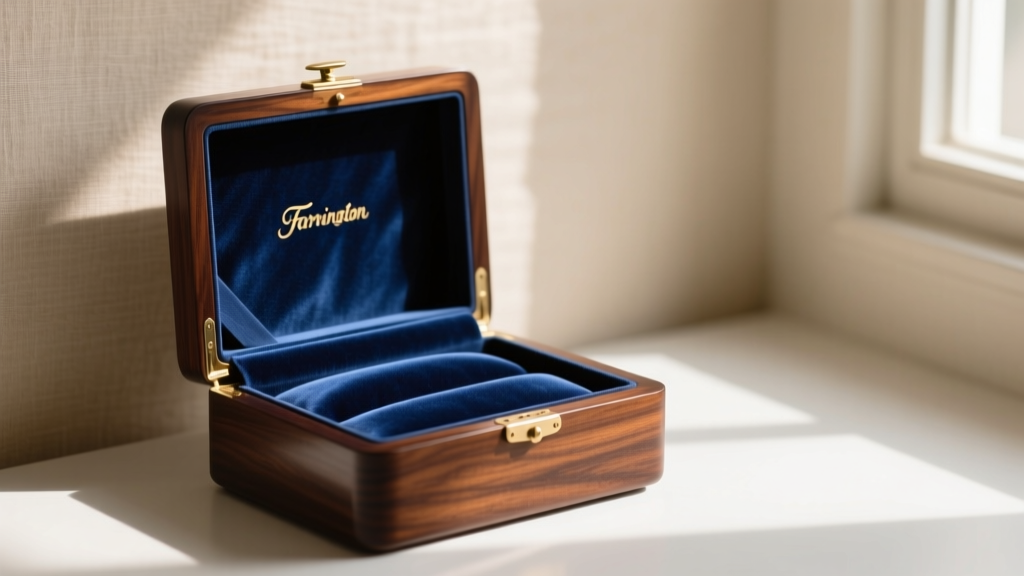
The Legacy and Construction of Farrington Boxes
The Farrington Manufacturing Company, operating primarily out of Chicago during the 1920s through the 1950s, produced some of the most elegant wooden valets, radio cabinets, and jewelry boxes of the mid-century era. For serious collectors and jewelry enthusiasts, a vintage Farrington jewelry box represents a pinnacle of functional artistry. However, acquiring one in the secondary market often means inheriting decades of environmental damage, degraded linings, and failing hardware. Restoring these pieces requires a deep understanding of period-specific woodworking techniques, historic finish chemistry, and modern archival conservation standards.
Unlike mass-produced modern MDF boxes, vintage Farrington pieces were typically constructed using a secondary wood substrate (often poplar or basswood) overlaid with premium exotic veneers. The company favored striking crotch mahogany, burl walnut, and birdseye maple. Understanding this foundational architecture is the first step in any technical restoration, as treating the veneer incorrectly can lead to catastrophic delamination.
Authenticating Your Vintage Farrington Piece
Before beginning any restoration protocol, you must verify the provenance and specific era of your box. Farrington did not always stamp their hardware, so authentication relies on a synthesis of joinery analysis, veneer matching, and hardware evaluation.
Veneer and Joinery Analysis
Examine the corner joints of the main carcase. High-end Farrington valets and jewelry boxes from the 1930s often feature hand-cut or precision-machine dovetails, while their more affordable 1940s lines utilized rabbet joints reinforced with hidden splines. Look closely at the veneer bookmatching on the lid and front panel. Farrington artisans were meticulous about mirroring the grain patterns across the center seam. If the grain does not mirror, or if the veneer thickness varies wildly under a raking light, you may be looking at a later repair or a misattributed piece.
Hardware and Hinge Specifications
Original Farrington hardware was predominantly stamped steel with a thin brass or nickel plating, though premium models featured solid cast brass butt hinges. 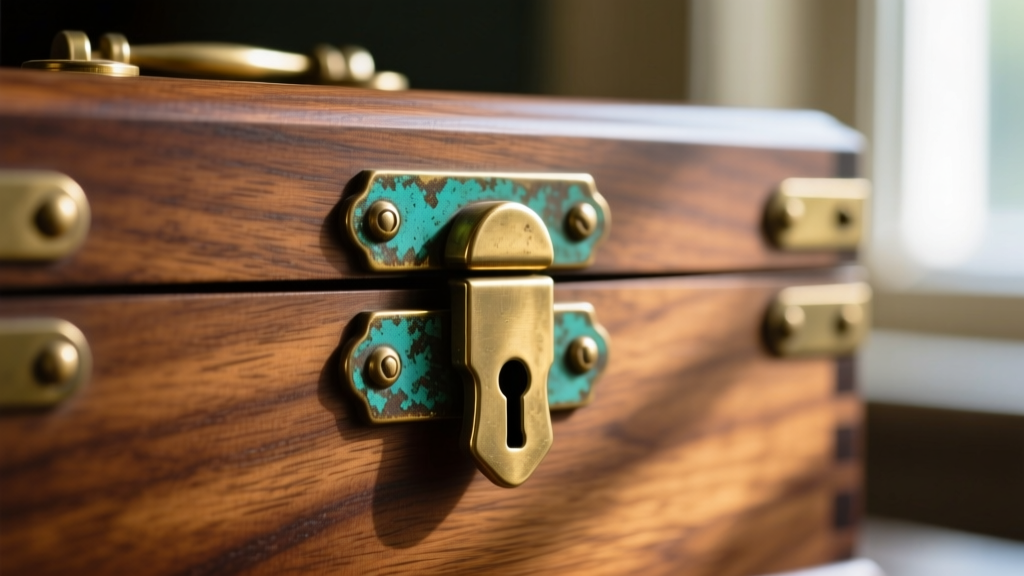 Check the underside of the lid for the original paper manufacturer's label, which often includes the Farrington crest and a specific model number. Be highly suspicious of modern Phillips-head screws; Farrington exclusively used slotted flathead screws with a slightly off-center slot, indicative of early 20th-century manufacturing tolerances.
Technical Restoration Protocols
Restoring a vintage Farrington jewelry box is an exercise in conservation rather than aggressive refinishing. The goal is to stabilize the piece, halt active degradation, and preserve the historic patina while ensuring the interior environment is safe for fine jewelry.
Stripping and Re-finishing Shellac and Lacquer
Most Farrington boxes from the 1920s and early 1930s were finished with traditional shellac or early nitrocellulose lacquer. Never apply modern polyurethane or harsh chemical strippers to these surfaces. To determine the finish, apply a drop of denatured alcohol to an inconspicuous area; if it becomes tacky, it is shellac. If it softens only with lacquer thinner, it is nitrocellulose.
For minor alligatoring (the fine cracking of aged shellac), use an amalgamation technique. Mix equal parts denatured alcohol, boiled linseed oil, and turpentine. Apply this solution with a fine linen pad using continuous circular motions. The alcohol slightly melts the existing shellac, the oil lubricates the pad, and the turpentine controls the evaporation rate, effectively fusing the cracked layers back into a smooth, glossy surface without removing the historic finish.
Replacing Degraded Cellulose Lining
The most critical flaw in vintage jewelry storage is the original lining. Farrington frequently used rayon, silk, or early cellulose acetate fabrics adhered with animal hide glues. According to research published by the Getty Conservation Institute, as these early synthetic and semi-synthetic textiles age, they undergo chemical breakdown, releasing volatile organic compounds (VOCs) and acidic off-gassing. This acidic environment actively accelerates the tarnishing of sterling silver and can corrode the copper alloys found in rose gold.
To remove the old lining, use a localized steam pen to gently reactivate the hide glue, lifting the fabric with a micro-spatula. Scrape away residual glue using a warm water and white vinegar solution. Once the substrate is bare and dry, you must install a modern, chemically inert lining.
Modern Anti-Tarnish Integration for Vintage Storage
Preserving fine jewelry requires controlling the microclimate inside the box. The Gemological Institute of America (GIA) emphasizes that porous gemstones like pearls, opals, and turquoise are highly susceptible to dehydration and chemical damage from off-gassing adhesives and tarnished metals. Therefore, the materials you choose to line your restored Farrington box are just as important as the exterior wood finish.
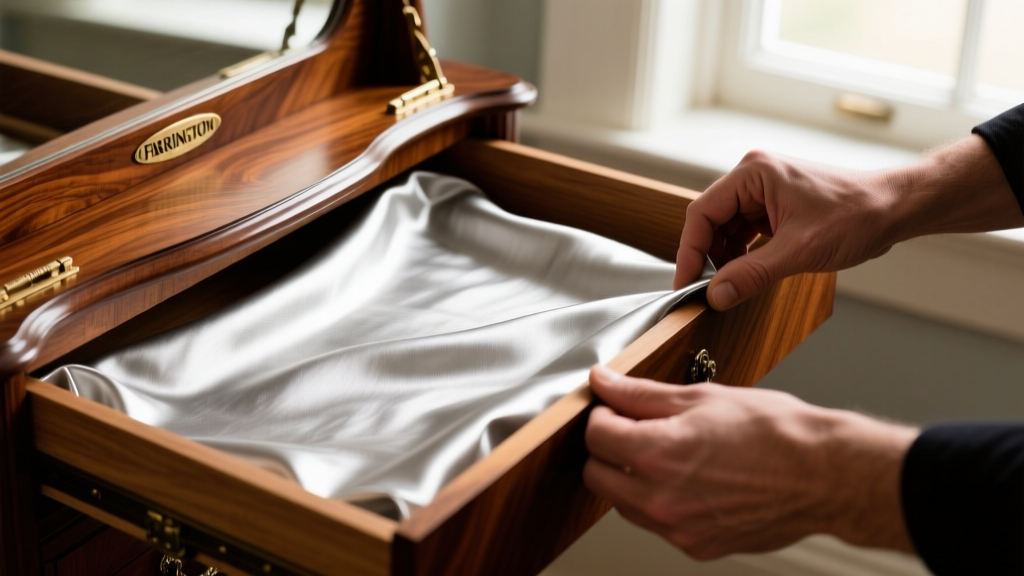
When installing new fabric, avoid standard craft glues or hot glue, which contain plasticizers that will eventually migrate into your jewelry. Instead, use archival-quality 3M 415 double-sided tape or a wheat starch paste for adhesion. For the fabric itself, you must select materials that actively neutralize hydrogen sulfide (H2S) in the air, the primary culprit behind silver sulfide tarnish.
| Lining Material | Era / Origin | Off-Gassing Risk | Archival Recommendation |
|---|---|---|---|
| Original Rayon / Silk | 1920s - 1940s | High (Acidic breakdown) | Remove immediately; do not store jewelry. |
| Standard Craft Felt | Modern | Moderate (Traps moisture) | Avoid for silver; acceptable only for non-reactive steel. |
| Pacific Silvercloth | Modern Archival | None (Neutralizes H2S) | Highly recommended for silver and gold storage. |
| Acid-Free Suedette | Modern Archival | None (pH Neutral) | Ideal for gemstone compartments and ring rolls. |
| Polyethylene Foam | Modern Archival | None (Inert) | Best for structural inserts and necklace supports. |
Optimizing the Microclimate
Even with archival linings, a vintage wooden box is not entirely airtight. To further protect your collection, integrate discreet anti-tarnish strips (such as 3M Silver Shield) into the hidden recesses beneath the lining or behind the drawer stops. These strips utilize copper-based intercept technology to permanently bind with corrosive gases. Replace these strips every 12 to 18 months depending on the ambient humidity of your storage environment.
Additionally, consider the placement of the Farrington box itself. Keep it out of direct sunlight to prevent UV degradation of the wood finish and interior fabrics. Maintain the room's relative humidity between 45% and 55%. Fluctuations beyond this range will cause the poplar substrate to expand and contract, leading to veneer blistering and joint failure.
Hardware Conservation and Final Assembly
When addressing the exterior brass or plated hardware, avoid abrasive polishes like Brasso, which will strip the thin vintage plating and expose the base steel to rust. Instead, create a mild paste using precipitated calcium carbonate and distilled water. Apply it with a soft cotton swab, gently working it into the crevices of the lock and hinges. Wipe away the residue with a damp cloth and immediately seal the metal with a micro-crystalline wax, such as Renaissance Wax. This provides a hard, non-yellowing barrier against skin oils and ambient moisture.
Finally, lubricate the moving parts. A single drop of synthetic clock oil applied to the hinge pins and locking mechanism will ensure smooth operation without the gumming associated with petroleum-based lubricants. By combining rigorous historical authentication with modern conservation science, your vintage Farrington jewelry box will not only serve as a stunning centerpiece but will provide a chemically stable, archival-grade sanctuary for your most precious jewelry for generations to come.


