How to Organize a Contemporary Jewelry Armoire: Step-by-Step
Learn how to organize a contemporary jewelry armoire with our step-by-step guide. Maximize space, prevent tarnish, and elevate your bedroom decor.

The Shift to Contemporary Jewelry Armoires
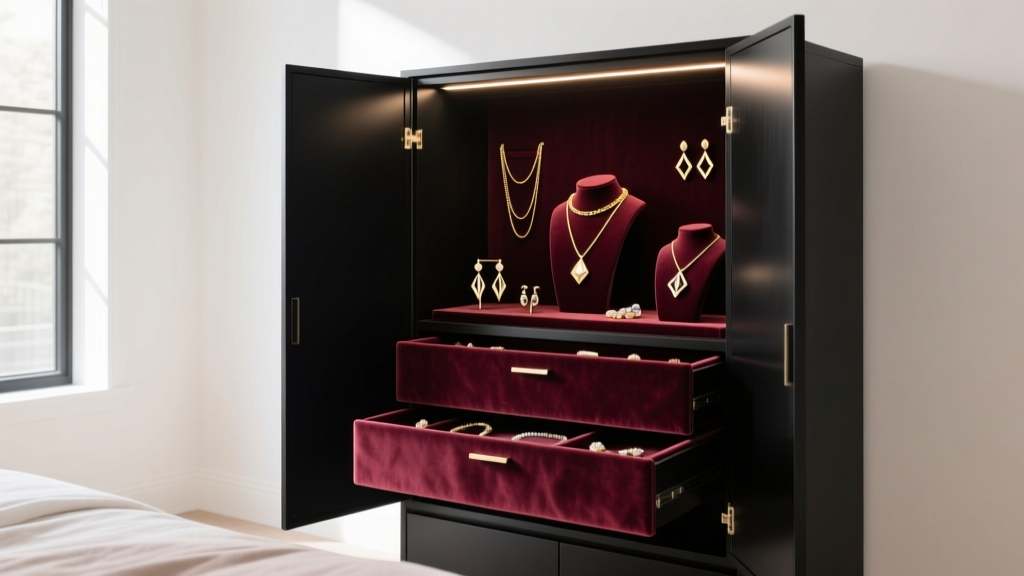
The era of cluttered, vintage jewelry boxes with tangled chains and scratched gemstones is over. Today, the contemporary jewelry armoire serves as both an architectural statement piece and a highly engineered preservation vault. Characterized by clean lines, matte finishes, walnut veneers, and integrated smart lighting, these modern storage solutions demand a strategic approach to organization. Unlike traditional wooden chests, a contemporary jewelry armoire maximizes verticality and utilizes modular inserts, requiring a deliberate curation strategy to protect your investments while maintaining a minimalist aesthetic.
Organizing this type of furniture is not merely about aesthetics; it is about material science and spatial geometry. According to the Gemological Institute of America (GIA), improper storage is a leading cause of micro-scratches on precious metals and gemstone abrasion. This step-by-step guide will walk you through auditing your collection, installing climate-control upgrades, and zoning your contemporary jewelry armoire for maximum display and protection.
Step 1: Spatial Planning and Inventory Auditing
Before placing a single piece inside your new armoire, you must map your collection against the physical dimensions of the unit. Standard contemporary armoires typically measure around 40 inches in height, 15 inches in width, and 10 inches in depth. However, the internal 'drop' space—the vertical clearance between hanging hooks and the shelf below—varies wildly.
- Choker and Princess Lengths (14-18 inches): Require a minimum vertical drop of 9 inches to hang without touching the base.
- Matinee Lengths (20-24 inches): Require at least 12 to 14 inches of vertical clearance.
- Opera Lengths (28-36 inches): Must be draped over dual-tiered hooks or stored flat in shallow, velvet-lined drawers to prevent the silk or wire core from warping under its own weight.
Measure the deepest drawers in your armoire. If you collect chunky, contemporary resin pieces or high-dome cabochon rings, ensure the drawer depth is at least 2.5 inches. Shallow 1-inch drawers will crush the settings or prevent the drawer from closing smoothly, risking severe damage to both the jewelry and the armoire's soft-close hinges.
Step 2: Upgrading for Tarnish and Moisture Control
Modern armoires often feature beautiful microfiber or faux-suede linings, but these materials do not actively prevent oxidation. Sterling silver, in particular, reacts with hydrogen sulfide in the air to form silver sulfide (tarnish). The Smithsonian Museum Conservation Institute emphasizes that controlling the micro-climate within storage enclosures is critical for long-term metal preservation.
To upgrade your contemporary jewelry armoire, implement the following anti-tarnish protocols:
- Line Drawers with Pacific Silvercloth: This specialized cotton fabric is embedded with microscopic silver particles that intercept and absorb tarnish-causing gases before they reach your jewelry. Cut the cloth to fit the bottom of your primary silver drawers.
- Deploy 3M Anti-Tarnish Strips: Place these small, unobtrusive strips in the corners of enclosed compartments. They absorb airborne sulfur compounds and typically remain effective for up to six months in a semi-sealed environment.
- Regulate Relative Humidity (RH): Keep the internal RH of your armoire between 40% and 50%. Toss a few indicating silica gel packets into the lower drawers to absorb ambient moisture, which accelerates both tarnishing and the degradation of organic gems like pearls and coral.
Expert Warning: Never store opals, emeralds, or turquoise directly on or near silica gel packets. These porous, water-bearing gemstones require a slight amount of ambient moisture to prevent internal crazing and cracking.
Step 3: Strategic Zoning and Hardware Mapping
A contemporary jewelry armoire thrives on modularity. Instead of tossing items into open bins, divide the interior into distinct 'zones' based on wear frequency, material vulnerability, and security. Use clear acrylic dividers to maintain the sleek, modern look of the armoire while keeping categories strictly separated.
| Armoire Zone | Jewelry Category | Required Hardware / Insert | Tarnish / Damage Risk |
|---|---|---|---|
| Top Door Panel | Daily Wear Studs & Small Hoops | Acrylic Grid Piercing Board | Low (High rotation prevents buildup) |
| Upper Drawers | Delicate Chains & Pendants | Felt-Lined Hook Strips | Medium (Prone to tangling/scratching) |
| Mid-Level Trays | Cocktail Rings & Statement Pieces | 25mm-30mm Velvet Ring Rolls | High (Gemstone abrasion risk) |
| Lower Deep Drawers | Heavy Cuffs & Vintage Brooches | Padded Microfiber Dividers | High (Weight can dent soft metals) |
| Hidden Lockbox | High-Value Diamonds & Heirlooms | Individual Soft Pouches | Low (Controlled environment) |
By mapping your collection to this grid, you ensure that heavy, diamond-encrusted cuffs are never stored in the same drawer as soft, high-polish gold chains, eliminating the risk of Mohs hardness scale disparities causing permanent scratches.
Step 4: Advanced Hanging and Display Techniques
The way you physically suspend your jewelry inside a contemporary armoire dictates its longevity. Wire-wrapped pendants and heavy gemstone necklaces should never be hung by their clasps, as the constant gravitational pull can weaken the jump rings and stretch the chain links over time.
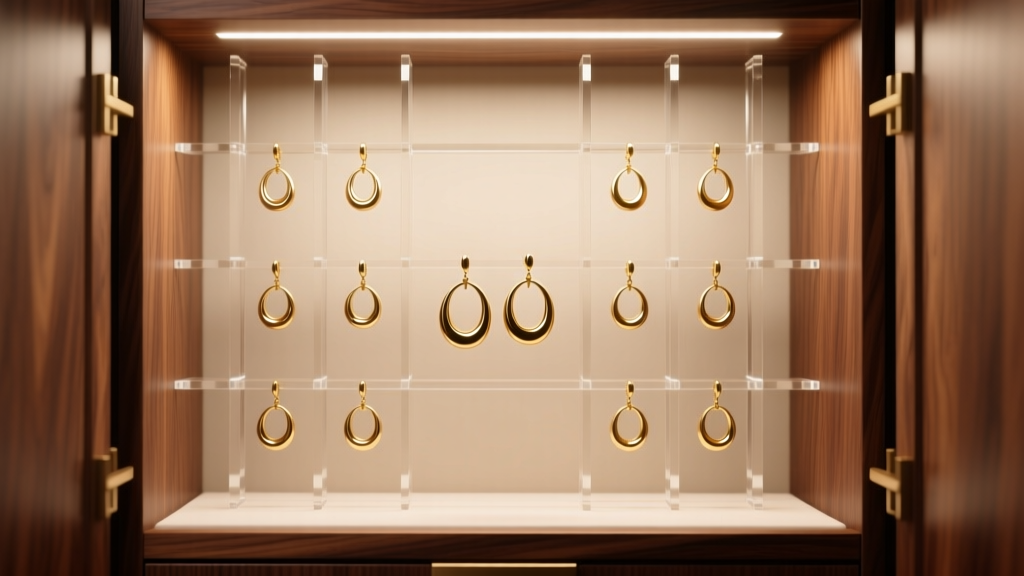
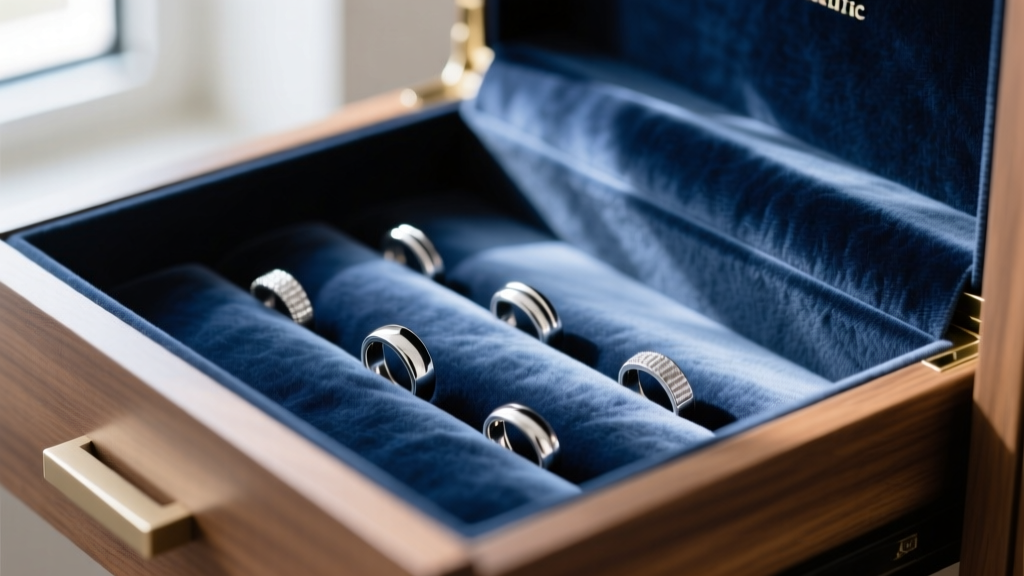
For earrings, abandon the traditional wire-mesh door panels found in older models. Instead, utilize laser-cut acrylic earring grids. These provide a rigid, scratch-free surface that supports the weight of heavy chandelier earrings without bending the posts. For rings, avoid generic foam slots. Invest in velvet ring rolls with 25mm to 30mm slot widths. Standard 15mm slots are too narrow for contemporary statement rings and will place undue pressure on the prongs, potentially loosening the gemstone settings over time.
When it comes to pearl strands, never hang them vertically inside the armoire. The silk thread used to knot pearls stretches under the weight of the beads, leading to gaps and eventual breakage. Always store pearls flat in a dedicated, breathable cotton-lined tray within the armoire, ensuring they are kept away from perfumes and cosmetics.
Step 5: Lighting Integration and Maintenance
Lighting is the final, crucial element that elevates a contemporary jewelry armoire from a simple storage box to a luxury display case. However, not all light is created equal when evaluating gemstones and metals. If your armoire does not come with pre-installed LEDs, you can easily retrofit it using adhesive, battery-operated LED strip lights.
Pay strict attention to the Color Rendering Index (CRI) and Kelvin temperature of the bulbs you choose:
- CRI Rating: Always select LEDs with a CRI of 90 or higher. A high CRI ensures that the light accurately renders the true color of your gemstones, preventing rubies from looking brown or emeralds from appearing washed out.
- 3000K (Warm White): Ideal for illuminating yellow gold, rose gold, and warm-toned gems like citrine and fire opals. It enhances the rich, buttery luster of the metal.
- 4000K to 5000K (Neutral to Cool White): Best for platinum, white gold, and diamonds. This cooler spectrum mimics natural daylight, maximizing the scintillation and brilliance of clear stones.
Finally, maintain the pristine interior of your armoire by dusting the acrylic dividers and mirrors weekly with a clean, dry microfiber cloth. Avoid chemical glass cleaners, as overspray can degrade the specialized anti-tarnish linings and cloud the acrylic components. By following this meticulous, step-by-step approach, your contemporary jewelry armoire will serve as a flawless, protective sanctuary for your collection for decades to come.


