The Egyptian Jewelry Box: Material Care & Restoration
Master the preservation of vintage and artisan Egyptian jewelry boxes. Learn technical care for mother-of-pearl inlay, brass hardware, and wood.

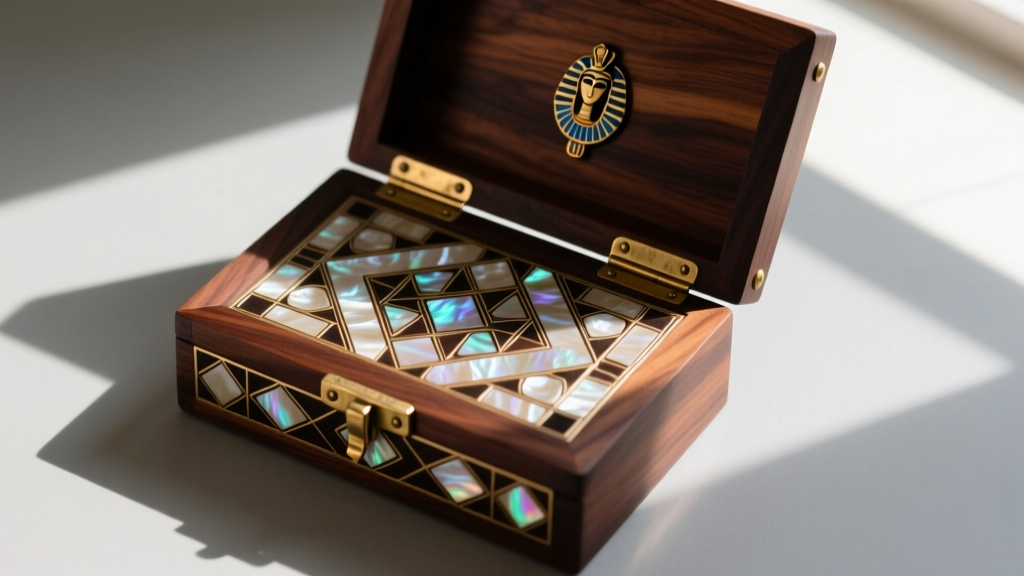
The Anatomy of an Artisan Egyptian Jewelry Box
When collectors and horologists discuss the Egyptian jewelry box, they are typically referring to the mid-century artisan inlay boxes originating from Cairo’s Khan el-Khalili district, or the highly coveted 1920s Art Deco Egyptian Revival pieces. From a conservation perspective, these storage vessels are complex, mixed-media engineering marvels. They are not merely decorative; they are micro-environments that directly impact the chemical stability of the precious metals and gemstones stored within.
A traditional artisan Egyptian jewelry box is constructed using a tripartite material system:
- The Substrate: Typically Lebanese Cedar (Cedrus libani) or Honduran Mahogany, chosen for their natural resistance to wood-boring insects and dimensional stability.
- The Inlay: Nacre (mother-of-pearl), camel bone, and ebony. The nacre is composed of microscopic aragonite platelets bound by conchiolin, making it highly sensitive to acidic environments.
- The Hardware: Solid brass or copper-alloy hinges, clasps, and corner brackets, often hand-chased with geometric or lotus motifs.
Understanding the mechanical and chemical interactions between these three distinct material classes is the first step in preventing catastrophic failure modes like delamination, verdigris migration, and acid-induced silver tarnishing.
The Science of Delamination and Wood Movement
The most common structural failure in a vintage Egyptian jewelry box is the lifting or 'tenting' of the mother-of-pearl (MOP) inlay. This is not a defect of the original craftsmanship, but rather a predictable result of hygroscopic mismatch.
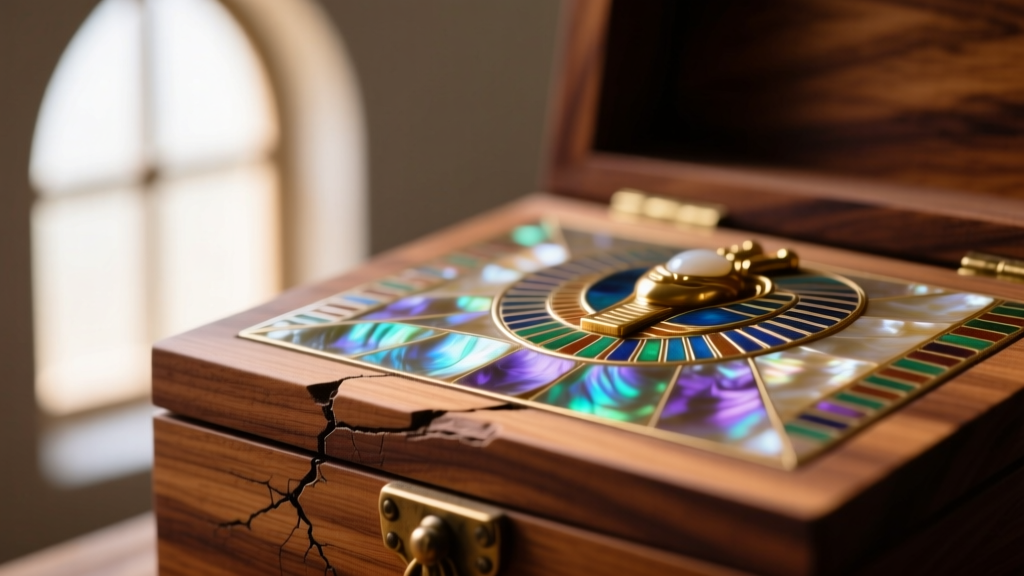
Wood is hygroscopic; it absorbs and releases moisture from the ambient air, expanding and contracting primarily across the tangential grain. Nacre, conversely, is a mineralized composite with a near-zero coefficient of hygroscopic expansion. When an Egyptian jewelry box is kept in an environment where Relative Humidity (RH) drops below 35%—a common occurrence in modern, climate-controlled homes during winter—the cedar substrate shrinks. The rigid MOP inlay cannot shrink with it.
Conservation Insight: The historical adhesive used in mid-century Cairo workshops was typically rabbit-skin hide glue. While hide glue offers excellent initial shear strength, it becomes highly brittle at low moisture content. When the wood shrinks, the brittle glue line fractures, resulting in irreversible delamination. Maintaining a strict RH of 45% to 55% is non-negotiable for these pieces.
Hardware Degradation: Verdigris and Stress Corrosion
The brass hardware on an Egyptian jewelry box is usually a CuZn30 (70% copper, 30% zinc) alloy. Over decades, exposure to high humidity, skin oils, and acidic off-gassing from deteriorating interior linings causes the copper to oxidize into copper acetate, commonly known as verdigris.
Verdigris is not merely a cosmetic issue; it is a highly acidic, creeping corrosion that will chemically burn into the adjacent cedar, turning the wood black and spongy. Furthermore, the mechanical stress of opening heavy, over-stuffed lids can induce stress corrosion cracking in brass hinges that have been exposed to ammonia-based cleaning agents. Never use commercial brass polishes containing ammonia on antique box hardware.
Technical Preservation Protocol Matrix
To systematically preserve your Egyptian jewelry box, follow this material-specific maintenance matrix, aligned with guidelines from the National Park Service Museum Handbook:
| Component | Primary Threat | Preventative Environment | Active Intervention |
|---|---|---|---|
| Cedar Substrate | Warping / Splitting | 45-55% RH, 65-70°F | Apply microcrystalline wax annually |
| MOP Inlay | Delamination / Chalking | Avoid direct UV / heat sources | Consolidate with Paraloid B-72 (expert only) |
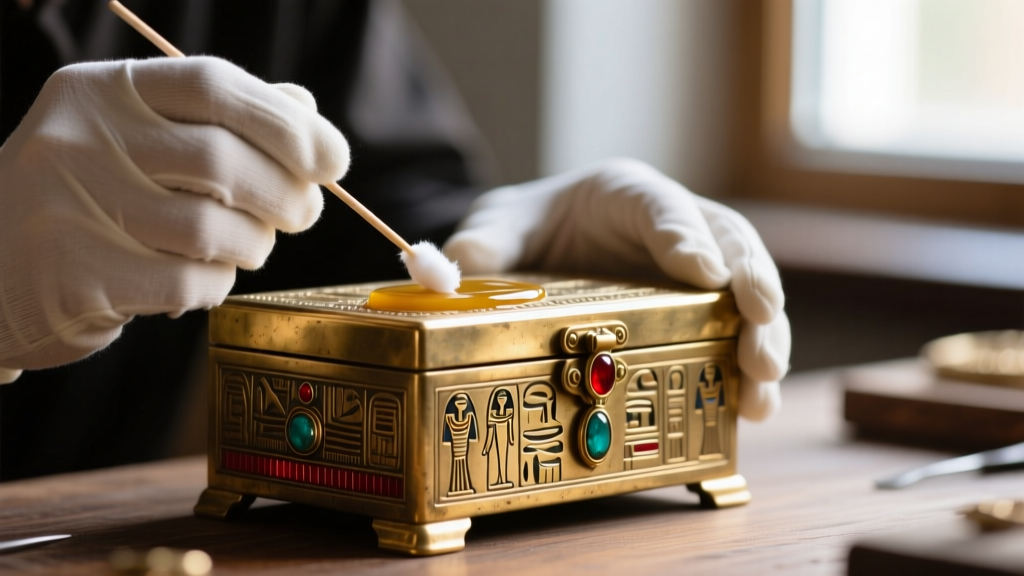
| Brass Hardware | Verdigris / Stress Cracking | Keep away from sulfur / ammonia | Mechanical cleaning + Renaissance Wax seal |
| Interior Lining | Acidic Off-Gassing | Monitor pH levels of textiles | Replace with unbuffered archival tissue |
The Hidden Danger: Interior Lining and Off-Gassing
Perhaps the most critical aspect of storing fine jewelry in a vintage Egyptian jewelry box is the interior lining. Mid-century boxes were frequently lined with rayon-acetate velvets dyed using direct, acidic dyes, and adhered to the wood using animal glues or early synthetic rubber cements.
As these adhesives and dyes degrade, they off-gas volatile organic compounds (VOCs), specifically acetic acid and sulfur dioxide. If you store sterling silver or copper-alloy jewelry in this environment, the off-gassing will accelerate the formation of silver sulfide (tarnish) at an exponential rate. According to research published by the Conservation OnLine (CoOL) database, acidic textiles can drop the localized pH inside a closed micro-environment to below 4.0 within a decade.
Archival Re-Lining Standards
If your Egyptian jewelry box has a degrading lining, it must be removed. Do not simply cover it. The replacement protocol requires inert materials:
- Barrier Layer: Line the raw wood cavities with Marvelseal 360 (an aluminum-nylon-polyethylene laminate) to block any residual acid migration from the cedar or old glue.
- Cushioning Layer: Use inert, closed-cell polyethylene foam (such as Ethafoam) cut to fit the compartments.
- Contact Layer: Cover the foam with unbuffered, acid-free archival tissue or undyed, washed linen. Avoid 'anti-tarnish' treated cloths unless they are specifically tested for archival neutrality, as some commercial treatments contain abrasive particulates.
Authentication: Hand-Crafted vs. Mass-Produced Tourist Wares
Not every Egyptian jewelry box holds horological or historical value. The tourist markets of the 1970s and 1980s produced thousands of mass-produced replicas. Differentiating a master-crafted piece from a factory reproduction requires technical inspection.
Joint and Adhesive Analysis
Examine the corners of the box. Authentic mid-century artisan boxes utilize hand-cut dovetail or fine finger joints. Mass-produced replicas will show evidence of pneumatic brad nails or modern PVA (yellow) wood glue squeeze-out. Furthermore, shining a long-wave UV (blacklight) on the inlay seams will reveal modern epoxy resins (which fluoresce brightly) versus traditional hide glue (which typically shows dull or no fluorescence).
The MOP Irregularity Test
True artisan inlay relies on hand-cut nacre. Look closely at the geometric patterns. You should see microscopic variations in the kerf (the cut width), slight asymmetries in the stars or lotus motifs, and natural variations in the nacre's iridescence. Laser-cut, mass-produced MOP will exhibit perfectly uniform, glass-smooth edges and a sterile, repetitive grain pattern. Additionally, use a rare-earth magnet on the brass hardware; modern tourist wares frequently use brass-plated steel to cut costs, which will immediately attract the magnet.
Conclusion: Stewardship of Mixed-Media Storage
An authentic Egyptian jewelry box is a functional artifact that demands respect for its material science. By controlling the hygroscopic environment, neutralizing acidic interior micro-climates, and utilizing proper conservation-grade waxes on the hardware, you ensure that both the box and the heirloom jewelry it protects will survive for another century. For further reading on mixed-media conservation, the Getty Conservation Institute offers extensive open-access literature on the stabilization of organic and inorganic composites.


