How to Store Delicate Jewelry Safely: Troubleshooting Guide
Learn how to store delicate jewelry safely by troubleshooting common box failures, preventing micro-pavé loss, and stopping pearl dehydration.

The Hidden Dangers in Your Jewelry Box
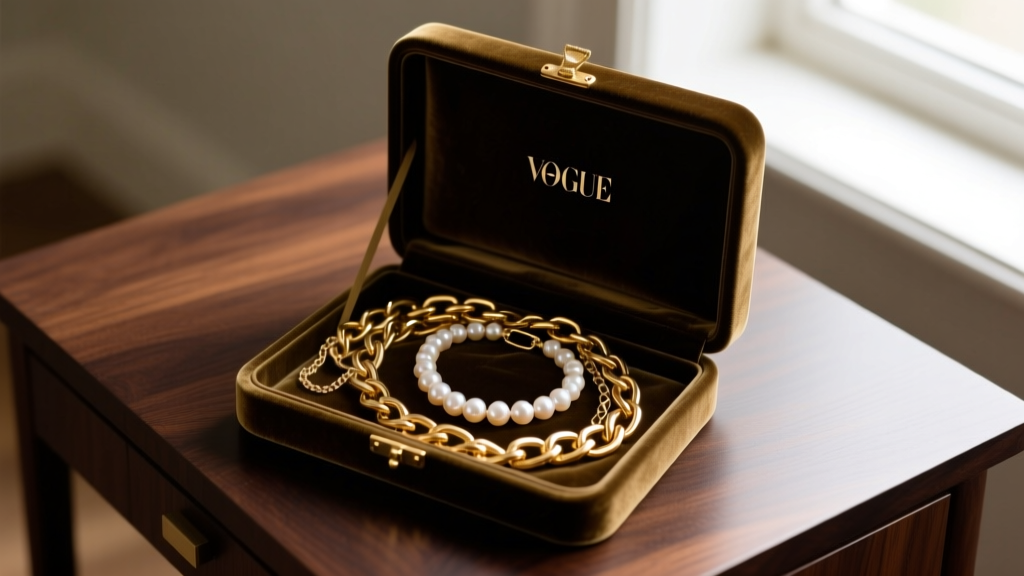
When collectors and everyday wearers ask how to store delicate jewelry safely, they are often met with generic advice: 'keep it in a soft pouch' or 'store it in a velvet box.' However, as of 2026, gemological conservation standards reveal that standard retail jewelry boxes are often the primary culprits behind irreversible damage. The false sense of security provided by a beautiful mahogany or leather-clad box can mask severe environmental and mechanical threats.
Delicate jewelry—defined by fragile gemstones (like opals and pearls), micro-mechanical settings (like micro-pavé), and high-karat or hollow metals—requires a highly calibrated storage environment. Standard felt linings frequently contain sulfur compounds that accelerate silver tarnishing, while airtight plastic bags can dehydrate organic gems, leading to catastrophic structural failure. Troubleshooting your current storage setup requires diagnosing these hidden hazards and implementing conservation-grade solutions.
Diagnosing Storage Failures by Material
To properly troubleshoot your storage infrastructure, you must first understand the specific failure modes of your most vulnerable pieces. Different materials react to humidity, pressure, and chemical off-gassing in vastly different ways.
Organic Gems: Pearls, Amber, and Coral
Pearls are composed of nacre (calcium carbonate) held together by an organic protein called conchiolin. According to the Gemological Institute of America (GIA), pearls require a stable relative humidity (RH) of 40% to 60%. A common troubleshooting scenario involves a collector storing pearls in an airtight Ziploc bag or a safety deposit box. This severely dehydrates the conchiolin, causing the nacre to crack, peel, or 'craze.' Furthermore, pearl necklaces are typically strung on size E or F silk thread. If stored in a damp, unventilated environment, the silk will stretch, rot, and eventually snap. Troubleshooting fix: Never store pearls in airtight plastics or unventilated safes. Store them flat in a breathable, acid-free cotton pouch to prevent the silk from stretching under the weight of the beads.
Micro-Pavé and Tension Settings
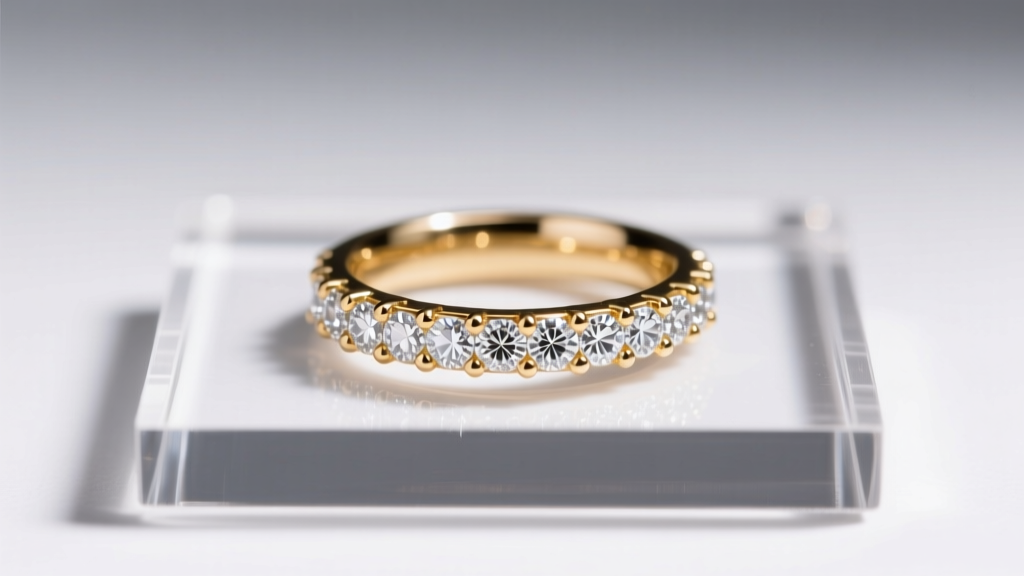
Micro-pavé settings utilize incredibly small prongs, often measuring just 0.5mm to 0.8mm in diameter, to secure sub-1mm diamonds. The primary failure mode here is mechanical pressure. Storing a micro-pavé ring in a soft velvet pouch or a crowded, un-partitioned drawer allows heavier items to press against the setting. This lateral pressure bends the microscopic prongs, leading to stone loss that is often only discovered when the piece is next worn. Troubleshooting fix: Micro-pavé requires rigid, individual honeycomb slots or hard-shell travel cases where the piece is suspended or secured without pressure on the crown of the ring.
High-Karat Gold and Hollow Chains
22k and 24k gold possess high Vickers hardness malleability, making them exceptionally prone to bending and denting. Hollow electroformed chains (like large but lightweight serpentine or Figaro chains) are notoriously difficult to untangle once knotted, and pulling a knot tight can crush the hollow links irreparably. Troubleshooting fix: Always clasp hollow chains before storage and lay them completely flat in individual, anti-tarnish flannel sleeves to prevent link-on-link abrasion and tangling.
The Anti-Tarnish and Anti-Abrasion Matrix
Upgrading your storage requires selecting the right materials. Below is a diagnostic matrix to help you audit your current jewelry box inserts and replace them with conservation-safe alternatives.
| Storage Material | Threat Level | Ideal Use Case | What to Avoid |
|---|---|---|---|
| Pacific Silvercloth | Very Low | Sterling silver, copper, brass | Storing damp items (traps moisture) |
| Standard Felt/Velvet | High | None (requires replacement) | Direct contact with silver or pearls |
| Polyethylene (PE) Bags | Low | Diamonds, platinum, gold | Storing pearls or opals (causes dehydration) |
| PVC / Vinyl Plastics | Extreme | None (discard immediately) | Any metal or organic gem (off-gasses HCl) |
| Acid-Free Tissue Paper | Very Low | Wrapping amber, coral, opals | Using standard bleached tissue paper |
Step-by-Step Troubleshooting: Fixing a Compromised Environment
If your jewelry is already showing signs of storage-related stress—such as accelerated tarnishing, sticky residues, or loose stones—follow this systematic protocol to rehabilitate your storage environment.
Expert Insight: Tarnish is not dirt; it is a chemical reaction. Silver reacts with hydrogen sulfide (H2S) in the air to form silver sulfide. The Library of Congress Preservation Directorate emphasizes that removing the gaseous pollutant from the micro-environment is far superior to constantly polishing the metal, which removes microscopic layers of silver over time.
Step 1: Audit for PVC and Sulfur Off-Gassing
Empty your jewelry box entirely. Smell the interior; a sharp, chemical odor often indicates PVC or toxic adhesives. Inspect the lining. If it is synthetic leather or standard glued felt, it is likely off-gassing sulfur or chlorides. Line the drawers with barrier foil or replace the inserts entirely with archival-grade, sulfur-free polyurethane foam.
Step 2: Calibrate the Micro-Climate
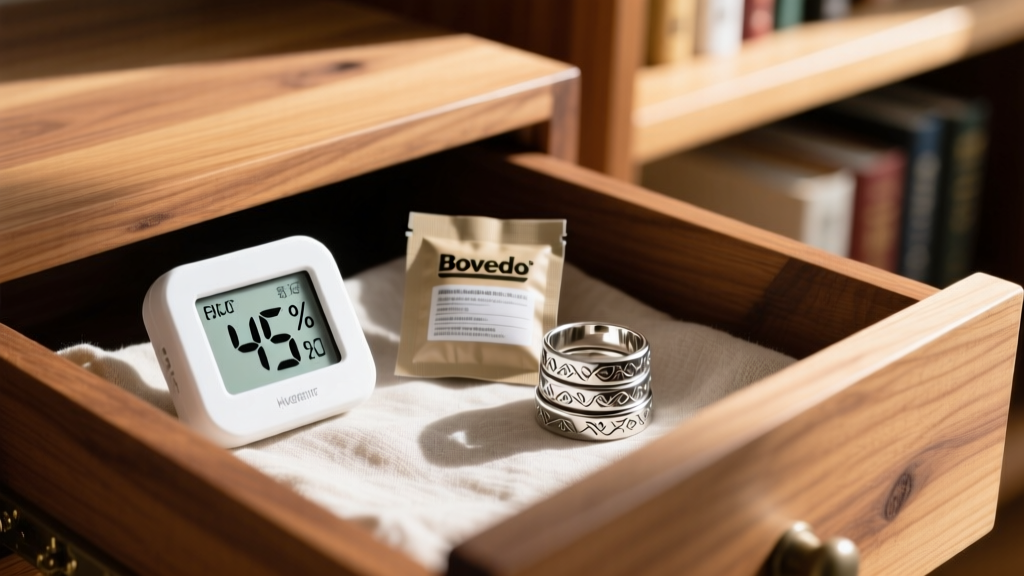
For wooden jewelry boxes or safes, humidity control is paramount. Silica gel packets are useful for absorbing excess moisture, but they can over-dry organic gems. Instead, utilize two-way humidity control packs, such as Boveda 49% RH packs, which are engineered for wooden instruments and cigar humidors. These packs will release moisture if the box gets too dry (saving your pearls) and absorb moisture if it gets too damp (saving your silk threads and preventing metal oxidation).
Step 3: Implement Active Gas Absorption
To stop tarnish in its tracks, integrate 3M Anti-Tarnish Strips into your storage drawers. These strips utilize a patented copper-based chemistry that actively absorbs and neutralizes hydrogen sulfide and sulfur dioxide gases. One 2-inch strip protects approximately 1 cubic foot of enclosed space for up to 12 months. Replace them annually, or when the copper indicator turns completely black.
Step 4: Reorganize by Hardness and Fragility
The Mohs scale of mineral hardness should dictate your drawer layout. Diamonds (Mohs 10) will easily scratch sapphires (Mohs 9), which in turn will scratch gold (Mohs 2.5-3). Never allow pieces to touch. Use rigid acrylic dividers for rings and bracelets, and utilize individual, soft-flannel roll slots for chains to eliminate kinetic friction when the drawer is opened and closed.
Expert Verdict: Upgrading Your Storage Infrastructure
Understanding how to store delicate jewelry safely is ultimately an exercise in preventive conservation. The transition from a standard retail jewelry box to a calibrated, compartmentalized, and chemically neutral storage environment will drastically extend the lifespan of your collection. By addressing the specific mechanical and chemical vulnerabilities of micro-pavé, organic gems, and high-karat metals, you eliminate the root causes of degradation. Invest in archival-grade materials, monitor your humidity levels, and treat your storage infrastructure with the same care and precision as the jewelry it protects.


