The Engineering Behind the Octagon Jewelry Box: A Technical Guide
Discover the structural engineering, material grades, and anti-tarnish mechanics that make the octagon jewelry box superior for fine gem storage.

The Geometry of Preservation: Why Octagonal?
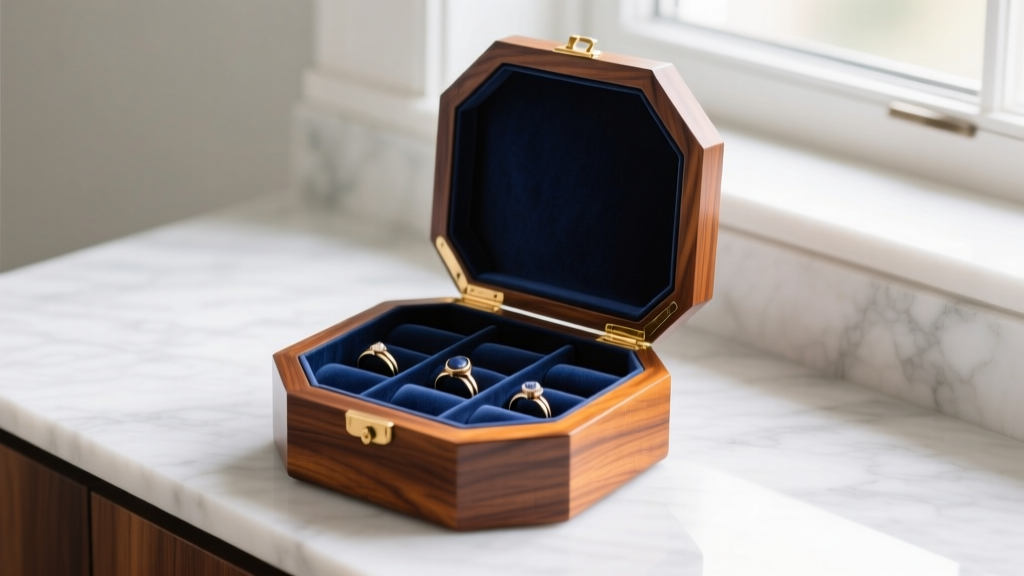
When evaluating high-end jewelry storage, most collectors focus on exterior aesthetics or interior compartment counts. However, the structural geometry of the vessel itself plays a critical role in long-term preservation. The octagon jewelry box represents a significant engineering leap over traditional rectangular or square chests, primarily due to its 135-degree interior angles. In standard 90-degree rectangular boxes, tight corners create micro-climates where air stagnates and humidity pockets form. This localized moisture retention accelerates the oxidation of silver and the degradation of porous gemstones like pearls and opals.
Furthermore, the octagonal footprint mirrors the geometry of some of the most vulnerable and valuable gemstone cuts. Asscher cuts, octagonal emerald cuts, and radiant cuts feature clipped corners that are notoriously prone to chipping if subjected to uneven pressure. According to the Gemological Institute of America (GIA), prong settings on these specific cuts require careful spatial mapping during storage. The 135-degree interior walls of an octagon jewelry box allow for custom-molded, angled resting pads that cradle the girdle of the stone without pressing against the vulnerable corner prongs, a feat nearly impossible to achieve in a standard right-angled velvet insert.
Material Science: Woods, Veneers, and Lining Tensions
The structural integrity of an octagonal shell requires materials that can withstand complex miter joints without warping. While mass-market options utilize Medium-Density Fiberboard (MDF), MDF is fundamentally unsuitable for archival jewelry storage due to its tendency to off-gas formaldehyde and other volatile organic compounds (VOCs). These VOCs react with the sulfur in the air to create silver sulfide, the black compound responsible for tarnish.
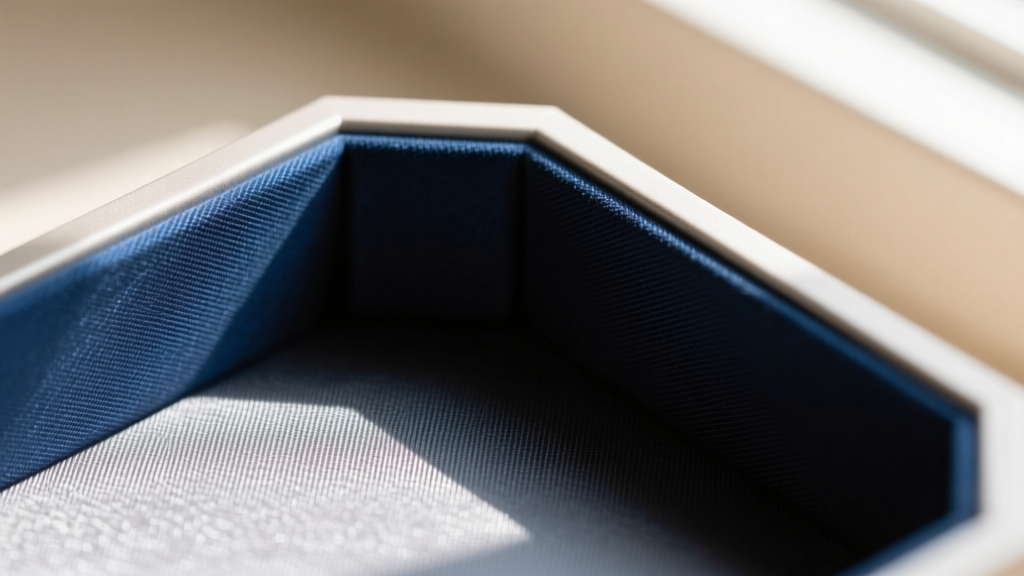
Expert-grade octagon boxes are milled from 18mm Baltic birch plywood or solid American Black Walnut. Baltic birch offers superior cross-banded tensile strength, ensuring the eight outer facets remain perfectly plumb even in fluctuating humidity environments. The interior lining presents another engineering hurdle: tensioning fabric over eight distinct corners. Standard 80 GSM (grams per square meter) velvet will pucker and pull away from the adhesive at the 135-degree seams. Premium manufacturers utilize 200 GSM anti-tarnish treated microfibre or Pacific Silvercloth, which possesses enough structural memory to be blind-stitched and stretched tightly across the angular transitions without distorting the pile.
The Adhesive Threat: Archival-Safe Glues
The unseen enemy of fine jewelry storage is the adhesive used to bind the lining to the wooden shell. Standard hot-melt glues and cyanoacrylates trap moisture against the wood and emit acetic acid as they cure. The American Institute for Conservation (AIC) strictly advises against the use of non-archival adhesives in proximity to sensitive metals and organic gems. In a properly engineered octagon jewelry box, master craftsmen utilize acid-free, PVA-based bookbinding glues, such as Lineco Neutral pH Adhesive. These glues remain flexible, do not off-gas harmful acids, and allow the wood to expand and contract naturally without delaminating the interior fabric.
Anti-Tarnish Integration in Angular Corners
Integrating anti-tarnish technology into an eight-sided enclosure requires a strategic approach to airflow and chemical interception. Tarnish-preventive strips (typically made of activated carbon or copper-based polymers) rely on ambient air circulation to neutralize hydrogen sulfide gas. The 135-degree angles of an octagon jewelry box naturally promote a circular convection current when the lid is opened and closed, drawing fresh air across the interior rather than trapping it in dead corners.
| Feature | Standard Rectangular Box (90°) | Octagon Jewelry Box (135°) |
|---|---|---|
| Corner Airflow | Stagnant; high humidity retention | Deflected; promotes micro-circulation |
| Tarnish Strip Placement | Requires multiple strips per corner | Centralized placement effective via convection |
| Prong Snag Risk | High in tight velvet folds | Low; angles accommodate clipped gem cuts |
| Structural Stress Points | Concentrated at 4 joints | Distributed across 8 mitered joints |
For optimal protection, the Smithsonian Museum Conservation Institute recommends storing silver in enclosed environments with dedicated tarnish-inhibiting materials. In an octagonal design, embedding a continuous strip of 3M Anti-Tarnish cloth beneath the base lining ensures that the circular convection current passes over the neutralizing agent before settling over the jewelry compartments.
Hinge Mechanics and Weight Distribution
The lid of an octagon jewelry box presents a unique center-of-gravity challenge. Unlike a rectangular lid that hinges along a single, uniform plane, an octagonal lid often hinges across a single flat facet while the bulk of the mass extends outward in a semi-circular geometry. When opened to a 95-degree angle, the torque exerted on the rear facet is significantly higher than on a square box of the same volume.
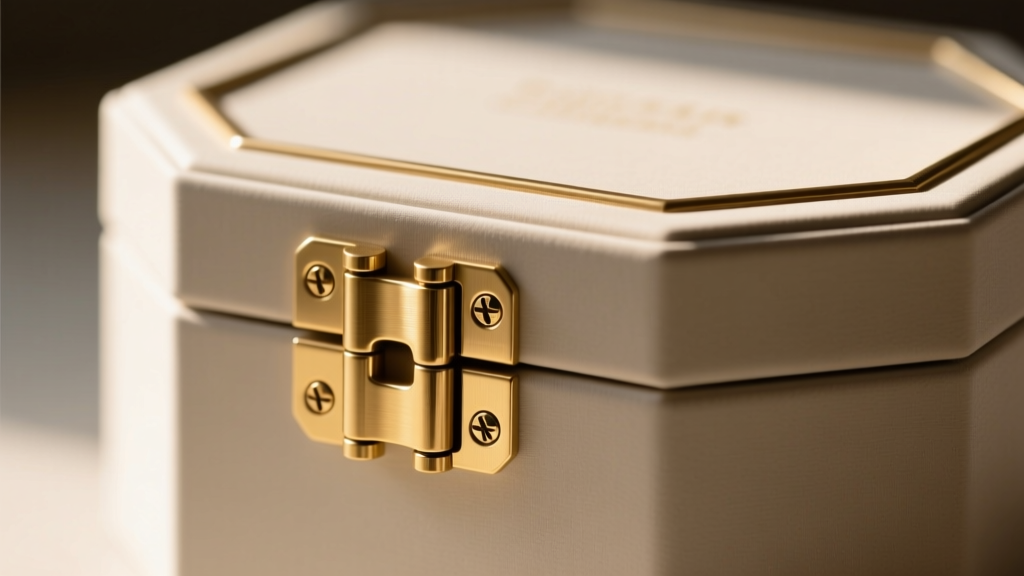
To counteract this rotational force, premium octagonal boxes employ dual solid brass stop hinges with reinforced steel pins. Brass is chosen not just for its aesthetic warmth, but because it is non-sparking and highly resistant to the corrosive effects of ambient humidity. The hinges must be mortised deeply into the 18mm shell and secured with brass wood screws, rather than relying on the weak grip of MDF. This dual-hinge distribution ensures that the lid remains perfectly balanced, preventing the warping of the rear facet over years of repetitive use.
Buyer’s Matrix: Evaluating Octagonal Storage
When investing in an octagon jewelry box for a high-value collection, bypass marketing jargon and inspect the technical specifications. Use this matrix to evaluate potential purchases:
- Shell Material: Verify the use of solid hardwood or Baltic birch. Tap the exterior; a hollow, synthetic sound indicates MDF or particleboard, which should be immediately rejected.
- Lining Composition: Demand 100% cotton Pacific Silvercloth or certified anti-tarnish microfibre. Avoid PU (polyurethane) leather, which degrades into a sticky residue and traps VOCs.
- Joint Construction: Inspect the exterior corners. You should see precise miter joints, ideally reinforced with internal splines or dovetails. Exposed end-grain indicates poor craftsmanship.
- Hinge Hardware: Check for solid brass or stainless steel hinges. Plated zinc alloys will pit and corrode within three to five years in humid environments.
- Adhesive Neutrality: While difficult to verify visually, ask the manufacturer if they use pH-neutral, archival PVA adhesives. A strong chemical odor upon opening the box is an immediate red flag for off-gassing VOCs.
Conclusion
The octagon jewelry box is far more than a stylistic departure from the traditional rectangular chest; it is a highly specialized environment engineered for the preservation of fine jewelry. By leveraging 135-degree geometry to eliminate stagnant humidity pockets, utilizing archival-safe materials to prevent chemical degradation, and employing reinforced hardware to manage unique torque loads, the octagonal design offers superior protection for vulnerable gemstone cuts and precious metals. For the serious collector, understanding these technical nuances is the key to ensuring that a storage vessel actively preserves, rather than slowly destroys, the treasures it holds.


