Peacock Jewelry Box: Expert Guide to Enamel & Inlay Storage
Master the preservation of your peacock jewelry box. Expert insights on enamel care, substrate metals, humidity control, and anti-tarnish linings.

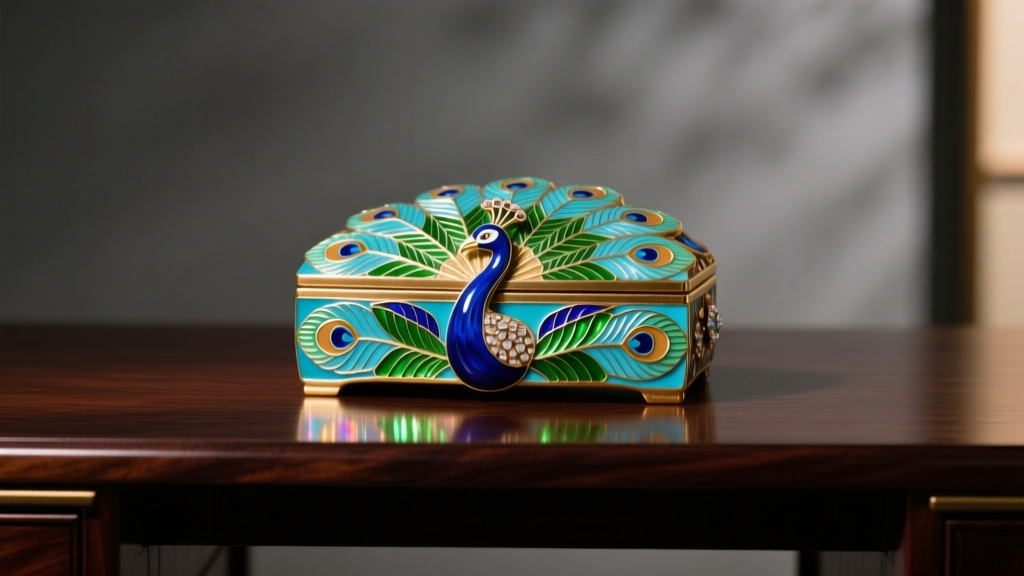
The Anatomy of Artisan Enamel and Inlay
When collectors and horology enthusiasts invest in a luxury peacock jewelry box, they are acquiring far more than a simple storage vessel. They are securing a piece of decorative art that often relies on centuries-old metallurgical and glass-fusing techniques. The iconic peacock motif—characterized by its iridescent blues, emerald greens, and metallic gold accents—is most frequently rendered through cloisonné, champlevé, or guilloché enameling, or occasionally through pietra dura (stone inlay). Understanding the material science behind these techniques is the first step in preserving them.
Enamel is essentially pulverized glass (silica) fused to a metal substrate at temperatures exceeding 1,400°F (760°C). According to the Getty Conservation Institute, the Mohs hardness of fired enamel typically ranges between 5.5 and 6.5, making it highly resistant to scratching but exceptionally vulnerable to blunt force and tensile stress. The substrate metal—usually copper, brass, or occasionally sterling silver—dictates the structural integrity of the piece. Copper is the most common base for mid-century Asian export cloisonné due to its excellent thermal conductivity, but it introduces specific preservation challenges that owners must actively manage.
Environmental Threats: Thermal Shock and Verdigris
The greatest enemy of any enameled peacock jewelry box is thermal shock, a phenomenon driven by the Coefficient of Thermal Expansion (CTE). Glass enamel and copper substrates expand and contract at different rates when exposed to temperature fluctuations. If a vintage box is moved from a cold storage unit to a heated bedroom, the metal base will contract or expand faster than the glass surface. This differential stress results in "crazing"—a network of microscopic fractures that compromises the enamel's structural bond and allows moisture to reach the bare metal beneath.
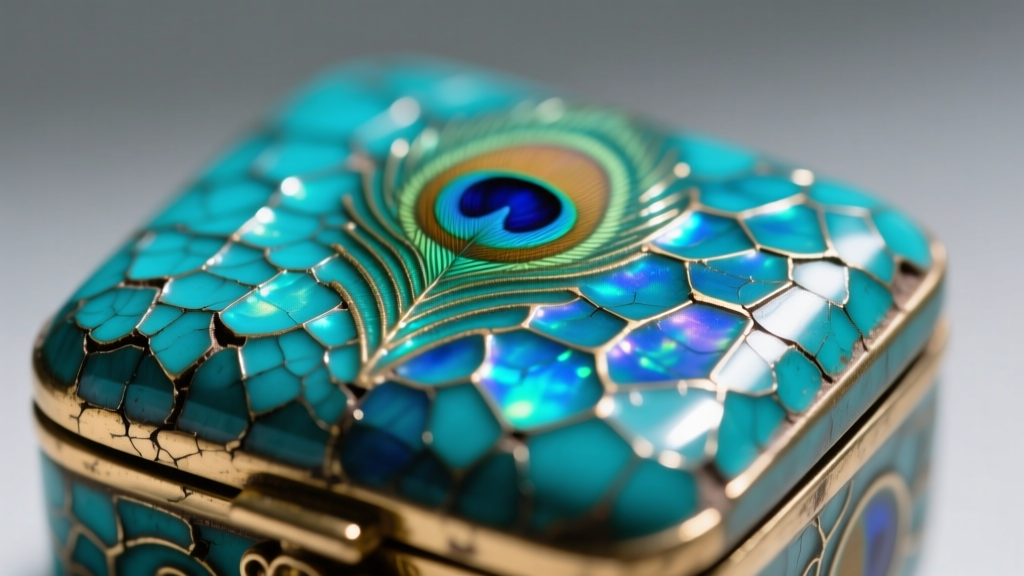
Once moisture breaches the enamel through crazing or edge-chips, the copper substrate becomes susceptible to verdigris (copper acetate) and bronze disease. This manifests as a powdery, pale green or blue-green crust that actively eats away at the metal. To prevent this, ambient temperature must remain strictly between 65°F and 70°F (18°C–21°C). Avoid placing your jewelry organizer near HVAC vents, radiators, or exterior walls where diurnal temperature swings are most pronounced.
"Never attempt to clean active verdigris with water or standard commercial jewelry dips. The moisture will accelerate the corrosion cycle, and the harsh chemicals will strip the vitreous luster from the surrounding enamel."
The Hidden Danger of Interior Linings
While the exterior of a peacock jewelry box demands visual admiration, the interior lining dictates the chemical safety of the jewelry stored within. Mass-produced and even some mid-century artisan boxes frequently utilize polyurethane foams, synthetic velvets, or PVC-based adhesives. As these materials degrade, they off-gas Volatile Organic Compounds (VOCs) and sulfur dioxide. In a sealed micro-environment, these gases react with the silver, copper, and low-karat gold jewelry stored inside, accelerating tarnish and causing irreversible pitting on porous gemstones like pearls and turquoise.
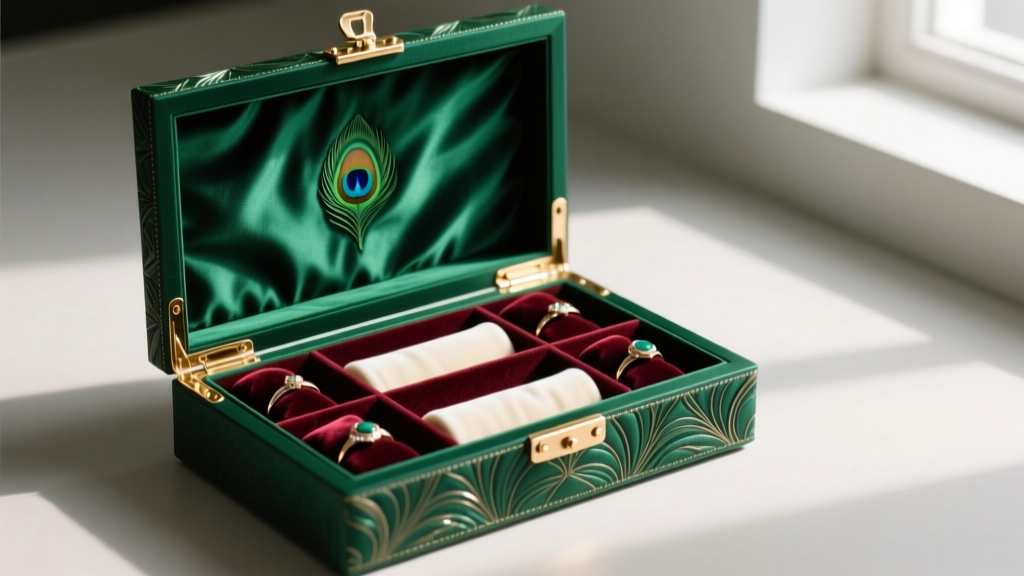
For expert-level preservation, the original lining should be evaluated. If it smells distinctly chemical, feels overly rigid, or shows signs of yellowing, it must be replaced. The gold standard for archival jewelry storage is Pacific Silvercloth or unbleached, acid-free cotton. These materials are either impregnated with fine silver particles that intercept and absorb sulfur gases before they reach your jewelry, or they are chemically inert, ensuring a stable pH environment. When re-lining a vintage box, always use archival-grade, acid-free PVA glue rather than standard craft adhesives, which contain acidic plasticizers.
Preservation Protocol and Climate Control
Maintaining a luxury enameled or inlaid organizer requires a strict, data-driven approach to climate control and handling. Below is the definitive preservation matrix for high-end decorative jewelry storage.
| Parameter | Ideal Range | Failure Mode if Ignored | Mitigation Strategy |
|---|---|---|---|
| Relative Humidity (RH) | 45% - 55% | Verdigris on copper substrates; wood warping in marquetry boxes. | Use silica gel cassettes (e.g., Art-Sorb) conditioned to 50% RH inside the storage room. |
| Temperature | 65°F - 70°F | CTE mismatch leading to enamel crazing and glass delamination. | Keep away from direct sunlight and HVAC drafts; use a digital thermo-hygrometer. |
| Light Exposure (Lux) | < 50 Lux (UV filtered) | Fading of dyed silk linings; degradation of pietra dura resins. | Store in a closed drawer or use UV-filtering acrylic display cases if kept open. |
| Handling Protocol | Clean cotton gloves | Oils and acids from fingerprints etch into brass fittings and unglazed inlay. | Always lift by the base, never by the lid or decorative finials. |
Hardware Maintenance: Hinges and Clasps
The mechanical hardware of a peacock jewelry box is often its most overlooked vulnerability. Vintage boxes typically feature solid brass piano hinges or steel pin-hinges. Steel pins are highly prone to oxidation, which can seize the hinge and cause the heavy, enamel-laden lid to snap off if forced. Brass hinges, while resistant to rust, will develop a dark patina that can transfer to the interior fabric.
To maintain the hardware, apply a micro-crystalline wax, such as Renaissance Wax, to all exposed metal fittings every 12 to 18 months. This museum-grade wax creates a moisture barrier that halts oxidation without leaving the sticky residue associated with petroleum-based polishes. If a hinge pin is seized, do not use WD-40; instead, apply a microscopic drop of synthetic clock oil via a precision needle applicator, allow it to penetrate for 24 hours, and gently work the hinge through its range of motion.
Sourcing and Valuation in the Modern Market
As of 2026, the secondary market for authentic mid-century cloisonné and Art Nouveau guilloché peacock jewelry boxes has seen a distinct bifurcation. Pieces with verifiable provenance, intact original linings, and no enamel restoration command premium prices, often ranging from $800 to over $3,500 depending on the maker (e.g., Fabergé-inspired workmasters or high-end Japanese export houses like Yasuyuki). Conversely, pieces with "invisible" epoxy repairs or replaced synthetic linings suffer a 40% to 60% depreciation in collector value.
When inspecting a potential acquisition, utilize a 10x jeweler's loupe to examine the transition lines between the enamel and the metal wire cells. According to the Victoria and Albert Museum's conservation guidelines, original fired enamel should sit perfectly flush or slightly concave to the metal wires. If the surface is convex, domed, or possesses a plastic-like luster, it has likely been repaired with cold enamel (epoxy resin), which will yellow and shrink over time, ultimately destroying the historical integrity of the piece.


