Mastering Copper Wire Wrap Jewelry: Gauges, Tempers & Techniques
Master the metallurgy of copper wire wrap jewelry. Explore AWG gauge selection, wire tempers, work hardening, and advanced patina sealing techniques.

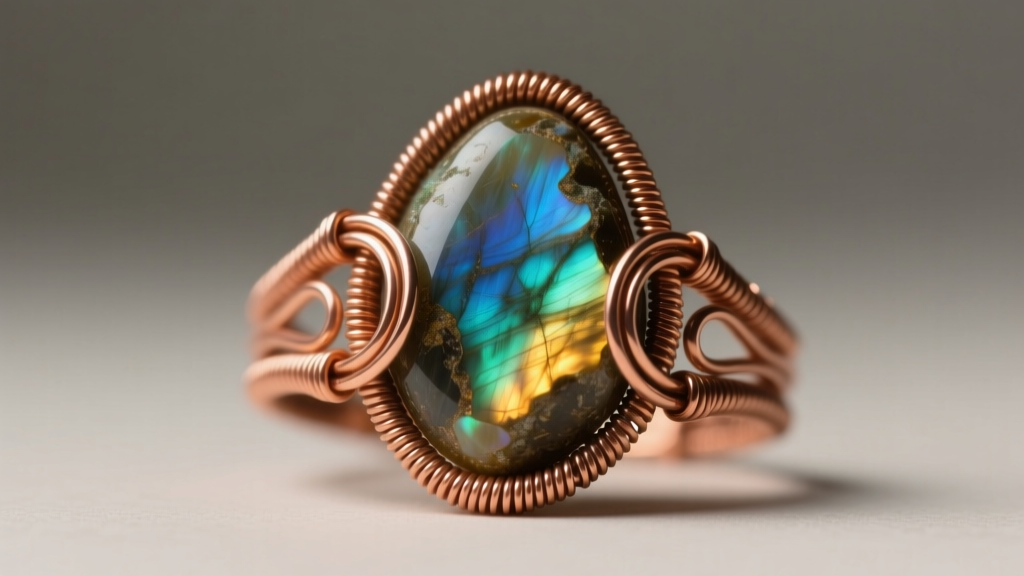
Creating high-quality copper wire wrap jewelry requires far more than basic manual dexterity; it demands a foundational understanding of metallurgy, crystal lattice deformation, and chemical patination. While copper is celebrated for its warmth, malleability, and affordability, treating it as a simple craft material leads to structural failures, uneven weaving, and premature tarnishing. To elevate your wire wrapping from hobbyist to professional grade, you must master the technical variables of wire temper, American Wire Gauge (AWG) selection, and precise work-hardening protocols.
The Metallurgy of Copper Wire: Understanding Tempers
In jewelry fabrication, 'temper' refers to the hardness and springiness of the metal, which is determined by how much it has been cold-rolled after its last annealing. Copper possesses a face-centered cubic (FCC) crystal structure, granting it exceptional ductility. However, the temper you select dictates how the wire will behave under the tension of wrapping and weaving.
Dead Soft vs. Half-Hard: The Structural Divide
Dead Soft (Fully Annealed): This wire has been heated and slowly cooled, aligning its crystal grains and relieving all internal stresses. It has a Rockwell hardness of approximately 40 (HRB). Dead soft copper offers zero springback, making it the mandatory choice for intricate weaving, tight coils, and flush cabochon bezels. When executing a 28-gauge weave over a 20-gauge frame, dead soft wire will 'bite' into the frame and lock into place without requiring excessive tension.
Half-Hard: Created by cold-rolling dead soft wire to reduce its cross-sectional area by roughly 50%, half-hard wire introduces dislocation tangles within the crystal lattice. This raises the Rockwell hardness to about 65 (HRB). Half-hard copper is essential for structural components in copper wire wrap jewelry, such as prongs, clasps, jump rings, and ear wires. It possesses enough 'memory' to hold a shaped prong securely over a gemstone without collapsing under minor impacts.
Expert Rule of Thumb: Never use dead soft wire for load-bearing prongs or clasps. Without the spring tension provided by a half-hard or hard temper, a dead soft prong will easily snag on clothing and bend away from the stone, resulting in gemstone loss.
AWG Gauge Selection for Copper Wire Wrap Jewelry
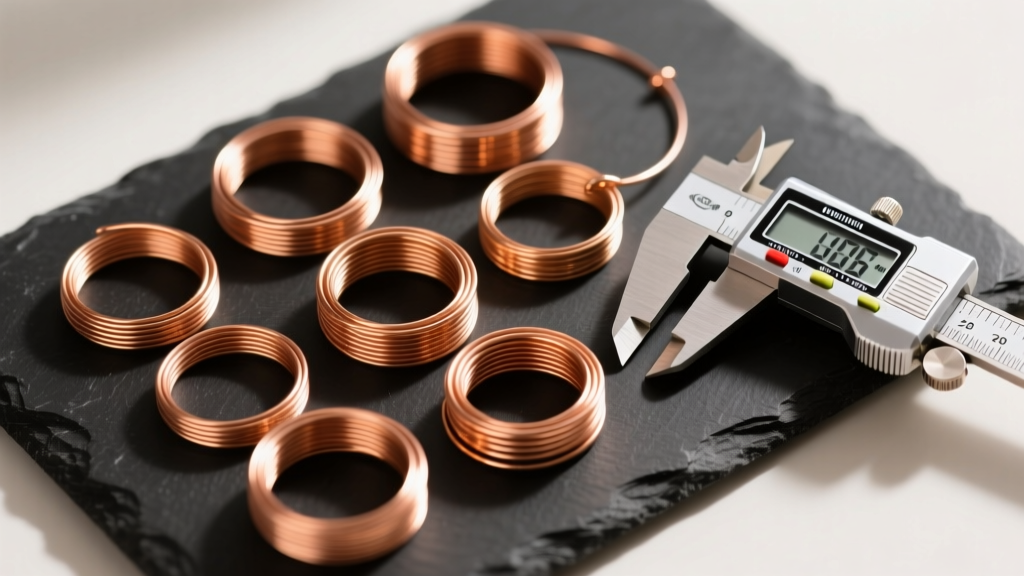
The American Wire Gauge (AWG) system is inversely proportional to the wire's diameter; a higher gauge number means a thinner wire. Selecting the correct gauge is critical for maintaining proportional aesthetics and structural integrity. Below is the definitive matrix for gauge applications in advanced wire wrapping.
| AWG Size | Diameter (mm) | Optimal Temper | Primary Application |
|---|---|---|---|
| 28 - 30 | 0.32 - 0.25 | Dead Soft | Micro-weaving, intricate filigree, binding fine details |
| 24 - 26 | 0.51 - 0.40 | Dead Soft | Standard weaving, coiling, securing cabochons |
| 20 - 22 | 0.81 - 0.64 | Half-Hard | Primary wrapping wire, jump rings, ear wires, light frames |
| 16 - 18 | 1.29 - 1.02 | Half-Hard | Heavy structural frames, bangles, thick clasps |
| 12 - 14 | 2.05 - 1.63 | Half-Hard / Hard | Neck collars, heavy-duty torque bangles |
Work Hardening and Annealing: Preventing Wire Fatigue
As you bend, weave, and pull copper wire, you are physically forcing its crystal lattice to deform. This process, known as work hardening (or strain hardening), increases the metal's yield strength but severely reduces its ductility. If you continue to manipulate heavily work-hardened copper, it will eventually suffer from metal fatigue and snap. You can identify work-hardened copper by its 'springback' (refusing to hold a tight bend) and the appearance of microscopic stress fractures or whitening along the bend radius.
The Torch Annealing Process
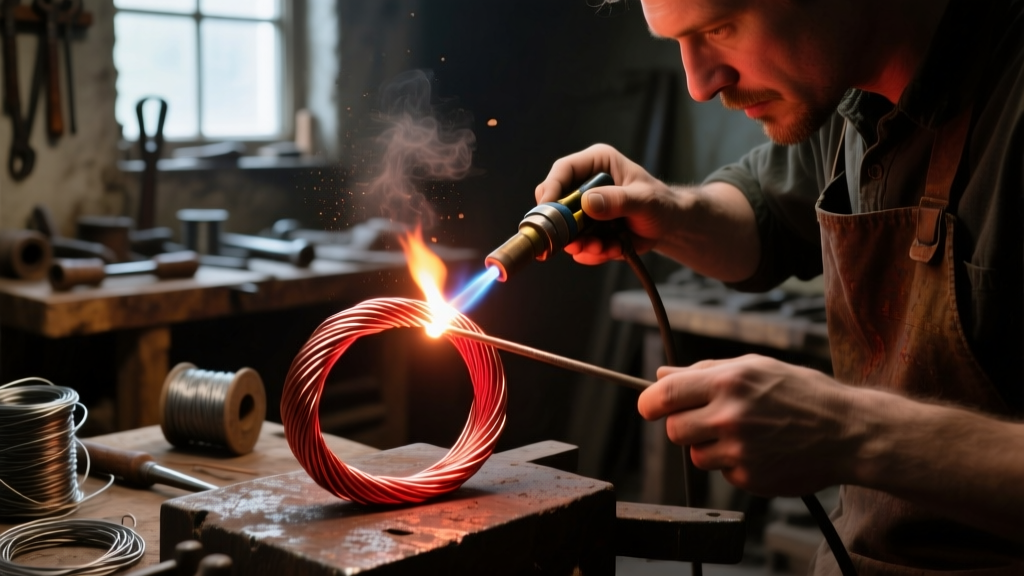
To restore the ductility of your copper wire frames mid-project, you must anneal them. According to metallurgical guidelines outlined by Ganoksin, pure copper anneals at approximately 700°F to 900°F (370°C to 480°C).
- Prepare the Surface: Ensure the wire is clean. Any oils or flux residues will burn into the metal during heating.
- Apply Heat: Using a butane micro-torch, play a neutral flame evenly across the wire. Do not hold the flame in one spot, as copper's high thermal conductivity will rapidly spread the heat, but localized melting can still occur on thin gauges.
- Watch the Color: Heat the wire until it reaches a dull, dark cherry red. In dim lighting, this color shift is unmistakable. Once the dull red glow is achieved, remove the heat immediately.
- Cooling: Unlike carbon steel, which hardens when quenched, copper's hardness is dictated by cold-working. You can quench it in water or let it air-cool; both will result in a dead soft temper.
Advanced Patina and Sealing Protocols
The raw, bright salmon-pink color of freshly polished copper is rarely the desired final state for artisan jewelry. Oxidation adds depth, contrast, and an antique aesthetic. However, unsealed copper will continue to react with the sulfur and moisture in human sweat, leading to the dreaded 'green skin' effect and a muddy, uncontrolled patina over time.
Chemical Oxidation with Liver of Sulfur
Liver of Sulfur (LOS) is a mixture of potassium sulfide, potassium polysulfide, and potassium thiosulfate. When dissolved in warm water, it releases hydrogen sulfide gas, which reacts with the copper surface to form cupric sulfide (CuS), creating a rich, dark brown-to-black patina. For a controlled, professional finish, follow these parameters:
- The Solution: Mix a weak solution. A ratio of 1 part LOS gel to 100 parts warm (not boiling) distilled water provides the most control. Hot solutions cause the patina to flash-black and flake off; cold solutions take too long and can result in uneven spotting.
- The Dip: Submerge the finished copper wire wrap jewelry for 30 to 60 seconds. Remove, rinse, and assess. Repeat in short intervals until the desired depth is achieved.
- Highlighting: Once fully oxidized and dried, use fine-grit sanding sponges (400 to 600 grit) or a brass bristle brush to polish the high points of the wire weave. This leaves the dark oxidation in the recesses, dramatically highlighting the wire work.
Sealing: Microcrystalline Wax vs. Polyurethane Coatings
To lock in the patina and prevent the copper from reacting with the wearer's skin chemistry, a barrier coating is mandatory. The two industry standards offer different advantages:
Renaissance Wax: A microcrystalline wax developed by the British Museum. It is applied with a soft cloth, allowed to haze for 15 minutes, and buffed to a soft sheen. It provides a highly natural, tactile feel that preserves the metallic texture of the copper wire. However, it requires reapplication every few months, especially on rings and bracelets subjected to high friction.
Everbrite ProtectaClear: A clear, tough polyurethane-acrylic coating designed specifically for metals. As noted in technical finishing guides by Rio Grande, applying two thin, brushed-on coats of ProtectaClear creates a permanent, scratch-resistant barrier. It completely halts the transfer of copper salts to the skin, making it the superior choice for copper rings and cuff bracelets that maintain constant skin contact.
Final Considerations for the Master Wire Wrapper
Excellence in copper wire wrap jewelry is achieved at the intersection of artistic vision and material science. By respecting the crystalline behavior of copper tempers, adhering to strict AWG gauge proportions, managing work hardening through precise torch annealing, and executing controlled chemical patination, you transform simple spools of wire into enduring, museum-quality adornments. Master these technical variables, and your structural integrity and aesthetic refinement will immediately separate your work from the amateur tier.