Dead Soft Copper Wire for Jewelry Making: Properties & Uses
Discover the metallurgical properties of dead soft copper wire for jewelry making. Learn gauge selection, work hardening, and temper comparisons.

The Metallurgy of "Dead Soft" Temper
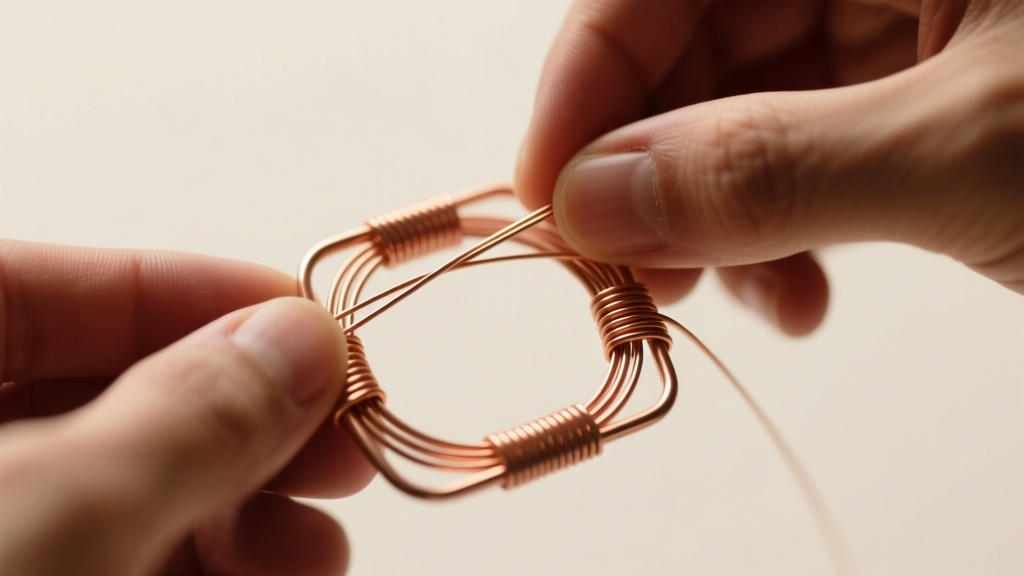
When sourcing materials for wire wrapping and structural metalwork, understanding the temper of your metal is just as critical as selecting the right alloy. Dead soft copper wire for jewelry making refers to wire that has undergone a full annealing process. During manufacturing, copper is drawn through progressively smaller dies, which compresses its face-centered cubic (FCC) crystal lattice and introduces microscopic dislocations. This makes the wire hard and brittle. To achieve a "dead soft" temper, the wire is heated to a dull cherry red (approximately 1,100°F to 1,300°F) and then rapidly quenched in water. This thermal shock relieves internal stresses, realigns the crystal grains, and restores maximum ductility.
Because of this relaxed crystalline structure, dead soft copper offers virtually zero resistance to bending. It can be manipulated by hand, woven tightly around core wires, and shaped into complex, sweeping curves without the need for heavy-duty pliers. However, this extreme malleability comes with a trade-off: dead soft wire lacks the structural integrity to hold heavy loads or maintain sharp, geometric angles without additional work hardening.
Dead Soft vs. Half-Hard vs. Hard: A Temper Comparison
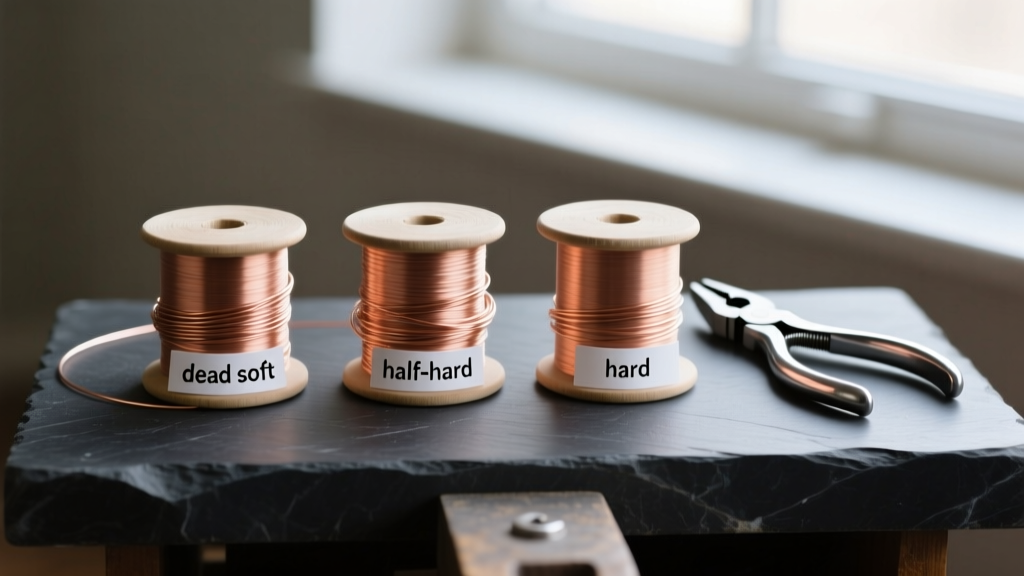
Choosing the correct temper dictates the success of your jewelry design. Below is a metallurgical and practical comparison of standard copper wire tempers available from major suppliers like Rio Grande.
| Temper State | Approx. Vickers Hardness | Bend Radius | Primary Jewelry Applications |
|---|---|---|---|
| Dead Soft | 40 - 50 HV | Zero (can fold flat) | Micro-weaving, coiling, intricate wire wrapping, bezel weaving. |
| Half-Hard | 80 - 100 HV | Moderate | Jump rings, ear wires, structural frames, simple loops. |
| Hard | 110 - 130 HV | High (resists bending) | Pin stems, clasps, heavy-duty structural components. |
| Spring Hard | 140+ HV | Extreme (will snap) | Springs, tension components (rarely used in standard wrapping). |
Gauge Selection Matrix for Copper Wire Wrapping
Pairing the dead soft temper with the correct American Wire Gauge (AWG) is essential for both aesthetics and structural failure prevention. According to wire weaving guidelines outlined by Interweave, the following gauge matrix serves as the industry standard for copper jewelry fabrication:
- 28-Gauge (0.32mm): The premier choice for micro-weaving and delicate coiling. Dead soft 28g wire behaves almost like thread, allowing it to pass through small gemstone bead holes multiple times. It is too fragile for structural use and will snap if pulled with pliers.
- 24-Gauge (0.51mm): The workhorse for standard wire weaving. It provides enough tensile strength to be pulled taut with nylon-jaw pliers without stretching, yet remains pliable enough to wrap tightly around 16g or 18g core wires.
- 20-Gauge (0.81mm): Rarely used in a dead soft temper for final structures, but excellent for creating complex, multi-layered woven frames that will later be work-hardened. It is also the standard gauge for crafting custom ear wires and headpins.
- 16-Gauge (1.29mm) & 14-Gauge (1.63mm): Used exclusively as the rigid "core" or "base" wire in wire-wrapped pendants and bangles. Dead soft 16g wire is easily shaped into heavy pendant bails and bracelet cuffs by hand before being hardened.
The Work Hardening Phenomenon
One of the most vital concepts to master when using dead soft copper wire for jewelry making is work hardening (or strain hardening). As you bend, twist, or hammer the annealed copper, you force the dislocations in its crystal lattice to multiply and tangle. This physical entanglement restricts further movement, increasing the wire's tensile strength and yield point while simultaneously decreasing its ductility.
In practical terms, this means a piece of dead soft copper wire will gradually become stiffer the more you manipulate it. If you continue to bend a work-hardened wire past its yield point, it will suffer from metal fatigue and snap cleanly. Expert jewelers use this to their advantage: they start with dead soft wire for easy shaping, then intentionally work-harden the finished piece using a rawhide mallet, a tumbler with stainless steel shot, or nylon-jaw pliers to lock the design into a rigid, durable state.
Pure Copper vs. Brass and Bronze Alloys
While pure copper (alloy C11000) is the baseline for dead soft wire, comparing it to its common alloys—brass and bronze—reveals distinct behavioral differences in the dead soft state.
- Pure Copper (C11000): Offers the highest ductility and the longest working time before work hardening causes brittleness. It is the most forgiving for beginners learning complex weaves like the mobius or the serpent weave.
- Yellow Brass (C26000): An alloy of 70% copper and 30% zinc. Even in a dead soft temper, brass is noticeably stiffer than pure copper. It work-hardens approximately 30% faster, meaning you must anneal it more frequently during heavy forging. It yields a brighter, gold-like finish but requires more hand strength to weave.
- Phosphor Bronze (C51000): Contains copper, tin, and a trace of phosphorus. Dead soft bronze is the stiffest of the three and possesses a high fatigue resistance. It is ideal for structural components that require a warm, vintage brown hue, but it is notoriously difficult to use for tight micro-coiling due to its inherent spring-back, even when fully annealed.
Patina, Tarnish, and Skin Chemistry
Bare copper is highly reactive. When exposed to atmospheric oxygen and sulfur compounds, it develops a patina. In jewelry making, this is often accelerated intentionally using Liver of Sulfur (potassium polysulfide) to create deep browns, iridescent purples, and matte blacks, which are then polished back on the high spots to create contrast.
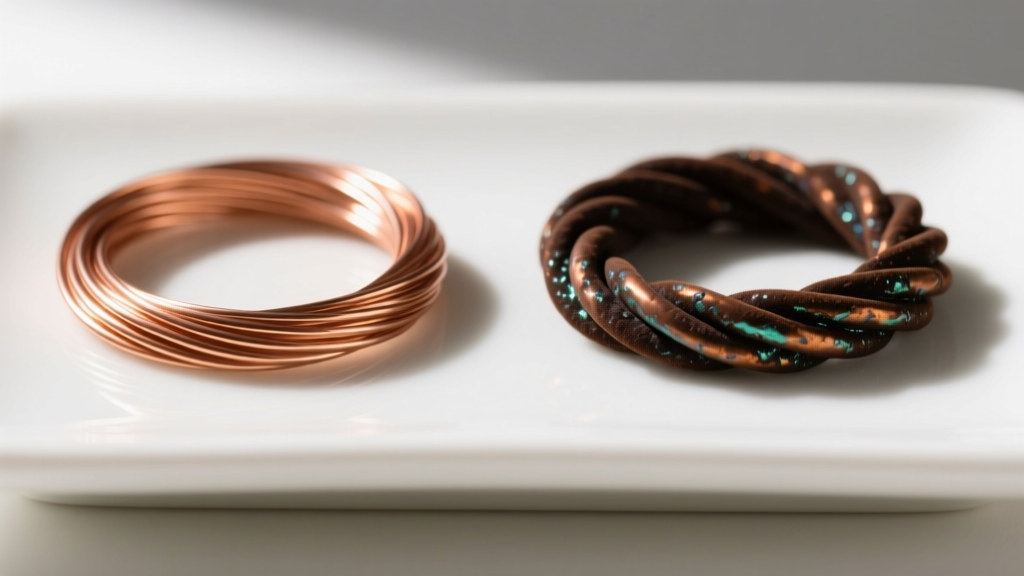
However, when worn against the skin, copper reacts with sweat, amino acids, and natural body oils to form copper chelates. This results in the well-known "green skin" effect. While entirely harmless and non-toxic, it is highly undesirable for most jewelry wearers. To mitigate this, jewelers must seal dead soft copper pieces using specialized micro-crystalline waxes (like Renaissance Wax) or electrostatic clear coats (like ProSeal). Note that any sealing agent will eventually wear off on high-friction areas like ring bands, requiring the wearer to reapply the sealant periodically.
Expert Troubleshooting: Breakage and Brittle Wire
If your dead soft copper wire is snapping prematurely during a weave, consider the following troubleshooting framework:
- Check the Spool Age and Storage: Copper can undergo slight oxidation over years of improper storage, leading to surface micro-fractures. Always store copper wire in airtight bags with anti-tarnish strips.
- Tool Damage: Using standard steel chain-nose pliers with serrated teeth will score the surface of soft copper. These microscopic scratches act as stress concentrators, causing the wire to snap when pulled taut. Always use nylon-jaw pliers or tape the jaws of your steel tools with painter's tape.
- Over-Manipulation: If you make a mistake in a weave and attempt to unbend and rebend the same section of dead soft copper repeatedly, you will rapidly work-harden that specific localized zone. Instead of trying to salvage a heavily bent section, cut it out and start fresh.
Sourcing Recommendations for 2026
When purchasing dead soft copper wire for jewelry making, avoid generic craft store spools, which often suffer from inconsistent gauge diameters and improper annealing. Instead, source from dedicated jewelry supply houses that guarantee ASTM-standard tolerances. Brands like ParaWire, Artistic Wire, and Rio Grande offer bare, uncoated dead soft copper that is guaranteed to be free of clear factory sealants, ensuring it is ready for immediate weaving, soldering, or chemical patination straight off the spool.

