Mens Copper Jewelry 2026: Brutalist & Dark Academia Trend Analysis
Discover 2026 mens copper jewelry trends. Explore brutalist rings, dark academia cuffs, and patina care tips for modern masculine styling.


The 2026 Shift: From Bohemian to Brutalist
For the past decade, men's alternative metal jewelry was heavily defined by minimalist bands and woven, bohemian-inspired copper wire wraps. However, as we navigate the style landscape of 2026, mens copper jewelry has undergone a radical aesthetic transformation. Driven by a cultural pivot toward tactile, grounded, and historically resonant accessories, copper has shed its rustic reputation. Today, it stands at the forefront of two dominant masculine movements: Architectural Brutalism and Dark Academia. This shift is not merely visual; it is deeply rooted in how modern men interact with materiality, oxidation, and the passage of time. According to recent accessory forecasting by JCK Online's menswear reports, alternative metals are outperforming traditional silver in the under-35 demographic, largely due to the desire for 'living' materials that evolve with the wearer.
Key Aesthetic Movements in Men's Copper
The modern copper renaissance is defined by two distinct stylistic poles. Both reject high-polish, mass-market finishes in favor of intentional imperfection and heavy, deliberate proportions.
Architectural Brutalism
Brutalist copper jewelry borrows from mid-century concrete architecture. These pieces are characterized by raw, unpolished surfaces, deep geometric gouges, and heavy, blocky silhouettes. Artisans are utilizing torch-texturing and acid-etching to create landscapes of oxidized valleys and raw, exposed peaks. A brutalist copper ring in 2026 is not a simple band; it is a structural statement, often measuring between 8mm and 14mm in width, featuring aggressive angles that catch the light unpredictably. The appeal lies in the contrast between the warmth of the copper and the cold, unforgiving nature of the brutalist geometry.
Dark Academia & Antiquarian Signets
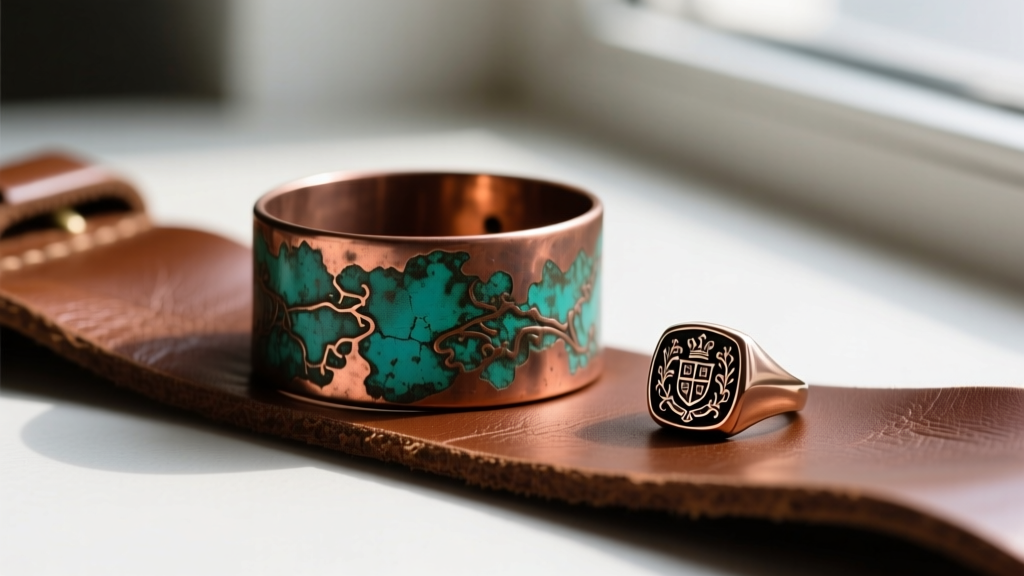
On the opposite end of the spectrum is the Dark Academia movement, which romanticizes scholarly pursuits, gothic literature, and classical antiquity. Mens copper jewelry in this niche focuses on heavy signet rings, intaglio-carved cuffs, and heraldic motifs. The copper is intentionally heavily oxidized to mimic centuries-old bronze artifacts unearthed from archaeological digs. Unlike the aggressive angles of brutalism, Dark Academia copper features smooth, worn edges, deep relief carvings, and a rich, mahogany-brown patina that feels inherited rather than purchased.
Material Specs: Alloys, Gauges, and Machinability
To execute these heavy, detailed designs, jewelers in 2026 are moving beyond standard hardware-store copper. The specific alloy and gauge thickness dictate the success of a brutalist or antiquarian piece. As detailed in Rio Grande's metallurgical guides, the choice of copper alloy drastically affects both the manufacturing process and the final patina.
| Alloy Designation | Composition | Machinability | Patina Characteristics | Best 2026 Use Case |
|---|---|---|---|---|
| C110 (ETP Copper) | 99.9% Cu | Poor (Gummy) | Fast, even oxidation | Hand-forged cuffs, hammered bands |
| C102 (Oxygen-Free) | 99.99% Cu | Poor (Gummy) | Extremely uniform dark patina | High-end Dark Academia signets |
| C145 (Tellurium) | 99.5% Cu, 0.5% Te | Excellent (Crisp) | Slightly mottled, high contrast | CNC-milled Brutalist geometric rings |
For brutalist rings requiring sharp, CNC-milled facets or deep, crisp lathe cuts, C145 Tellurium copper is the undisputed king. The addition of tellurium allows the metal to chip cleanly rather than tearing, resulting in razor-sharp architectural edges. Conversely, for hand-forged cuffs and hammered textures, C110 Electrolytic Tough Pitch (ETP) copper remains the standard due to its superior malleability under the hammer.
Gauge thickness is equally critical. For men's copper cuff bracelets, the 2026 standard has shifted heavier. While 16-gauge (1.3mm) was common in the 2010s, contemporary artisan cuffs are now cut from 10-gauge (2.5mm) or 8-gauge (3.2mm) stock. This provides the necessary rigidity to hold the cuff's shape on a larger wrist while imparting a satisfying, premium heft that consumers now demand from luxury alternative metals.
Styling Framework: Proportions and Placement
Wearing heavy copper requires an understanding of visual weight and proportion. The days of stacking five thin, delicate copper rings are over. The 2026 styling framework favors isolation and bold placement.
- The Index Finger Signet: The index finger is the prime real estate for Dark Academia copper signets. A 12mm to 14mm wide copper signet with a deep intaglio crest balances the hand's natural proportions and draws immediate attention without looking overly flashy.
- The Statement Cuff: Limit to one cuff per arm. A 15mm to 20mm wide brutalist copper cuff worn on the mid-forearm (just above the watch) creates a sophisticated, intentional layering effect. Avoid wearing copper cuffs on the same wrist as a steel dive watch; the galvanic reaction and visual clash will ruin both the aesthetic and the metal.
- The Minimalist Contrast: If wearing a heavy, textured copper ring, pair it with a matte black tungsten or dark ceramic band on the opposite hand. This grounds the warmth of the copper and prevents the 'pirate' aesthetic that plagued early 2000s men's jewelry.
Maintenance: Embracing vs. Halting the Verdigris
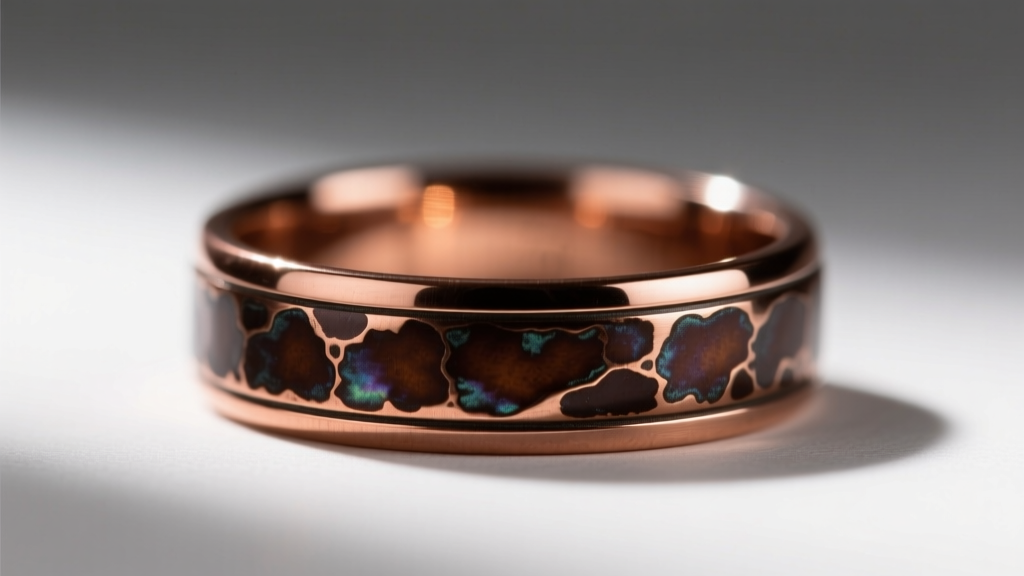
The most common barrier to entry for mens copper jewelry is the dreaded 'green skin' effect. This verdigris (copper carbonate/chloride) occurs when copper reacts with the chlorides and moisture in human sweat. In 2026, the approach to patina management is highly scientific, splitting into two distinct camps: forced antiquing and nano-sealing.
Forced Antiquing (The Dark Academia Route): Jewelers are using Liver of Sulfur (potassium sulfide) solutions to force a deep, mahogany-black patina before the piece ever reaches the customer. By immersing the copper in a heated liver of sulfur bath, the metal rapidly oxidizes. The jeweler then uses fine steel wool to buff only the high spots, leaving the recesses pitch black. This creates immense visual depth and stabilizes the surface, slowing down the reaction with the skin.
Nano-Sealing (The Brutalist Route): For brutalist pieces where the raw, bright orange-pink color of the copper is desired, artisans are abandoning traditional clear coats (which chip and look like cheap plastic). Instead, the 2026 standard is microcrystalline wax (such as Renaissance Wax) or nano-ceramic coatings like ProtectaClear. These sealants are incredibly thin, completely invisible, and halt the oxidation process, preventing skin staining while maintaining the raw, tactile feel of the metal. Reapplication of Renaissance wax is required every few months, a ritual that owners of high-end copper jewelry have come to embrace as part of the material's living nature.
Price Tiers and Artisan Benchmarks
As the appreciation for heavy-gauge, specialized copper alloys has grown, so has the pricing structure. In 2026, mens copper jewelry is firmly divided into three tiers:
- Commercial Cast ($40 - $90): Mass-produced, hollow-backed rings and thin 18-gauge cuffs. Often coated in thick, glossy lacquers that eventually peel. These lack the structural integrity and material honesty required by modern enthusiasts.
- Artisan Fabricated ($120 - $350): The sweet spot for serious collectors. These pieces are hand-cut from heavy C110 or C145 stock, feature intentional torch-texturing or liver of sulfur patinas, and are finished with microcrystalline waxes. Brands in this tier offer custom sizing and substantial weight.
- Bespoke / Fine Alternative ($400 - $800+): Master-level dark academia signets featuring hand-engraved heraldry, or brutalist rings incorporating inlaid meteorite, Damascus steel, or rare earth magnets. At this tier, copper is treated with the same reverence and hourly bench rates as 18k gold.
Ultimately, the 2026 landscape of mens copper jewelry is a testament to the male consumer's growing sophistication. By embracing heavy alloys, architectural brutalism, and the scholarly depth of dark academia, copper has cemented its place not as a cheap alternative to precious metals, but as a premier material for masculine artistic expression.


