How to Safely Clean and Maintain Affordable Diamond Jewelry
Discover expert-backed methods to safely clean and maintain affordable diamond jewelry, protecting budget stones, thin prongs, and treated gems.

The Hidden Vulnerabilities of Budget-Friendly Diamonds
Affordable diamond jewelry offers incredible aesthetic value, allowing consumers to enjoy the brilliance of natural or lab-grown stones without the luxury markup. However, budget-friendly pieces often come with unique structural and gemological vulnerabilities that require specialized care. When you purchase affordable diamond jewelry, you are frequently encountering stones in the SI1, SI2, or I1 clarity grades, or diamonds that have undergone clarity enhancement treatments like fracture filling. Furthermore, the settings are often crafted from 10k or 14k gold alloys with thinner, cast prongs.
Standard cleaning advice—such as tossing your rings into an ultrasonic cleaner or blasting them with a high-pressure steamer—can catastrophically damage these specific materials. According to the Gemological Institute of America (GIA), understanding the specific treatments and inclusions present in your stone is the first step in preventing irreversible damage. This guide provides a meticulous, gemologist-approved framework for maintaining the fire and brilliance of your budget-friendly diamond pieces.
The Only Cleaning Solution You Actually Need
Forget expensive, branded jewelry cleaning solutions. Many commercial dips contain harsh chemicals like ammonia or mild acids that can degrade the alloy metals in 10k gold settings or cloud the surface of fracture-filled diamonds. The safest, most effective cleaning agent for affordable diamond jewelry is a simple mixture of pH-neutral liquid dish soap (such as original Dawn) and distilled water.
Why distilled water? Tap water contains dissolved minerals like calcium and magnesium. When the water evaporates, these minerals leave behind microscopic hard water spots on the diamond's pavilion (the underside), significantly reducing its light return and brilliance. Distilled water ensures a completely spot-free rinse.
Step-by-Step Manual Cleaning Protocol
- Secure Your Workspace: Always clean jewelry over a soft towel or a silicone mat. Never clean directly over an open sink drain; a single slip can result in the permanent loss of a loose stone.
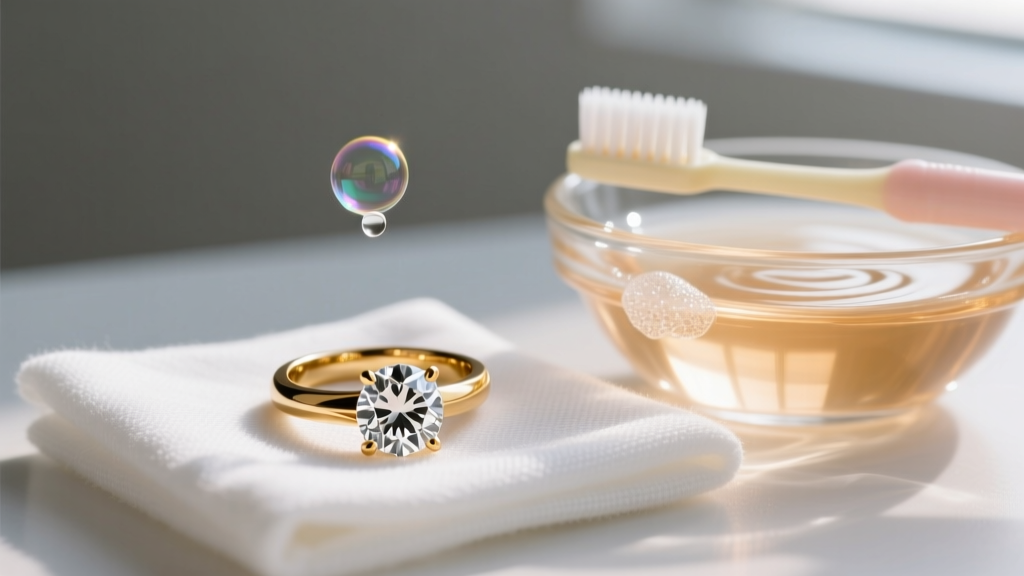
- Prepare the Bath: Mix three parts warm (not hot) distilled water with one part pH-neutral dish soap in a small glass bowl. Allow the water to sit for a minute to ensure the soap is fully dispersed.
- Soak Briefly: Submerge your affordable diamond jewelry for 10 to 15 minutes. This loosens the sebum, dead skin cells, and cosmetic residues that cling to the diamond's girdle and setting.
- Agitate Gently: Using a brand-new, extra-soft baby toothbrush, gently sweep the bristles across the stone. Pay special attention to the pavilion and the culet (the bottom point), where grease accumulates most heavily.
- Rinse and Dry: Rinse the piece under a gentle stream of distilled water. Pat dry with a lint-free microfiber cloth, avoiding paper towels, which can leave microscopic wood fibers trapped in the prongs.
Dangerous Cleaning Methods to Avoid at All Costs
When maintaining affordable diamond jewelry, knowing what not to do is just as critical as knowing the proper cleaning steps. Budget-friendly pieces are highly susceptible to the following common cleaning hazards:
- Ultrasonic Cleaners: These devices use high-frequency sound waves (typically 20-40 kHz) to create microscopic cavitation bubbles that implode, blasting away dirt. While great for solid platinum and high-clarity diamonds, ultrasonic vibrations can easily shake loose stones from worn cast prongs. More dangerously, if your affordable diamond is fracture-filled (often using the Yehuda process), the violent vibrations can shatter the stone or dislodge the glass-like filler.
- Steam Cleaners: Steam cleaning exposes jewelry to rapid, extreme temperature changes. Diamonds with surface-reaching inclusions (common in I1 clarity stones) can experience thermal shock, causing internal feathers to expand and split the stone entirely.
- Chlorine Bleach: Affordable jewelry frequently utilizes 10k or 14k gold, which contains high percentages of alloy metals like copper, zinc, and silver. Chlorine reacts aggressively with these alloys, causing stress corrosion cracking that can make your prongs brittle and snap without warning.
Compatibility Matrix: Cleaning Methods by Stone Treatment
Not all affordable diamonds are created equal. Use this matrix to determine which cleaning methods are safe based on your specific stone's characteristics. The American Gem Society (AGS) strongly recommends verifying your diamond's treatment status before attempting any deep cleaning.
| Diamond Type / Clarity | Manual Soap & Water | Ultrasonic Cleaner | Steam Cleaner | Commercial Ammonia Dips |
|---|---|---|---|---|
| Untreated (VS/SI Clarity) | Safe | Safe (if prongs are tight) | Safe | Safe |
| Untreated (I1/I2 Clarity) | Safe | Unsafe (vibration risk) | Unsafe (thermal shock) | Use with caution |
| Fracture-Filled | Safe | Highly Unsafe | Highly Unsafe | Highly Unsafe |
| Laser-Drilled | Safe | Safe | Safe | Safe |
| HPHT Color-Treated | Safe | Safe | Safe | Safe |
Prong and Setting Maintenance for Thinner Metals
To keep costs down, manufacturers of affordable diamond jewelry often use cast settings rather than die-struck or hand-forged ones. Cast gold is inherently more porous and slightly more brittle. Furthermore, the prongs on budget-friendly solitaire or halo rings are often milled thinner (sometimes under 1.2mm) to maximize the visible face-up size of the diamond while minimizing metal weight.
Expert Insight: Thinner, cast prongs wear down up to 30% faster than thick, hand-tipped wire prongs. If you wear your affordable diamond ring daily, you must inspect the prongs with a 10x jeweler's loupe every three months. Look for flattened tips, pitting, or any visible gap between the metal and the diamond's girdle.
If you notice a prong catching on your clothing, do not attempt to push it back into place with your fingers or household tools. The porosity of cast gold means it can snap if bent back and forth. Take it to a professional jeweler for a simple prong retipping or tightening, which typically costs between $25 and $50.
Storage and Environmental Hazards
Maintenance extends beyond cleaning; how you store and wear your affordable diamond jewelry dictates its long-term survival. Diamonds rank a 10 on the Mohs scale of hardness, meaning they can only be scratched by another diamond. However, they possess perfect cleavage planes, making them vulnerable to chipping if struck at the right angle.
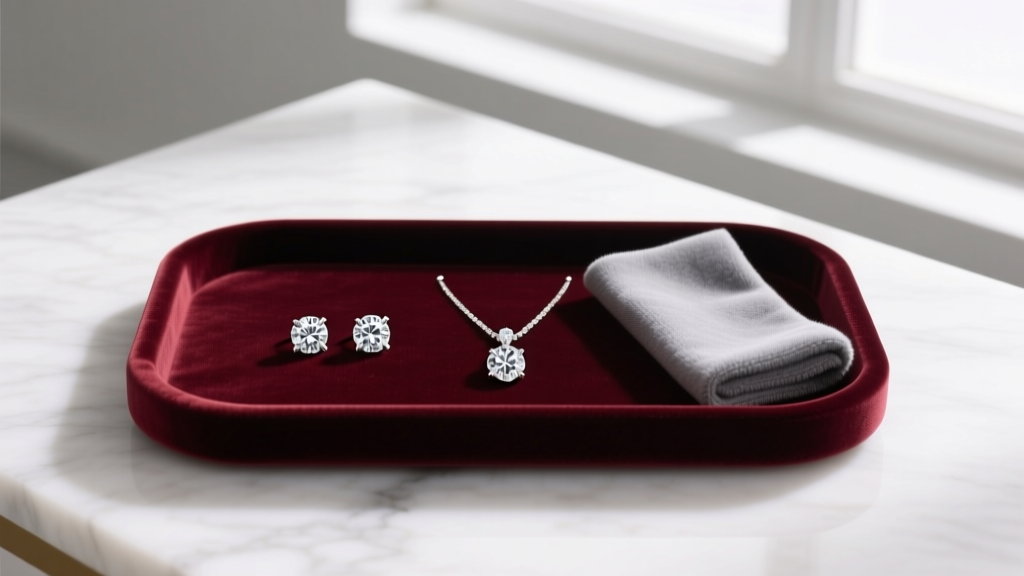
Never toss multiple pieces of diamond jewelry into a single drawer or pouch. The diamonds will scratch the gold or silver settings of neighboring pieces, and the impact can chip the girdles of the stones. Store each piece individually in a soft, anti-tarnish flannel pouch or a lined jewelry box with dedicated compartments.
Environmentally, lotions, sunscreens, and hairsprays are the enemies of diamond brilliance. These products contain lipids and polymers that create a microscopic film over the diamond's facets. Because diamonds are naturally lipophilic (oil-attracting), this film adheres stubbornly to the stone, reducing its light return and fire by up to 40%. Always put your jewelry on after applying cosmetics and styling products.
When to Seek Professional Maintenance
While manual home cleaning is perfect for weekly maintenance, affordable diamond jewelry requires professional attention at least once a year. If your piece features a white gold setting, the rhodium plating will inevitably wear thin, revealing the slightly yellowish underlying alloy. A jeweler can re-plate the setting (usually for $40-$75) to restore its bright, reflective white finish.
Additionally, a professional will use a microscope to check the structural integrity of the cast prongs, the security of any micro-pave accent stones, and the condition of the ring's shank. By combining meticulous at-home care with annual professional inspections, you can ensure that your affordable diamond jewelry remains secure, brilliant, and beautiful for a lifetime.