New York Jewelers Chicago Wabash Avenue Reviews: Diamond Jewelry
An expert technical review of New York Jewelers on Chicago's Wabash Avenue, analyzing diamond certifications, custom bench work, and pricing.


Chicago’s historic Jewelers Row, anchored heavily along Wabash Avenue and Washington Street, remains one of the most concentrated hubs of diamond trading and custom jewelry manufacturing in the Midwest. Among the legacy establishments, New York Jewelers of Chicago frequently surfaces in consumer discussions. However, sifting through standard New York Jewelers Chicago Wabash Avenue reviews diamond jewelry discussions often yields superficial feedback focused on customer service or store ambiance. As domain experts, we look past the retail polish to evaluate the technical realities of their diamond inventory, metallurgical bench work, and pricing structures in 2026.
When investing in high-carat weight or precision-cut diamonds, the difference between a legacy brick-and-mortar experience and an online vendor lies in the technical execution of the setting and the verifiable metrics of the stone. This deep dive analyzes what you are actually paying for when you walk into a Wabash Avenue establishment.
Decoding Diamond Certifications on Jewelers Row
A common pitfall for buyers navigating Wabash Avenue is accepting a diamond based solely on the seller's verbal grading or outdated in-house certificates. At legacy stores like New York Jewelers, you will encounter a mix of modern GIA (Gemological Institute of America) dossiers and older AGS (American Gem Society) reports. Following the GIA's acquisition of AGS Laboratories, the grading landscape has shifted. According to the GIA's official reporting guidelines, a full Diamond Grading Report is essential for stones over 1.00 carat to verify plot diagrams of inclusions.
Cut Precision and Light Performance Metrics
Do not settle for a generic "Excellent" cut grade. When evaluating round brilliants at Wabash Avenue jewelers, demand the Sarine Light Performance report or verify the exact proportions on the GIA report. For a true super-ideal cut, you should be looking for:
- Table Percentage: 53% to 57%
- Total Depth: 59.5% to 62.0%
- Crown Angle: 34.0 to 35.0 degrees
- Pavilion Angle: 40.6 to 41.0 degrees
Many Wabash Avenue reviews note that sales staff may push stones with thicker girdles or 36.5-degree crown angles that technically score "Excellent" on the GIA scale but leak light at the edges. Always inspect the stone with an ASET (Angular Spectrum Evaluation Tool) to confirm red light return across the entire table.

Technical Analysis of Custom Bench Work
The primary advantage of purchasing from a Wabash Avenue legacy jeweler over an online mega-retailer is access to on-site master jewelers. New York Jewelers is known for its custom design capabilities, but buyers must understand the metallurgical differences in how settings are manufactured. The durability of your diamond jewelry relies entirely on the alloy composition and the fabrication method.
Casting vs. Hand-Forging: A Metallurgical Comparison
Many negative reviews regarding prong wear or stone loss stem from a misunderstanding of casting porosity. Below is a technical breakdown of the setting methods you should discuss with the bench jeweler:
| Fabrication Method | Metal Alloy Standard | Technical Pros & Cons |
|---|---|---|
| CAD/CAM Casting | Pt950 / Ruthenium | Pros: High hardness, excellent for complex micro-pavé. Cons: Susceptible to microscopic porosity if not cast under vacuum; requires rhodium plating if white gold. |
| Hand-Forged / Die Struck | Pt900 / Iridium or 18k White (Palladium) | Pros: Work-hardened metal; denser molecular structure; prongs are significantly more resistant to bending. Cons: Higher labor cost; limited to simpler, classic solitaire or three-stone designs. |
When reading New York Jewelers Chicago Wabash Avenue reviews diamond jewelry enthusiasts often praise the store's ability to recreate vintage settings. If you are commissioning an antique-style milgrain setting, ensure the jeweler is using Pt950/Ruthenium. This alloy provides the necessary tensile strength to hold crisp milgrain edges without wearing smooth within the first two years of daily wear.
Prong Dimensions and Security
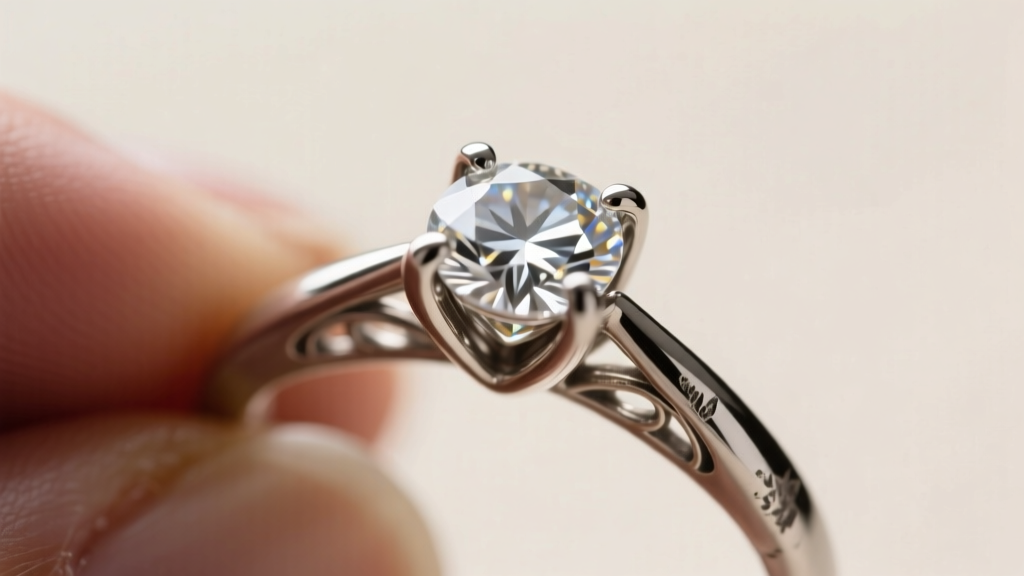
For a 2.00-carat round or cushion cut diamond, standard commercial prongs are often poured at 1.0mm, which is dangerously thin for long-term security. A reputable Wabash Avenue bench jeweler should be cutting and shaping prongs at a minimum of 1.3mm to 1.5mm thickness at the base, tapering elegantly to a 1.2mm tip over the girdle. Always ask to measure the gallery wire (the metal ring connecting the prongs beneath the stone); it should be at least 1.8mm thick to prevent the setting from warping if the ring is squeezed.
Pricing Transparency and the Wabash Premium
A recurring theme in local reviews is the pricing delta between Chicago's Jewelers Row and online competitors. It is vital to understand the economics of legacy diamond trading. Stores on Wabash Avenue operate with significant overhead, including secure vaulting, on-site master bench jewelers, and physical inventory holding costs.
The Rapaport Reality Check
Diamond pricing is heavily influenced by the Rapaport Price List, a wholesale benchmark used by the trade. According to industry data tracked by Rapaport, a 1.50-carat, G-color, VS1-clarity diamond with Excellent cut and no fluorescence will carry a specific wholesale baseline. Online vendors typically sell at a 10% to 15% markup over this baseline. Legacy brick-and-mortar stores like those on Wabash Avenue generally operate at a 25% to 40% markup.
However, this premium is not purely arbitrary. It buys you the following technical advantages:
- Physical Verification: The ability to compare three identical GIA grades side-by-side under controlled D65 daylight-equivalent lighting to detect brown or green undertones not listed on the certificate.
- Post-Sale Bench Support: Free lifetime rhodium plating, prong re-tipping, and ultrasonic cleaning, which online vendors cannot provide without expensive shipping and insurance loops.
- Custom Integration: Immediate CAD modifications and wax-model approvals before the final casting.
Actionable Negotiation Framework
If you decide to purchase from New York Jewelers or a neighboring Wabash Avenue establishment, approach the transaction with technical leverage. Do not negotiate on the total retail price; negotiate on the wholesale metrics and bench labor.
- Request the Rap Discount: Ask the dealer what discount off the Rapaport list they are offering for the specific GIA certificate number. A fair in-store discount for high-quality stones in 2026 is typically 15% to 20% off Rap.
- Itemize the Setting: Ask for the diamond price and the mounting price to be separated. Legacy stores often inflate the mounting cost. You can negotiate the custom CAD and casting labor down significantly if you are paying full market rate for the center stone.
- Leverage Competing Certs: If the store is pushing an IGI-certified lab-grown diamond, use the aggressive 2026 lab-grown market deflation to your advantage. Lab-grown wholesale prices have dropped drastically; ensure the store's pricing reflects current market realities, not 2022 peaks.
Final Expert Verdict
When analyzing New York Jewelers Chicago Wabash Avenue reviews diamond jewelry buyers must separate emotional retail experiences from technical deliverables. The true value of shopping on Wabash Avenue lies not in beating internet prices on a loose stone, but in the metallurgical expertise of the custom bench work and the ability to physically verify light performance. By demanding precise cut metrics, specifying work-hardened platinum alloys, and understanding the Rapaport wholesale baseline, you can leverage the historic expertise of Chicago's Jewelers Row to secure a technically flawless piece of diamond jewelry.


