Best Jewelry Cleaner for Moissanite: Style & Care Guide
Discover the best jewelry cleaner for moissanite to maintain its icy sparkle. Expert tips on ultrasonic, steam, and eco-friendly care solutions.

In the evolving landscape of fine jewelry, moissanite has cemented its status as the premier diamond alternative. With a refractive index of 2.65—significantly higher than a diamond's 2.42—moissanite delivers an unmatched 'crushed ice' brilliance and fiery dispersion. However, maintaining that signature icy aesthetic requires more than a quick wipe with a cloth. As modern beauty routines increasingly rely on heavy silicones, ceramides, and mineral sunscreens, finding the right jewelry cleaner for moissanite has become a critical component of jewelry care and style preservation.
This guide dives deep into the material science of moissanite, analyzes current cleaning trends, and provides actionable frameworks to keep your stones optically flawless without compromising your precious metal settings.
The Science of Moissanite and Modern Skincare Buildup
To understand why moissanite requires specific cleaning protocols, we must look at its surface chemistry. According to the Gemological Institute of America (GIA), moissanite (silicon carbide) is exceptionally hard, ranking at 9.25 on the Mohs scale. While this makes it highly resistant to scratching, its surface tension properties make it distinctly lipophilic (oil-attracting).
In 2026, the 'skin-care first' beauty trend means our hands are frequently coated in dimethicone (a common silicone primer), zinc oxide (mineral SPF), and heavy lipid barriers. These compounds easily migrate to the pavilion (underside) of your moissanite ring. Because moissanite's brilliance relies on light entering the crown, bouncing off the pavilion facets, and returning to the eye, even a microscopic layer of silicone will cause total internal reflection to fail, resulting in a cloudy, dull appearance.
Evaluating the Best Jewelry Cleaner for Moissanite
Not all cleaning methods are created equal. The ideal jewelry cleaner for moissanite must effectively break down complex lipid and silicone bonds without degrading the alloy of your setting (typically 14k/18k gold or platinum). Below is a comparative analysis of the top cleaning methodologies.
| Cleaning Method | Active Mechanism | Efficacy on Silicones/Oils | Setting Safety (Pavé/Prong) |
|---|---|---|---|
| Ultrasonic (45 kHz) | Cavitation bubbles | Excellent | High (Gentle frequency) |
| Steam Cleaning | Thermal shock & pressure | Good (Struggles with heavy waxes) | Moderate (Risk to porous accents) |
| Enzymatic/Bio-Cleaners | Protein & lipid breakdown | Excellent | Very High (Zero mechanical stress) |
| Ammonia-Based Liquids | Chemical degreasing | Good | Low (Degrades gold alloys over time) |
Trend Analysis: The Shift to Enzymatic and Bio-Cleaners
Historically, harsh ammonia-based solutions were the industry standard for degreasing diamonds and diamond alternatives. However, a major style and care trend has emerged: the pivot toward non-toxic, enzymatic jewelry cleaners.
Why Enzymes are Winning
Plant-based enzymatic cleaners utilize lipase enzymes, which specifically target and break down the lipid bonds in skincare residues and sebum. Unlike ammonia, which can cause micro-porosity in 14k and 18k gold alloys over years of repeated use, enzymatic solutions operate at a neutral pH (7.0-8.0). This makes them the safest, most effective jewelry cleaner for moissanite rings featuring intricate pavé halos or delicate milgrain detailing, as they dissolve the 'glue-like' silicone buildup without vibrating the stones loose.
Setting Metals Matter: Gold vs. Platinum Care
When selecting a cleaner, the stone is only half the equation. The metal holding your 9.25 Mohs moissanite requires equal consideration. The Jewelers of America emphasizes that metal porosity and alloy composition dictate chemical compatibility.
- Platinum: Dense and highly durable. Platinum can withstand ultrasonic cleaners (40-45 kHz) and high-heat steam cleaners without issue. It does not tarnish, making simple degreasing sufficient.
- 14k & 18k Yellow/Rose Gold: Alloyed with copper, silver, and zinc. These metals are susceptible to chemical oxidation. Avoid chlorine-based cleaners or harsh abrasives, which will strip the rhodium plating on white gold and cause micro-scratching on yellow/rose gold.
- White Gold: Requires rhodium plating to maintain its bright white color. Frequent use of abrasive pastes or aggressive ultrasonic cycles can accelerate the wearing of this microscopic plating layer, revealing the yellowish alloy beneath.
The Ultimate Weekly Maintenance Routine
To maintain the trending 'icy' aesthetic, passive cleaning isn't enough. Implement this structured, bi-weekly maintenance routine to ensure optimal light return.
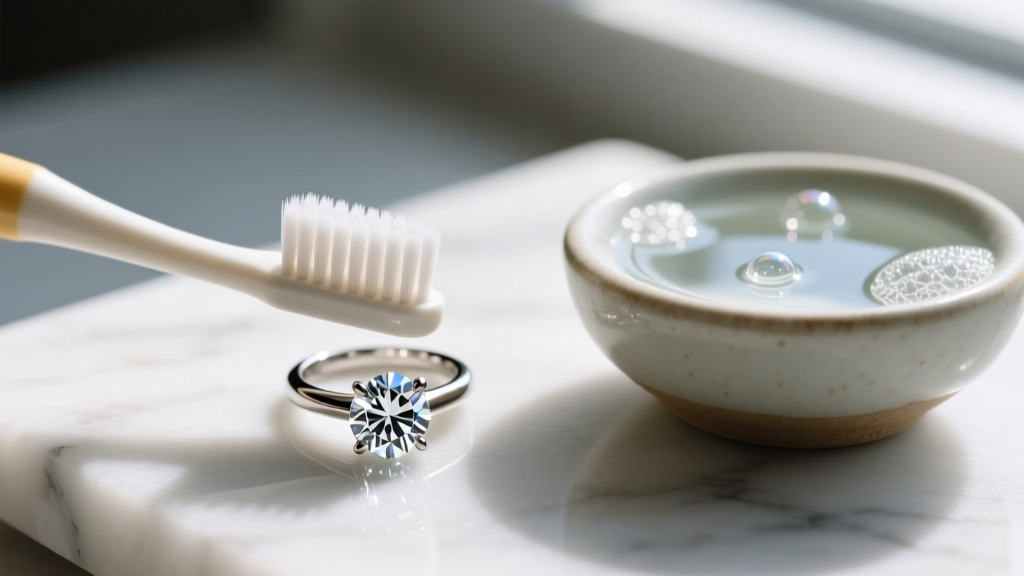
- The Pre-Soak: Fill a small ceramic bowl with warm water (not hot) and two drops of pH-neutral, phosphate-free dish soap (avoid moisturizing soaps containing lanolin). Let the ring soak for exactly 10 minutes to soften hardened sebum and dimethicone.
- The Pavilion Scrub: Using a dedicated, ultra-soft baby toothbrush (never a medium or hard brush), gently agitate the pavilion underside. Focus on the culet and the gallery wire where oils pool.
- The Rinse: Rinse under a gentle stream of lukewarm distilled water. Distilled water prevents hard water mineral deposits (calcium and magnesium) from spotting the stone as it dries.
- The Dry: Do not air dry. Use a lint-free microfiber cloth or a blast of compressed air to remove moisture from beneath the gallery. Air drying leaves microscopic water spots that mimic cloudiness.
Ingredients to Avoid at All Costs
The internet is rife with DIY jewelry cleaning 'hacks' that can permanently damage your setting or degrade the optical clarity of your stone's environment. Avoid these common culprits:
- Baking Soda & Toothpaste: Both are highly abrasive. While moissanite at 9.25 Mohs won't easily scratch, your 14k gold or platinum prongs will. Over time, this creates micro-grooves in the metal, weakening the structural integrity of the prong and increasing the risk of stone loss.
- Chlorine Bleach: Never wear or clean your ring in chlorinated pools or with household bleach. Chlorine reacts violently with the copper and zinc alloys in gold, causing 'stress corrosion cracking' that can snap a prong cleanly off.
- Alcohol & Hand Sanitizer: While alcohol cuts grease, frequent exposure dries out the natural oils in your skin and can leave a filmy residue on the stone. It also accelerates the degradation of certain jewelry adhesives used in tension or bezel settings.
Expert Takeaway: The best jewelry cleaner for moissanite isn't just about the stone; it's about preserving the entire ecosystem of the ring. By shifting away from harsh ammonia and embracing 45 kHz ultrasonic technology or pH-neutral enzymatic soaks, you protect both the 2.65 refractive brilliance of the silicon carbide and the structural integrity of your precious metal setting.
Ultimately, treating your moissanite with the same rigorous, science-backed care as a high-clarity natural diamond ensures that your jewelry remains a flawless reflection of modern style and enduring elegance.


