Diamond Dust Jewelry: Material Properties & Comparison Guide
Explore the material properties of diamond dust jewelry. Compare infused resin, sintered matrices, and traditional melee for durability and sparkle.

The Truth About "Diamond Dust" in Modern Jewelry
When consumers search for diamond dust jewelry, they are often met with a confusing array of products ranging from $20 epoxy pendants to $2,000 textured gold bands. As a gemological and materials science concept, "diamond dust" occupies a highly misunderstood space in the jewelry industry. To make an informed purchase, one must separate literal diamond carbon inclusions from clever marketing terminology.
True diamond dust consists of microscopic diamond particles—often the byproduct of industrial cutting, polishing, or lab-grown diamond synthesis. Because these particles lack the faceted geometry required to reflect light, they behave entirely differently than traditional diamond melee. Furthermore, the term is frequently hijacked by metalworkers to describe a specific texturing technique that contains zero actual diamond material.
This guide deconstructs the material properties, optical physics, and real-world durability of diamond dust jewelry, comparing infused matrices, sintered composites, and traditional pavé alternatives.
Material Matrix 1: Resin and Glass Infusions
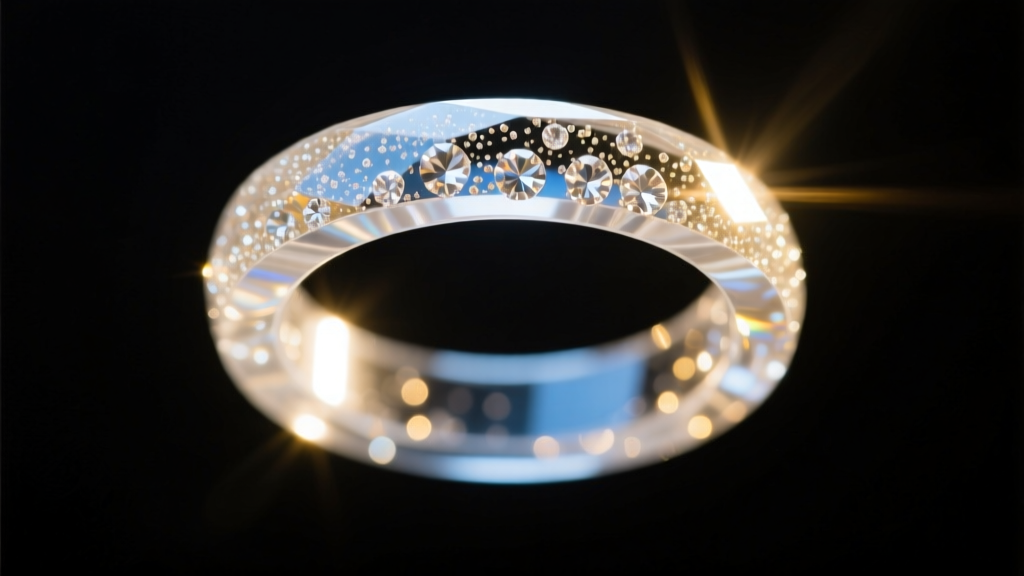
The most common and affordable iteration of literal diamond dust jewelry involves suspending micro-diamond grit (typically 100 to 400 mesh size) inside a transparent polymer resin or borosilicate glass matrix. This approach is popular in artisan and commemorative jewelry, often marketed as containing "authentic diamond remnants."
Optical Properties and Refractive Limitations
From a gemological perspective, suspending diamond dust in resin creates a severe optical mismatch. According to the Gemological Institute of America (GIA), a faceted diamond owes its brilliance to its high Refractive Index (RI) of 2.417, which allows for total internal reflection. Epoxy and polyurethane resins, however, possess an RI of roughly 1.50 to 1.55.
When light enters the resin and hits the microscopic, unfaceted diamond dust, it cannot undergo total internal reflection. Instead, the light scatters or passes straight through the carbon particles. The result is a piece of jewelry that sparkles superficially like glitter, but entirely lacks the "fire" and scintillation of a solid gemstone. The diamond dust acts merely as a high-hardness reflective aggregate rather than a true optical gem.
Polymer Degradation and UV Stability
The primary vulnerability of resin-based diamond dust jewelry is the polymer matrix itself. Standard epoxies are highly susceptible to ultraviolet (UV) degradation. Over 12 to 24 months of daily wear, the resin will undergo photo-oxidation, resulting in a yellowish tint that severely mutes the visual contrast of the diamond inclusions. High-end manufacturers mitigate this by using UV-stabilized polyurethanes or optically clear silicones, but these materials remain inherently soft, scoring a mere 2.0 to 3.0 on the Mohs hardness scale, making them prone to micro-scratches that cloud the surface.
Material Matrix 2: Sintered Diamond Powder in Metal Alloys
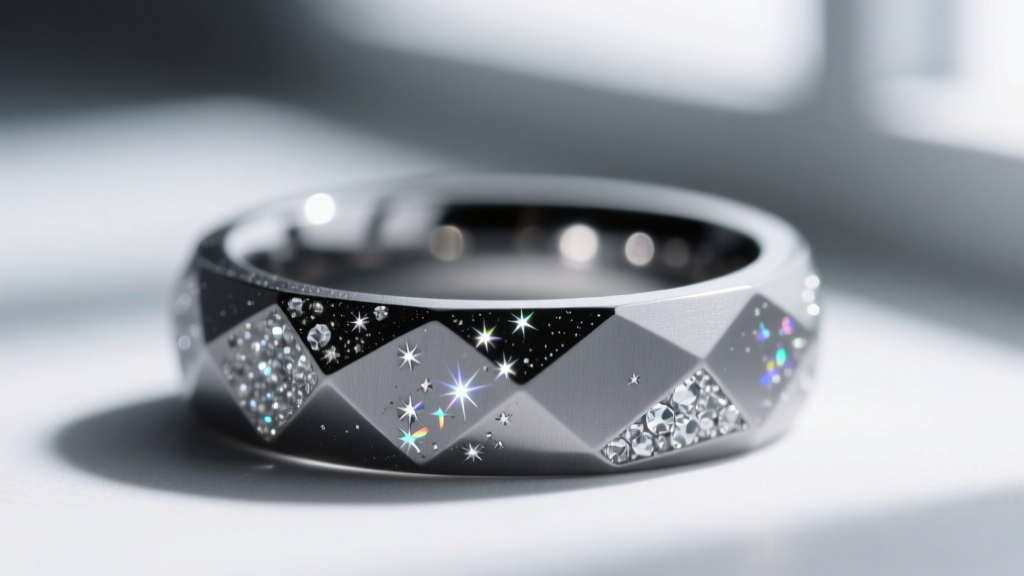
A more advanced, albeit rarer, application of diamond dust jewelry involves powder metallurgy. In this process, diamond grit is mixed with metal powders (such as titanium, tungsten carbide, or specialized bronze alloys) and subjected to heat and pressure to create a solid composite.
The Thermal Graphitization Challenge
Creating sintered diamond dust jewelry is a metallurgical tightrope. Diamond is a metastable allotrope of carbon; when exposed to temperatures exceeding 700°C in the presence of oxygen, it rapidly oxidizes. Even in an inert argon atmosphere, diamond begins to graphitize (convert to soft, opaque graphite) at the high temperatures required to melt and sinter precious metals like gold or platinum.
Therefore, genuine sintered diamond jewelry is almost exclusively limited to base metals or specialized low-temperature metal clays. The diamond dust in these pieces does not sparkle brightly; instead, it provides a localized, matte-grey micro-texture that catches the light subtly. It is prized by avant-garde jewelry designers for its industrial aesthetic and extreme surface hardness, rather than traditional brilliance.
The "Diamond Dust Finish" Misnomer: Textured Metals
If you encounter a solid gold or silver ring marketed with a "diamond dust finish," it is critical to understand that there is no diamond in the jewelry. This is a widespread industry misnomer.
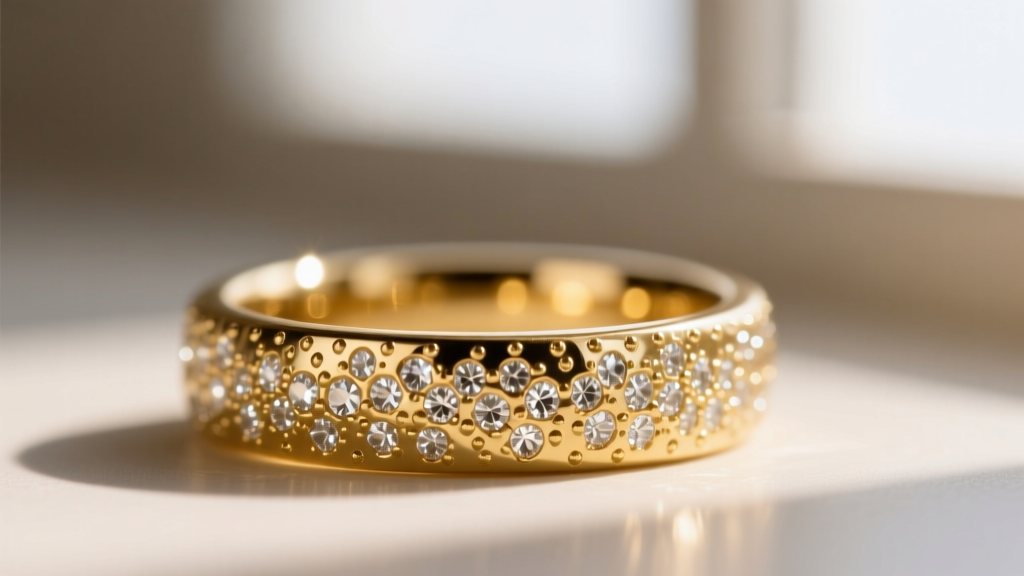
A diamond dust finish is actually a physical metal texturing technique. Jewelers use specialized sandblasting media, laser etching, or a diamond-tipped bur to aggressively stipple the surface of the metal. This creates thousands of microscopic, jagged craters that reflect light from multiple angles, mimicking the chaotic sparkle of crushed stones. While this technique provides a beautiful, high-shimmer effect without the cost of gemstones, it is purely a surface treatment on the metal alloy. Suppliers like Rio Grande provide the specialized abrasive media used to achieve this effect, which relies entirely on the hardness of the blasting media, not the inclusion of diamond dust.
Comparative Data: Durability, Mohs Hardness, and Pricing
To contextualize the material differences, the following table compares the physical properties and market positioning of resin-infused dust, sintered composites, the metal finish misnomer, and traditional diamond melee pavé.
| Material / Technique | Mohs Hardness | Refractive Index (RI) | Avg. Price Range | Primary Failure Mode |
|---|---|---|---|---|
| Resin-Infused Dust | 2.0 - 3.0 (Matrix) | 1.50 (Matrix) | $30 - $150 | UV Yellowing & Surface Scratching |
| Sintered Metal Matrix | 7.0 - 9.0 (Matrix) | N/A (Opaque Metal) | $150 - $500 | Oxidation & Graphitization |
| Diamond Dust Finish | 2.5 - 5.0 (Metal) | N/A (Metallic Luster) | $300 - $1,200 | Texture Flattening from Friction |
| Traditional Melee Pavé | 10.0 (Diamond) | 2.417 | $800 - $3,000+ | Prong Wear & Stone Loss |
Expert Insight: While diamond dust (the carbon material) is a 10 on the Mohs scale, its utility in jewelry is entirely bottlenecked by the matrix holding it. A diamond is only as durable as the resin or metal that secures it.
Care and Degradation: Real-World Failure Modes
Caring for diamond dust jewelry requires strict adherence to material-specific protocols. The most common mistake consumers make is treating resin or sintered pieces with the same aggressive cleaning methods used for traditional diamond jewelry.
- Ultrasonic Cleaners: Never place resin-infused diamond dust jewelry in an ultrasonic cleaner. The high-frequency cavitation bubbles will cause micro-fractures in the polymer, leading to cloudiness and eventual structural delamination of the diamond particles.
- Thermal Shock: Sintered diamond-metal composites are highly sensitive to thermal shock. Exposing the ring to boiling water or steam cleaning can cause the metal matrix to expand at a different rate than the diamond inclusions, resulting in "pop-outs" where the diamond dust is ejected from the surface.
- Abrasive Polishing: If your "diamond dust finish" gold band loses its sparkle over time, it is because the sharp peaks of the stippled metal have been worn flat by friction against clothing and skin. This cannot be fixed with a polishing cloth; it requires a jeweler to re-apply the abrasive blasting treatment.
Expert Verdict: When to Choose Diamond Dust Alternatives
If your goal is to achieve maximum optical brilliance, light return, and generational durability, literal diamond dust jewelry—whether in resin or sintered metal—will fall short. The physics of unfaceted carbon particles simply cannot replicate the scintillation of a precision-cut gemstone. For heirloom-quality brilliance, traditional diamond melee set in platinum or 18k gold remains the undisputed standard.
However, if you are seeking an avant-garde, industrial aesthetic, or a deeply sentimental piece (such as resin jewelry incorporating dust from a specific lab-grown origin), infused diamond dust offers a unique, highly textured alternative. Just ensure you are buying from a transparent manufacturer who clearly discloses the exact polymer or metal matrix used, and always adapt your care routine to protect the binding material rather than the diamond itself.