Raw Diamond Jewelry: Properties, Durability & Alternatives Compared
Explore the physical properties, setting requirements, and market pricing of raw diamond jewelry compared to uncut moissanite and sapphire alternatives.

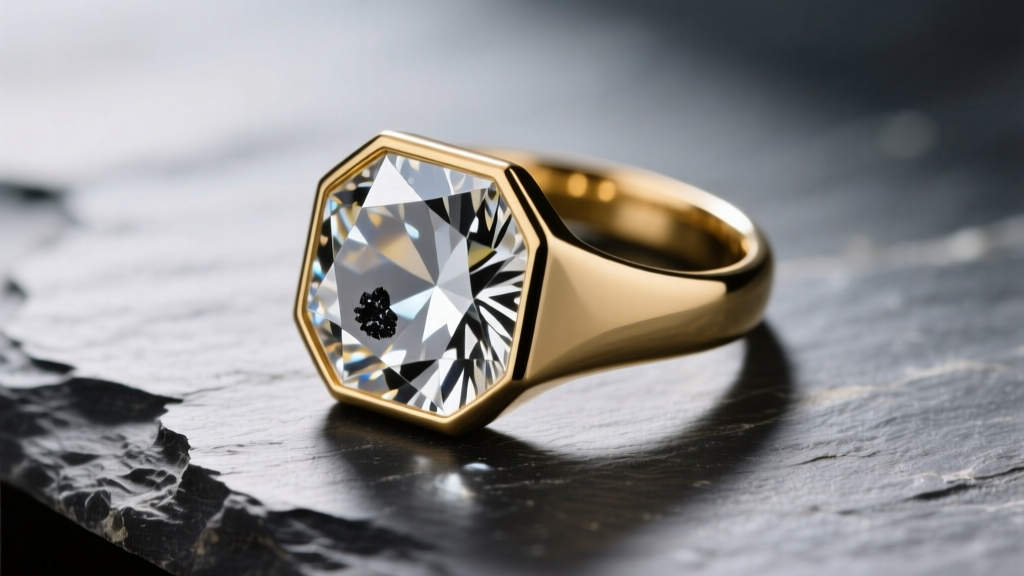
The Crystallography of Raw Diamond Jewelry
When consumers transition from traditional faceted gems to raw diamond jewelry, they are interacting with carbon in its purest geological form. Unlike polished diamonds, which are cut to maximize light return, raw diamonds retain their natural crystal habit. According to the Mindat Mineral Database, the most common natural crystal form for a diamond is the octahedron—a shape resembling two four-sided pyramids joined at their bases. However, jewelers also frequently work with macle twins (flattened, triangular twinned crystals) and dodecahedral forms.
Understanding this crystallography is not merely an academic exercise; it is critical for durability. While diamonds rank as a 10 on the Mohs scale of mineral hardness—meaning they are virtually immune to scratching—they possess perfect octahedral cleavage. This means that if a raw diamond is struck sharply along one of its natural cleavage planes, it can chip, fracture, or even split entirely in half. This inherent structural vulnerability dictates everything from how the stone must be set to how it should be worn daily.
Optical Properties: The Reality of Uncut Stones
A common misconception among first-time buyers is that raw diamond jewelry will exhibit the same brilliance and fire as a faceted stone. In reality, the optical properties of an uncut diamond are vastly different. Brilliance (white light return) and fire (the dispersion of light into spectral colors) in a polished diamond are the direct results of precise mathematical faceting, specifically the pavilion angles that force total internal reflection.
Because raw diamonds lack these engineered facets, light enters the stone and simply passes through or scatters internally, often resulting in a translucent, icy, or slightly matte appearance rather than a sparkling one. Inclusions, which are typically cut away or hidden in polished stones, remain fully visible in raw diamonds. Black carbon inclusions, internal fractures (feathers), and mineral crystals trapped inside the diamond are celebrated as unique 'fingerprints' of the earth, but they do reduce the stone's overall transparency and structural integrity.
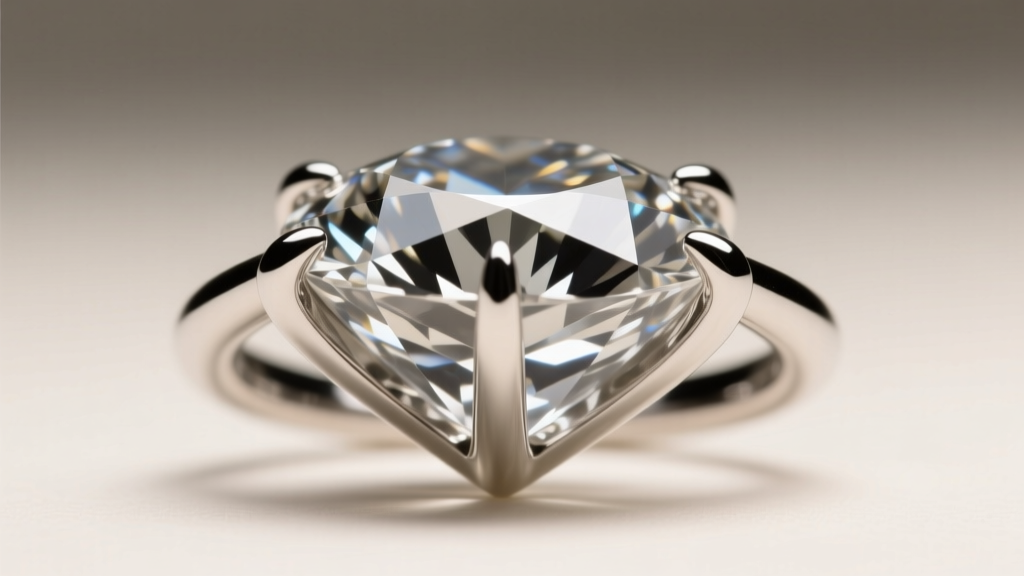
Material Comparison: Raw Diamond vs. Uncut Alternatives
For buyers drawn to the organic, unrefined aesthetic of raw stones but seeking different optical properties or price points, uncut alternatives present viable options. Below is a technical comparison of raw diamond against two popular uncut alternatives: raw moissanite and uncut white sapphire.
| Property | Raw Diamond (Carbon) | Raw Moissanite (Silicon Carbide) | Uncut White Sapphire (Corundum) |
|---|---|---|---|
| Mohs Hardness | 10 | 9.25 | 9 |
| Cleavage / Fracture | Perfect Octahedral Cleavage (High Chip Risk) | Indistinct Cleavage (More Impact Resistant) | No True Cleavage (Parting only) |
| Refractive Index | 2.417 | 2.65 - 2.69 | 1.76 - 1.77 |
| Average Rough Price (Per Carat) | $150 - $400 (Commercial to Gem Grade) | $40 - $90 (Lab-Created Rough) | $80 - $200 (Natural Rough) |
| Thermal Conductivity | Extremely High | High (Mimics Diamond on Basic Testers) | Moderate |
Raw moissanite offers a higher refractive index, meaning even in its uncut state, it tends to exhibit more internal light bounce than a raw diamond. Furthermore, because lab-created raw moissanite lacks the perfect cleavage planes of natural diamond, it is structurally less prone to shattering upon impact. Uncut white sapphire, while softer, lacks cleavage entirely, making it highly resistant to chipping, though it will appear significantly more opaque and glassy than a raw diamond.
Setting Mechanics: Mitigating Cleavage Risks
Setting raw diamond jewelry requires specialized bench skills. Traditional tension settings, which rely on the compressive force of the metal band to hold a faceted stone by its girdle, are strictly prohibited for raw diamonds. The immense pressure combined with the stone's cleavage planes will almost certainly cause the diamond to fracture during the setting process or shortly after.
Instead, jewelers must utilize protective mounting techniques:
- Custom Bezel Settings: A heavy-gauge metal rim (minimum 0.8mm thickness) that completely encircles the equator of the raw crystal. This protects the vulnerable edges from lateral impacts.
- Cradle Prong Settings: If prongs are used, they must be thick (minimum 1.2mm gauge) and shaped to 'cradle' the natural indentations of the octahedral or macle habit. Standard V-prongs used for faceted princess cuts are ineffective here; the prongs must be hand-carved to map the specific topography of the individual rough stone.
- Flush/Gypsy Settings: Rarely used for true raw diamonds due to the depth of the natural crystal, but sometimes adapted for heavily flattened macle twins by carving a deep seat into the metal shank.
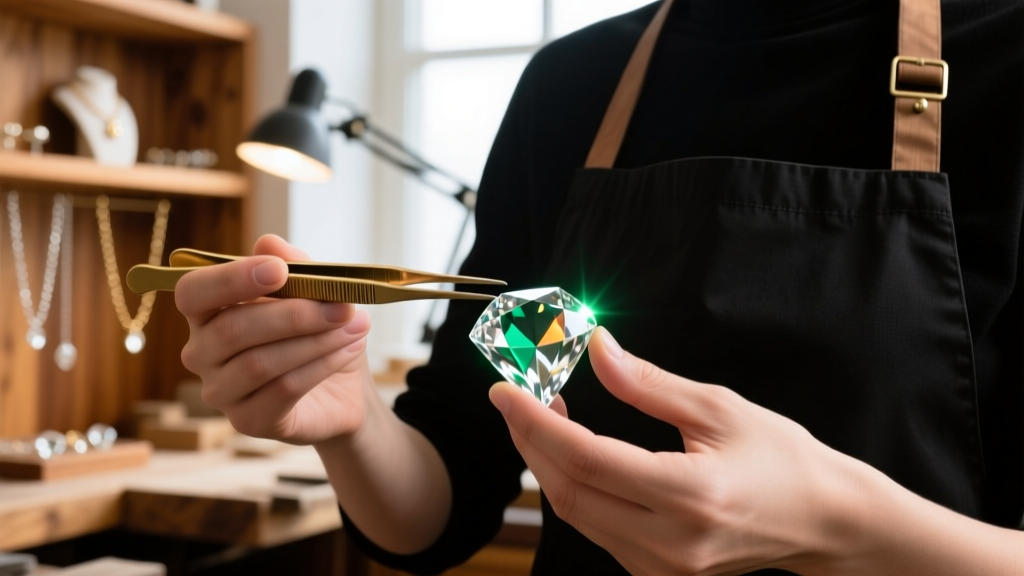
Authenticity Testing and Ethical Sourcing
Verifying the authenticity of raw diamond jewelry requires moving beyond basic visual inspection. Because raw diamonds lack the engineered brilliance of cut stones, visual identification is unreliable. According to the Gemological Institute of America (GIA), thermal conductivity testing remains the most reliable first step. Diamond testers measure how quickly heat passes through the stone; diamonds disperse heat faster than almost any other material.
However, because raw moissanite also exhibits high thermal conductivity, a secondary electrical conductivity test is mandatory. Moissanite is electrically conductive, whereas natural diamond is an electrical insulator (with the rare exception of Type IIb boron-rich blue diamonds). A dual-tester that checks both thermal and electrical properties will definitively separate raw diamond from raw moissanite.
Ethical sourcing is another paramount concern when purchasing raw diamonds. The rough diamond trade has historically been linked to conflict financing. Buyers must insist on stones that are fully compliant with the Kimberley Process Certification Scheme (KPCS). Furthermore, progressive jewelers in 2026 are increasingly utilizing blockchain traceability platforms (such as Tracr) that provide a digital ledger tracking the rough diamond from the specific mine of origin (e.g., Botswana, Canada, or Australia) directly to the retail setting, ensuring absolute supply chain transparency.
Care and Maintenance of Uncut Stones
The maintenance of raw diamond jewelry differs significantly from polished counterparts. While the stone itself will not scratch, the natural surface texture of a raw diamond—often featuring trigons (triangular growth pits) and rough ridges—acts as a magnet for oils, lotions, and environmental grit.
To clean raw diamond jewelry, avoid ultrasonic cleaners. The high-frequency vibrations can propagate existing internal fractures (feathers) within the rough stone, potentially causing it to split along a cleavage plane. Instead, use a soft-bristled brush (such as a baby toothbrush) with a mild solution of warm water and degreasing dish soap. Gently agitate the brush around the stone's natural crevices to dislodge trapped sebum and dirt. Rinse thoroughly and dry with a lint-free microfiber cloth, taking care not to snag the cloth on any sharp, unpolished crystal points that may protrude from the setting.