Jewelry with Amethyst for Men: Material & Property Guide
Discover the best jewelry with amethyst for men. Compare stone properties, metal pairings, durability grades, and cuts for everyday masculine wear.


When building a masculine jewelry collection, most men default to opaque, dark stones like onyx or lapis lazuli. However, jewelry with amethyst for men offers a striking alternative that balances historical prestige with genuine mineralogical durability. As a member of the macrocrystalline quartz family, amethyst provides a Mohs hardness of 7, making it highly viable for daily-wear rings, cufflinks, and heavy bracelets—provided the cut, setting, and metal pairing are chosen correctly.
This guide breaks down the exact material properties, structural failure modes, and grading metrics you need to know before investing in men's amethyst jewelry in 2026 and beyond.
The Mineralogy of Amethyst: Hardness, Toughness, and Cleavage
To understand how amethyst performs in a men's ring or bracelet, we must look past its color and examine its physical properties. According to the Gemological Institute of America (GIA), amethyst is a purple variety of quartz, colored by iron impurities and natural irradiation.
- Mohs Hardness: 7. This means it resists scratching from everyday dust (which contains quartz particles at hardness 7), but it will be scratched by topaz, corundum, or diamond.
- Toughness: Good. Unlike tanzanite or opal, amethyst does not easily chip from minor impacts.
- Cleavage: Indistinct. It lacks defined cleavage planes, meaning it fractures conchoidally (like glass) rather than splitting cleanly. This makes it safer for bezel and tension settings.
However, amethyst has a critical vulnerability: thermal and UV sensitivity. Prolonged exposure to direct sunlight or temperatures exceeding 300°C (572°F) can cause the purple color centers to degrade, fading the stone to a pale gray or altering it into yellow citrine. For men who work outdoors or with high-heat equipment, this is a vital consideration.
Amethyst vs. Traditional Men's Gemstones
How does amethyst stack up against the usual suspects in men's jewelry? The table below compares the physical properties and average market pricing for high-quality cabochon stones.
| Gemstone | Mohs Hardness | Toughness | Cleavage | Price per Carat (Cabochon) |
|---|---|---|---|---|
| Amethyst (Uruguayan) | 7 | Good | Indistinct | $15 - $40 |
| Black Onyx | 6.5 - 7 | Fair | None | $5 - $15 |
| Tiger's Eye | 7 | Good | None | $2 - $10 |
| Lapis Lazuli | 5 - 6 | Fair | None | $10 - $30 |
| Turquoise | 5 - 6 | Poor | Good | $20 - $50+ |
As the data shows, amethyst offers superior toughness compared to lapis lazuli and turquoise, making it far less likely to crack if dropped on a hard surface. While black onyx is a staple in men's signet rings, its brittle nature makes it prone to chipping at the girdle if struck against a steering wheel or desk edge.
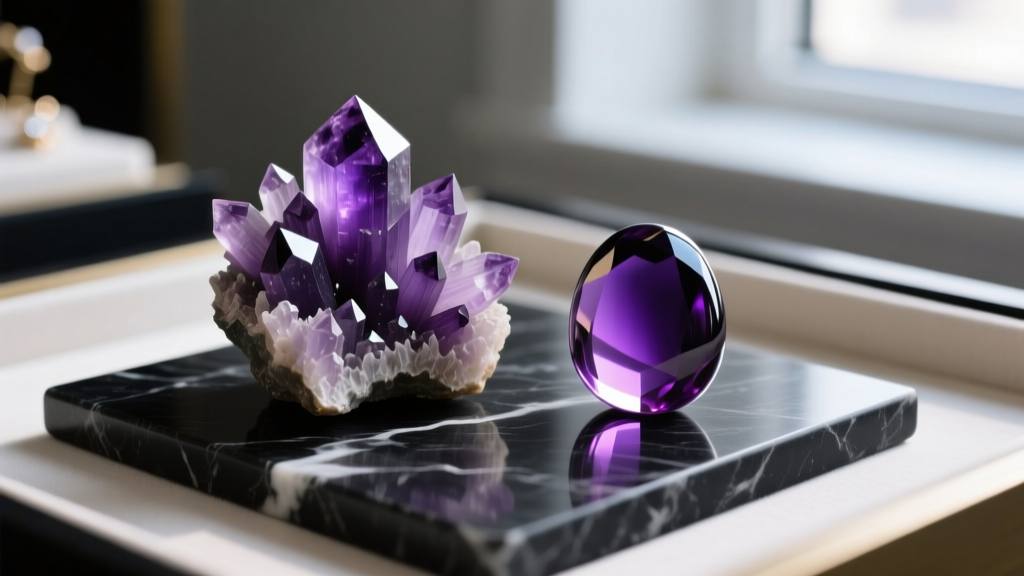
Cut and Finish: What Works for Men's Aesthetics
The way an amethyst is cut drastically alters both its visual weight and its structural integrity in men's jewelry.
Cabochon (Smooth Dome)
For active men, a high-dome or flat-top cabochon is the most practical choice. Because there are no sharp facet junctions, a cabochon is highly resistant to edge chipping. Furthermore, minor surface scratches that accumulate over years of wear are easily buffed out by a jeweler without losing the stone's overall geometry. Dark, heavily included amethyst cabochons also provide a subtle, understated look that pairs well with casual or rugged attire.
Faceted (Step or Brilliant Cut)
Faceted amethyst maximizes light return, showcasing the stone's deep purple saturation. However, step cuts (like emerald or baguette cuts) feature long, parallel facet lines and sharp corners that are vulnerable to chipping. If you prefer faceted jewelry with amethyst for men, opt for a cushion cut or a round brilliant, and ensure the corners are protected by heavy V-prongs or a full bezel setting.
Raw or Geode Slices
Raw, unpolished amethyst crystals set in electroformed copper or heavy silver are trendy in artisan circles. While visually striking, raw stones trap dirt, oils, and moisture in their natural crevices. They are best reserved for pendants or occasional-wear statement rings rather than daily drivers.
Metal Pairings and Structural Integrity
The metal you choose dictates both the color contrast and the security of the stone. For men's rings, look for a band thickness of at least 2.0mm to 2.5mm to prevent the shank from bending and popping the amethyst out of its setting.
- Oxidized Sterling Silver: The dark, gunmetal patina of oxidized silver creates a high-contrast, gothic aesthetic that makes deep purple amethyst pop. It is the most popular choice for men's signet and biker rings.
- Titanium and Tungsten: These aerospace-grade metals are virtually scratch-proof. Because they cannot be sized or easily repaired, amethyst stones in these metals are usually set using high-tension or permanent epoxy bezels. They are ideal for men in trades or engineering who need maximum impact resistance.
- Rose Gold (14k or 18k): The copper alloys in rose gold naturally complement the red undertones found in top-tier "Siberian" amethyst. This creates a warm, luxurious contrast suitable for formal cufflinks or dress rings.

Sourcing, Grading, and Avoiding Synthetics
Not all amethyst is created equal. According to mineralogical data from Mindat.org, the geographic origin heavily influences the color saturation and color zoning of the quartz.
Color Grades and Origins
The most prized amethyst features a deep, saturated purple with subtle red flashes (often called "Siberian" or "Deep Russian" purple, though most high-grade material today comes from Uruguay). Uruguayan amethyst tends to be darker and more consistent. Brazilian amethyst, while abundant and affordable, often exhibits visible color zoning (light and dark bands) and is generally lighter in tone.
The Synthetic Threat
Hydrothermal synthetic amethyst is prevalent in the mass-market jewelry space. As of 2026, lab-grown quartz has become nearly indistinguishable to the naked eye. Synthetics are chemically identical to natural stones but often lack natural inclusions (like "tiger stripe" liquid feathers or two-phase inclusions). Furthermore, synthetic quartz often exhibits "zebra stripe" color zoning under magnification. When buying high-end men's amethyst jewelry, always request a loupe inspection to look for natural mineral inclusions or opt for stones certified by reputable gemological labs.
Long-Term Care and Failure Modes
To ensure your amethyst jewelry lasts a lifetime, you must mitigate its specific failure modes:
- Prong Wear: If your ring uses standard prongs, have them checked every 12 months. Amethyst's hardness (7) means it will actually wear down soft metals like pure gold or low-karat silver over time, eventually loosening the grip on the stone.
- Ultrasonic and Steam Cleaners: While ultrasonic vibrations are generally safe for flawless natural amethyst, they can shatter stones that have internal liquid inclusions or micro-fractures. Furthermore, the intense heat of a steam cleaner can cause thermal shock, leading to conchoidal fracturing. Stick to warm water, mild dish soap, and a soft-bristled toothbrush.
- UV Fading: Never leave your amethyst ring on a dashboard or windowsill. Cumulative UV exposure will bleach the color centers over a period of years, turning a vibrant purple stone into a dull, grayish-lilac.
"Amethyst bridges the gap between the rugged durability of quartz and the regal aesthetics of precious gems. For men, the key to successful wear lies in choosing protective bezel or cabochon settings that honor the stone's physical limits while maximizing its bold color."
Whether you are selecting a heavy silver signet ring or a modern titanium bracelet, understanding the material properties of amethyst ensures your jewelry remains as striking on day one thousand as it was on day one.


