Tortoise Shell Jewelry: Authentication and Ethical Alternatives
An expert gemological guide to antique tortoise shell jewelry. Learn authentication techniques, CITES regulations, and premium ethical alternatives.

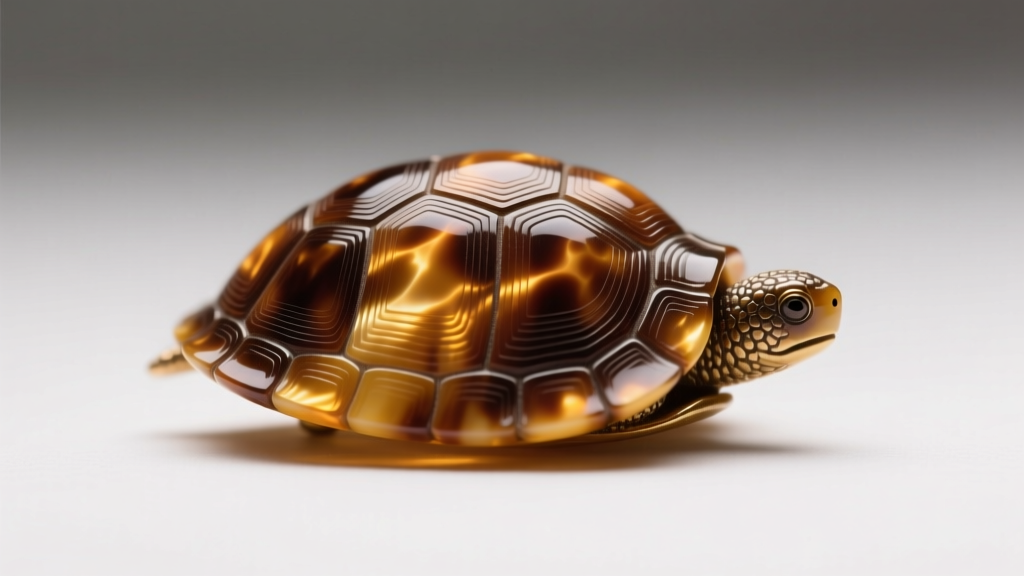
The Gemological Profile of Hawksbill Turtle Shell
Within the specialized field of organic gemology, few materials carry the historical weight and aesthetic allure of genuine tortoise shell. Unlike crystalline gemstones formed through geological pressure, tortoise shell is a biological polymer derived primarily from the hawksbill sea turtle (Eretmochelys imbricata). Classified alongside pearls, amber, and coral, this organic gem is composed almost entirely of keratin—the same structural protein found in human hair and rhinoceros horn.
From a technical standpoint, genuine hawksbill shell exhibits specific gemological properties that aid in its identification. It possesses a refractive index (RI) of approximately 1.55 and a specific gravity (SG) of 1.29, making it noticeably lighter than most mineral gemstones. On the Mohs scale of hardness, it ranks at a mere 2.5, rendering it highly susceptible to scratching and abrasion. The material's defining characteristic is its thermoplastic nature; when gently heated to around 150°C (302°F), the keratin plates soften, allowing artisans to mold, carve, and fuse the material without the use of chemical adhesives.
The Lost Art of Piqué de Tortue
To understand the value of antique tortoise shell jewelry, one must understand piqué de tortue, an intricate inlay technique that peaked in 18th-century France and Victorian England. Master artisans would heat the shell and press delicate foils of gold or silver directly into the softened keratin. As the shell cooled and contracted, it gripped the precious metals with immense mechanical force, eliminating the need for prongs or glues.
Expert Insight: When appraising piqué jewelry, examine the metal-to-shell interface under 10x magnification. Genuine 19th-century piqué will show the metal sitting slightly below or perfectly flush with the shell surface, with microscopic stress fractures in the keratin surrounding the inlay. Modern laser-cut replicas glued into pre-carved voids will sit proud of the surface and lack these natural tension markers.
Authentication Techniques: Separating Genuine Shell from Plastic
The market is flooded with early plastics (celluloid, Bakelite) and modern resins designed to mimic the mottled translucency of hawksbill shell. As a gemologist, relying on visual inspection alone is insufficient. A rigorous testing protocol is required.
1. Microscopic Examination of Pigment Structures
The most definitive non-destructive test involves observing the material's color distribution. Under a gemological microscope with darkfield illumination, genuine tortoise shell reveals a distinct spherulitic structure. The dark brown and black patches are composed of microscopic, overlapping pigment dots that cluster organically. Conversely, early 20th-century celluloid and modern dyed plastics exhibit linear dye streaks, flow lines, or uniform cloud-like swirls caused by the liquid molding process.
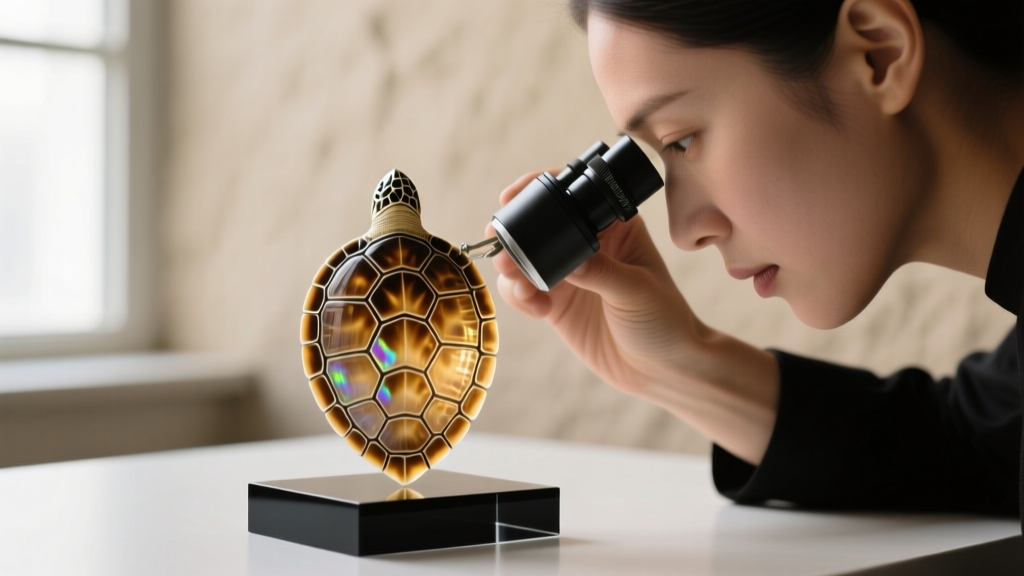
2. The Thermal (Hot Pin) Test
While destructive and generally avoided on museum-quality pieces, the hot pin test remains a staple for identifying organic keratin. When a red-hot needle is applied to an inconspicuous area (such as the back of a hairpin), genuine tortoise shell will emit a distinct odor of burning hair or feathers, characteristic of sulfur-rich keratin. Plastics will smell acrid, sweet, or like burnt vinegar, and will often melt into a sticky bead rather than charring into a dry ash.
3. Ultraviolet Fluorescence
Under long-wave UV light (365 nm), genuine hawksbill shell typically exhibits a dull, slightly bluish-white or pale yellowish fluorescence. Early plastics like celluloid may fluoresce brightly, while Bakelite often shows a milky, opaque reaction. This test is best used as a secondary sorting mechanism rather than a primary identifier.
The Legal Landscape: CITES and the 2026 Enforcement Reality
The hawksbill turtle is critically endangered, and the global trade of its shell is strictly prohibited. The species was moved to Appendix I of the Convention on International Trade in Endangered Species (CITES Species Database) in 1975, banning all commercial international trade. In the United States, the Endangered Species Act of 1973 provides parallel domestic protections.
As of 2026, customs enforcement regarding organic gemstones has become increasingly stringent. The only legal avenue for buying, selling, or transporting tortoise shell jewelry is through the "antique exemption." In most jurisdictions, a piece must be provably over 100 years old (pre-1926) or, in specific US cases, pre-date the 1973 ESA enactment. However, the burden of proof lies entirely on the seller. Without verifiable provenance, appraisals from certified gemologists, or original estate documentation, customs agents are authorized to seize the items, and sellers face severe federal penalties. The GIA Organic Gems Guide strongly advises against purchasing undocumented shell, regardless of the seller's claims.
Premium Ethical Alternatives in Modern Jewelry
For contemporary jewelers and collectors who desire the aesthetic warmth of tortoise shell without the legal and ethical liabilities, several high-end alternatives exist. Modern material science has produced bio-polymers that rival the thermoplastic and optical properties of genuine shell.
| Material | Composition | Specific Gravity | Workability & Aesthetics |
|---|---|---|---|
| Genuine Hawksbill | Keratin (Organic) | 1.29 | Unmatched depth, thermoplastic fusion, illegal to trade without antique proof. |
| Cellulose Acetate | Wood Pulp / Cotton Linters | 1.28 - 1.32 | Excellent mottling, hypoallergenic, polishes to a high luster. The luxury eyewear standard. |
| Galalith (Casein) | Milk Protein Polymer | 1.32 - 1.35 | Opaque to semi-translucent, excellent for carved cameos, takes dye exceptionally well. |
| Water Buffalo Horn | Keratin (Organic) | 1.30 - 1.35 | Naturally dark but can be bleached and dyed to mimic shell. Thermoplastic properties similar to shell. |
| Bio-Resin Epoxies | Plant-based Polymers | 1.15 - 1.25 | Highly customizable translucency, but lacks the thermal molding capabilities of keratin. |
Why Cellulose Acetate Leads the Market
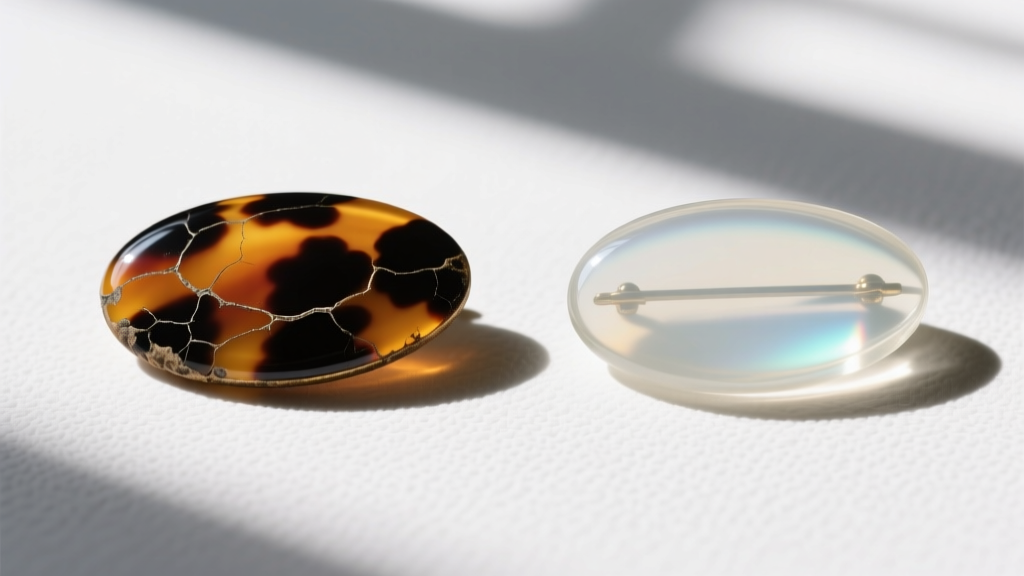
Among modern alternatives, high-grade cellulose acetate is the undisputed champion for luxury jewelry and eyewear. Unlike cheap injection-molded acrylics, premium acetate is extruded in blocks, allowing artisans to carve and hand-polish the material. By layering different colored acetate sheets and applying chemical mottling techniques, manufacturers can replicate the exact depth and chatoyancy of hawksbill shell. Furthermore, acetate shares a nearly identical specific gravity to genuine shell, giving the finished jewelry the same satisfying, lightweight tactile feedback on the skin.
Archival Care and Conservation for Antique Pieces
For those who legally own and collect authenticated antique tortoise shell jewelry, proper conservation is critical. Keratin is highly hygroscopic; it absorbs and releases moisture in response to ambient humidity. If stored in an overly dry environment (below 30% relative humidity), the shell will desiccate, leading to irreversible micro-cracking, warping, and the popping of piqué metal inlays.
- Climate Control: Maintain a stable environment with a relative humidity between 45% and 55%. Never store shell jewelry near radiators, HVAC vents, or in unheated safes during winter.
- Chemical Avoidance: Never clean tortoise shell with alcohol, ammonia, or commercial jewelry dips. These solvents will strip the natural lipids from the keratin, causing it to turn opaque, brittle, and chalky.
- Polishing Protocol: To restore luster, gently wipe the piece with a lint-free microfiber cloth lightly dampened with distilled water. Follow this by applying a microscopic layer of Renaissance Wax (a micro-crystalline conservation wax used by museums) and buff gently. Never use ultrasonic cleaners, as the high-frequency vibrations will shatter the internal keratin matrix.
By understanding the complex gemological, historical, and legal dimensions of tortoise shell, collectors can navigate this challenging niche with confidence, preserving the past while supporting the ethical innovations of the present.


