How to Authenticate, Grade, and Care for Star Ruby Jewelry
Learn how to authenticate, grade, and properly clean star ruby jewelry. Discover expert tips on evaluating asterism, rutile inclusions, and daily care.

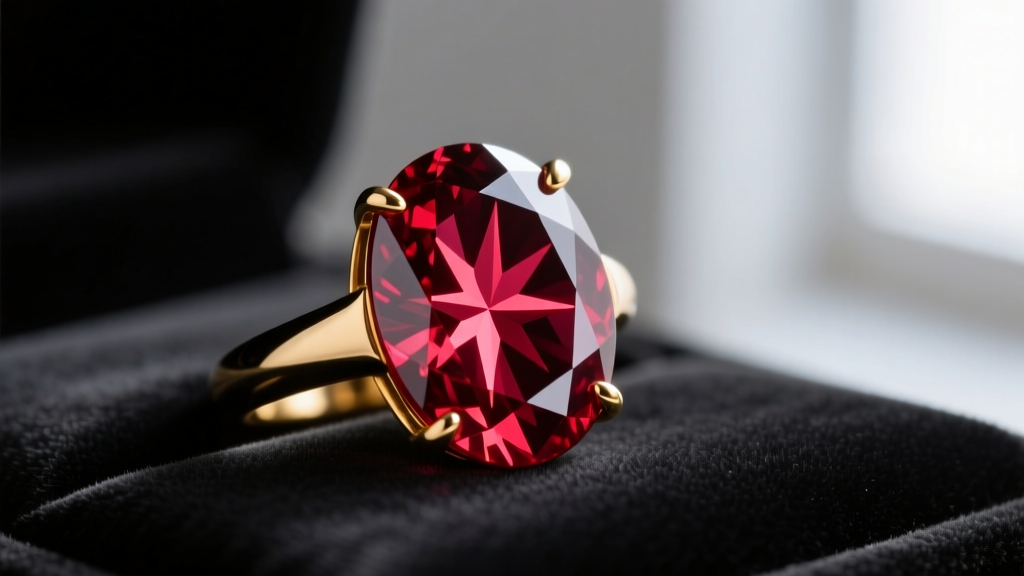
The Gemology of Asterism: What Creates the Star?
Star ruby jewelry represents one of the most captivating intersections of geology and lapidary art. Unlike faceted gems that rely on brilliance and dispersion, star rubies are cut en cabochon (polished into a smooth, domed shape) to showcase a rare optical phenomenon known as asterism. This celestial effect is caused by microscopic, needle-like inclusions of rutile (titanium dioxide) that align along the crystallographic axes of the corundum host stone.
When a single, direct light source hits the dome of the cabochon, these intersecting rutile needles reflect light back in a concentrated six-rayed star. According to the Gemological Institute of America (GIA), the stone must be cut with the base perfectly parallel to the horizontal needle planes; otherwise, the star will be off-center or entirely absent. Understanding this structural requirement is the first step in evaluating any piece of star ruby jewelry.
Step-by-Step Guide to Authenticating Star Ruby Jewelry
The market is currently saturated with synthetic alternatives and heavily treated stones. Whether you are evaluating a vintage estate piece or a modern custom ring, follow these steps to verify authenticity.
Step 1: Evaluate the Asterism (The Star)
Natural star rubies rarely possess a "perfect" star. Under a single penlight, examine the rays closely:
- Natural Stones: The star may be slightly off-center. The rays often exhibit uneven thickness, minor breaks, or a "soft" glow that seems to emanate from deep within the stone. The star moves smoothly across the dome as the light source shifts.
- Synthetic Stones: Vintage synthetic star rubies (such as the famous Linde stars produced via the Verneuil flame-fusion process in the mid-20th century) feature razor-sharp, perfectly symmetrical stars. The star often appears to "float" on the surface of the glass-like dome rather than originating from within.
Step 2: Magnification and Inclusion Mapping
Using a 10x triplet loupe or a gemological microscope, inspect the surface and subsurface of the cabochon.

Natural rutile silk appears as dense, intersecting geometric webs of fine needles. In contrast, synthetic flame-fusion rubies will lack natural silk. Instead, you may observe curved striae (growth lines) or tiny, perfectly spherical gas bubbles—hallmarks of the Verneuil process. As noted in GIA Research on Synthetic Rubies, the presence of curved color banding is a definitive indicator of synthetic origin.
Step 3: Check for Fracture Filling (Lead Glass Treatment)
Many low-grade, opaque natural star rubies on the modern market are heavily fractured and stabilized with lead glass. While the stone is technically "natural" corundum, the treatment drastically lowers its value and durability. Look for surface-reaching fractures that exhibit a blue or orange flash under reflected light, or flattened gas bubbles trapped within the glass-filled fissures.
Grading and Valuation Framework for Star Rubies
Valuing star ruby jewelry requires balancing three competing factors: body color, star sharpness, and transparency. Generally, the more transparent the stone, the weaker the star, because fewer rutile needles are present to reflect light. Finding a stone with both a vivid color and a sharp star is exceptionally rare.
| Quality Tier | Body Color | Star Quality | Transparency | Estimated Price Range (Per Carat) |
|---|---|---|---|---|
| Commercial / Treated | Dull purplish-red, brownish | Faint, broken, or off-center | Opaque | $10 - $50 |
| Fine Natural | Medium to dark red | Sharp, well-centered 6-ray star | Semi-opaque to slightly translucent | $500 - $2,500 |
| Extra Fine (Mogok) | Vivid "Pigeon's Blood" red | Brilliant, sharp, distinct rays | Semi-transparent (Rare) | $5,000 - $15,000+ |
| Synthetic (Vintage) | Vivid, uniform red | Razor-sharp, perfect symmetry | Transparent to semi-transparent | $20 - $100 (Total piece value) |
How to Properly Clean and Maintain Star Ruby Jewelry
While corundum ranks a 9 on the Mohs hardness scale—making it highly resistant to scratching—the dense network of rutile inclusions creates structural planes of weakness. Furthermore, if your stone has been fracture-filled with lead glass, it is highly vulnerable to chemical damage.
Safe Cleaning Protocol
- Prepare a Mild Solution: Mix lukewarm water with a few drops of gentle, phosphate-free dish soap in a glass bowl.
- Soak Briefly: Submerge the star ruby jewelry for no more than 3 to 5 minutes to loosen surface oils and lotions.
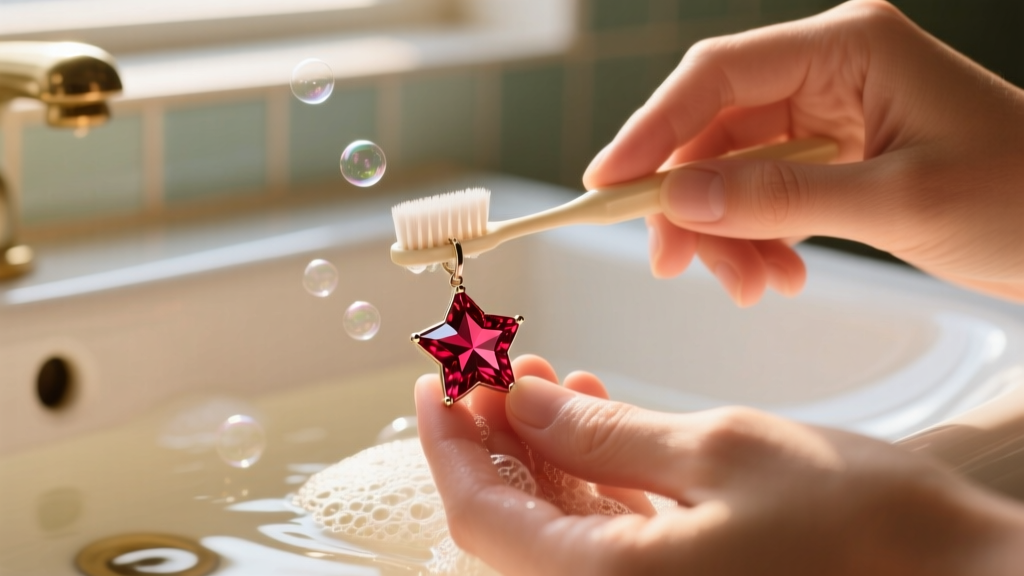
- Gentle Agitation: Use an extra-soft baby toothbrush to gently sweep around the bezel or prongs where dirt accumulates. Do not scrub the dome of the cabochon aggressively.
- Rinse and Dry: Rinse under a gentle stream of lukewarm water (ensure the drain is plugged). Pat dry with a lint-free microfiber cloth.
Critical Warnings: What to Avoid
Never place star ruby jewelry in an ultrasonic cleaner. The high-frequency vibrations can easily shatter a stone weakened by rutile silk or internal fractures. Similarly, steam cleaners should be strictly avoided, as the sudden thermal shock can cause the cabochon to crack. Finally, keep the jewelry away from harsh chemicals, including lemon juice, vinegar, and commercial jewelry dips, which will instantly dissolve the lead glass in fracture-filled stones, leaving a pitted, ruined surface.
Setting and Storage Best Practices
The way a star ruby is set significantly impacts its longevity and the visibility of its asterism.
Expert Setting Tip: Always opt for a bezel or semi-bezel setting for star ruby cabochons. High prong settings leave the sloping edges of the dome exposed to impacts. Furthermore, a bezel setting secures the stone evenly around its girdle, preventing it from being levered out if the ring is knocked against a hard surface.
Because the star requires a direct, single light source to be visible, avoid settings that feature heavy halos or deep gallery wires that block overhead light from reaching the dome. The American Gem Society (AGS) recommends open-back or low-profile settings to maximize light return.
When storing your star ruby jewelry, keep it in a separate, soft-lined compartment. Although the ruby itself will not be scratched by most other gems, the gold or silver setting can be, and harder diamonds in your collection could potentially scratch the polished surface of the cabochon, dulling the star's reflection over time. By following these authentication and care protocols, your star ruby jewelry will retain its celestial beauty and structural integrity for generations.