How to Clean, Care for, and Restore Moonstone Jewelry
Learn how to safely clean, store, and restore the adularescence of your moonstone jewelry. Step-by-step care guide to prevent cracks and clouding.

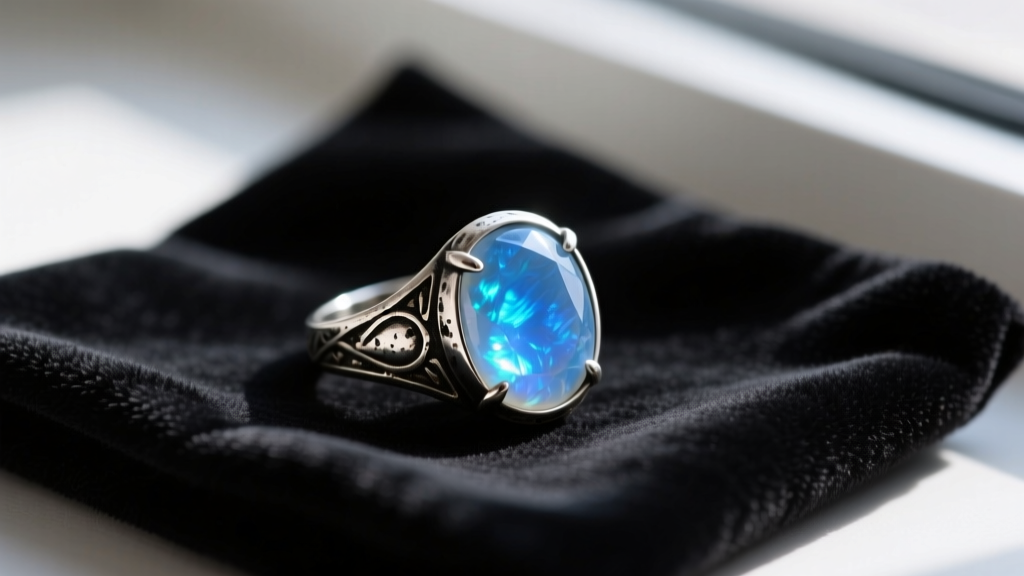
Moonstone jewelry is prized across the globe for its ethereal, billowy glow—a phenomenon known as adularescence. However, this captivating gemstone is notoriously fragile. With a Mohs hardness of just 6 to 6.5 and distinct cleavage planes, moonstone requires a highly specific, gentle approach to maintenance. Using the wrong cleaning methods or storing it improperly can permanently dull its signature Schiller effect or, worse, cause internal fracturing.
In this comprehensive 2026 guide, we break down the exact mineralogical reasons behind moonstone's fragility and provide a step-by-step masterclass on how to clean, restore, and protect your moonstone jewelry for generations.
The Mineralogy of Moonstone: Why Standard Cleaning Fails
To understand how to care for moonstone, you must first understand its internal structure. According to the Gemological Institute of America (GIA), moonstone is a variety of the feldspar-group mineral orthoclase. It is composed of alternating microscopic layers of orthoclase and albite. When light enters the stone, it scatters between these layers, creating the glowing effect we call adularescence.
While beautiful, this lamellar twinning creates structural weaknesses. Moonstone has two directions of perfect cleavage. This means that a single sharp knock, exposure to extreme thermal shock, or the high-frequency vibrations of an ultrasonic cleaner can cause the stone to split or develop internal spiderweb cracks along these planes. Furthermore, harsh chemicals like ammonia or bleach can degrade the polish and seep into micro-fissures, permanently clouding the stone.
Step-by-Step Guide to Cleaning Moonstone Jewelry
Forget commercial jewelry dips and ultrasonic machines. To safely clean moonstone jewelry, you need a manual, low-impact approach. Follow these four precise steps to remove oils, lotions, and environmental grime without damaging the cabochon.
Step 1: Dry Dusting and Inspection
Before introducing any moisture, use a clean, dry microfiber cloth to gently wipe away loose dust and grit. Rubbing a wet stone with surface dust can create micro-scratches on the polish. Inspect the setting under a bright light to ensure no prongs are loose; water pressure can dislodge a poorly secured cabochon.
Step 2: The Lukewarm Distilled Soak
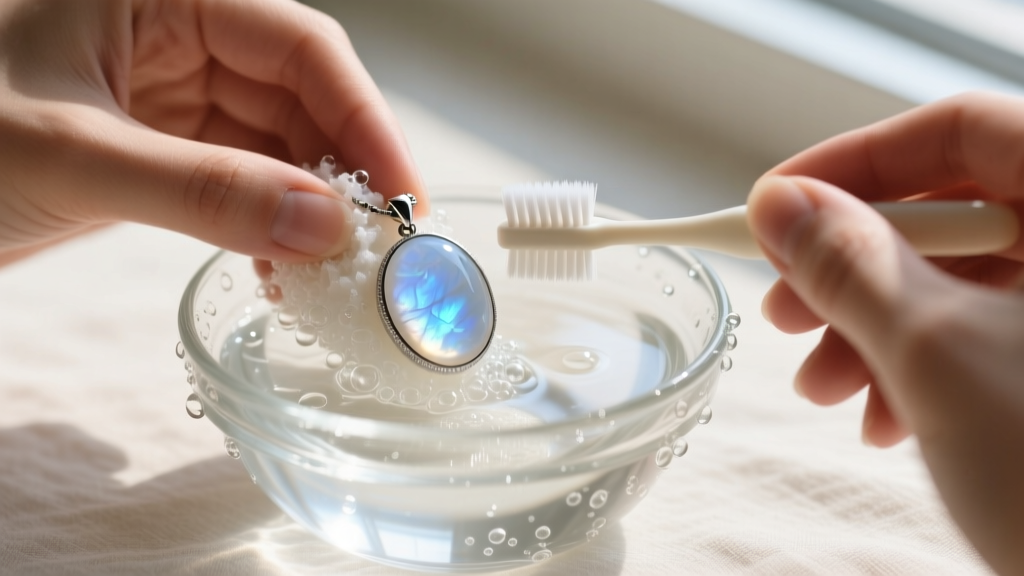
Fill a small glass bowl with distilled water (never tap water, as chlorine and hard minerals can leave stubborn spots). Add a single drop of pH-neutral, dye-free dish soap. Submerge the moonstone jewelry for exactly 3 to 5 minutes. This brief soak loosens sebum and cosmetic buildup without allowing water to penetrate any microscopic surface reaches.
Step 3: Gentle Agitation
Using a brand-new, ultra-soft baby toothbrush, gently sweep the bristles over the surface of the moonstone and around the metal setting. Do not apply downward pressure. Let the bristles do the work of lifting the dirt. Pay special attention to the back of the cabochon, where skin oils accumulate and block light from entering the stone.
Step 4: Drying and Polishing
Rinse the piece briefly under a gentle stream of lukewarm distilled water. Pat it dry with a lint-free cotton cloth. Allow it to air dry completely on a towel for 15 minutes before storing or wearing to ensure no moisture is trapped beneath the bezel or prongs.
Restoring Lost Adularescence (The Glow)
If your moonstone jewelry has lost its signature glow, it is rarely due to permanent internal damage. In 90% of cases, cloudiness is caused by a buildup of microscopic oil films or a dulling of the surface polish due to friction against harder materials.
- For Oil Buildup: Repeat the distilled water and pH-neutral soap soak, but extend the time to 10 minutes. Use a wooden toothpick to gently scrape away hardened grime near the bezel edge where the brush cannot reach.
- For Surface Dulling: If the stone feels rough or looks matte, the polish has been worn away. Do not use abrasive polishing compounds at home. Instead, use a treated jeweler's polishing cloth (like a Sunshine cloth) to gently buff the surface. If the dullness persists, the piece must be sent to a lapidary for a professional re-polish using cerium oxide.
Environmental Hazards and Storage Matrix
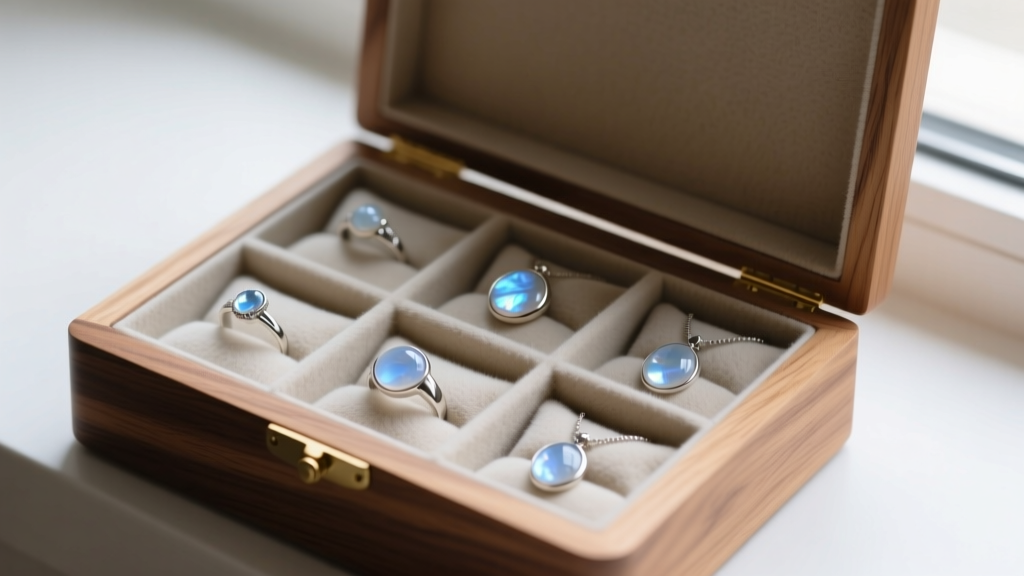
Proper storage is just as critical as cleaning. Because moonstone is easily scratched by harder gems (like diamonds, sapphires, or quartz) and can be damaged by environmental extremes, you must isolate it. Reference the International Colored Gemstone Association (ICA) guidelines for long-term feldspar preservation.
| Environmental Factor | Risk Level | Specific Failure Mode | Prevention Protocol |
|---|---|---|---|
| Ultrasonic Cleaners | Critical | High-frequency vibrations shatter cleavage planes. | Never use; stick to manual soaking. |
| Thermal Shock | High | Sudden temperature changes cause internal fracturing. | Remove before hot tubs, saunas, or winter sports. |
| Hard Impacts | High | Chipping or cleaving of the cabochon dome. | Remove during gym workouts or manual labor. |
| Co-mingled Storage | Medium | Surface scratching from harder gems (Mohs 7+). | Store in individual soft flannel pouches. |
| Prolonged Sunlight | Low | Potential fading in certain peach/yellow varieties. | Keep in a closed, dark jewelry box. |
Troubleshooting: Cracks, Cloudiness, and Loose Settings
Even with meticulous care, accidents happen. Here is how to diagnose and address common moonstone jewelry emergencies.
1. The Stone Appears 'Cracked' but is Smooth to the Touch
This is often a cleavage fracture that occurred internally due to a past impact or thermal shock. While the structural integrity might still be holding, the fracture will interrupt the adularescence, creating a 'dead' spot in the glow. Action: Stop wearing the piece immediately. Take it to a jeweler to have the setting reinforced or the stone replaced, as future impacts will likely split the stone entirely.
2. The Cabochon Rattles in the Bezel
Moonstone is frequently set in bezels to protect its edges. If the metal has warped or worn thin, the stone will rattle. Action: Do not attempt to push the metal back yourself with pliers, as the localized pressure will crack the feldspar. A jeweler must use a bezel roller and apply even, distributed pressure to secure the stone.
3. White, Chalky Residue on the Surface
This is usually caused by exposure to harsh chemicals, such as chlorine in swimming pools or alkaline cleaning products, which etch the surface polish. Action: This is chemical damage, not dirt. It requires professional lapidary re-polishing to remove the etched layer and restore the optical clarity required for adularescence.
Expert Insight: When purchasing moonstone jewelry, always prioritize pendants and earrings over rings. Rings are subjected to constant blunt force and abrasion. If you must own a moonstone ring, ensure it features a deep, protective bezel setting and a high-dome cabochon cut to deflect direct impacts away from the stone's vulnerable cleavage planes.
By respecting the unique mineralogy of moonstone and adhering to these gentle, precise care protocols, you can ensure your jewelry retains its mesmerizing, moonlit glow for a lifetime. For further reading on feldspar group minerals and their physical properties, consult the extensive mineralogical databases at Mindat.org.


