White Jade Jewelry: An Expert Guide to Nephrite and Jadeite Grades
Discover the technical differences between nephrite and jadeite in white jade jewelry. Learn grading systems, treatments, and pricing metrics.

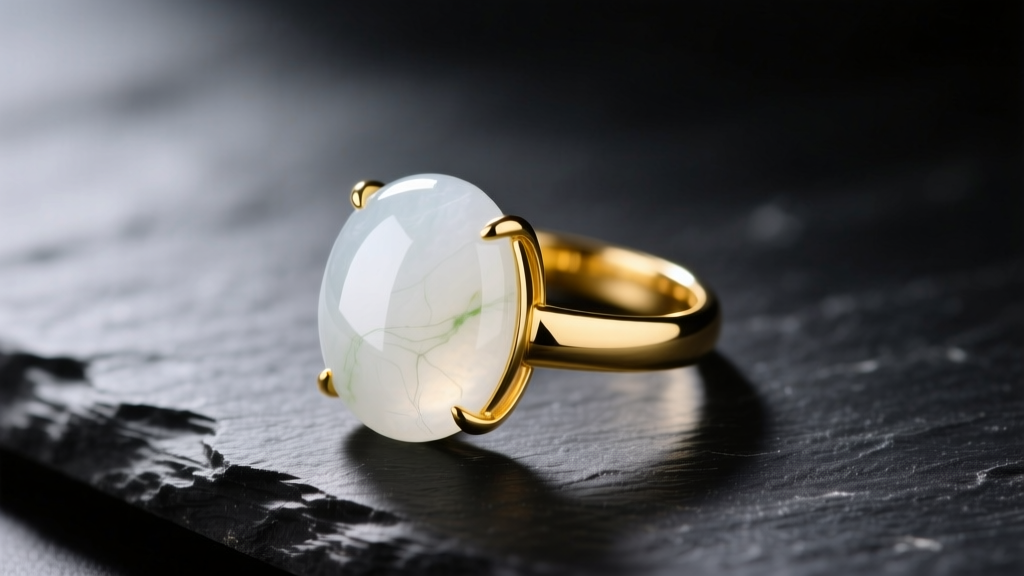
The Mineralogy of White Jade: Nephrite vs. Jadeite
When collectors, jewelers, and gemologists discuss white jade jewelry, they are navigating a complex commercial umbrella that covers two entirely distinct silicate minerals: nephrite and jadeite. While both have been prized for millennia, their crystallographic structures, chemical compositions, and market valuations differ drastically. Understanding these mineralogical distinctions is the first step in evaluating high-end jade pieces and avoiding costly misrepresentations in the current market.
Chemical and Crystallographic Profiles
Nephrite is a calcium magnesium iron silicate belonging to the tremolite-actinolite series of the amphibole group. Its defining characteristic is a felted, interlocking fibrous matrix. This microstructure grants nephrite an extraordinary level of toughness—often cited as greater than steel—making it highly resistant to chipping and fracturing during the carving process. Conversely, jadeite is a sodium aluminum silicate belonging to the pyroxene group. Jadeite forms in a granular, interlocking crystalline structure. While slightly harder on the Mohs scale than nephrite, jadeite is marginally less tough due to the absence of those tightly woven fibrous bundles.
| Property | Nephrite (Amphibole) | Jadeite (Pyroxene) |
|---|---|---|
| Chemical Formula | Ca2(Mg,Fe)5Si8O22(OH)2 | NaAlSi2O6 |
| Mohs Hardness | 6.0 - 6.5 | 6.5 - 7.0 |
| Specific Gravity | 2.90 - 3.03 | 3.25 - 3.36 |
| Refractive Index | 1.606 - 1.632 | 1.654 - 1.667 |
| Luster (Polished) | Greasy to Vitreous | Vitreous to Sub-Vitreous |
According to mineralogical data from Mindat, the specific gravity and refractive index variances are the most reliable non-destructive testing metrics for separating the two species in a gemological laboratory.
Decoding the Grading Systems: Type A, B, and C
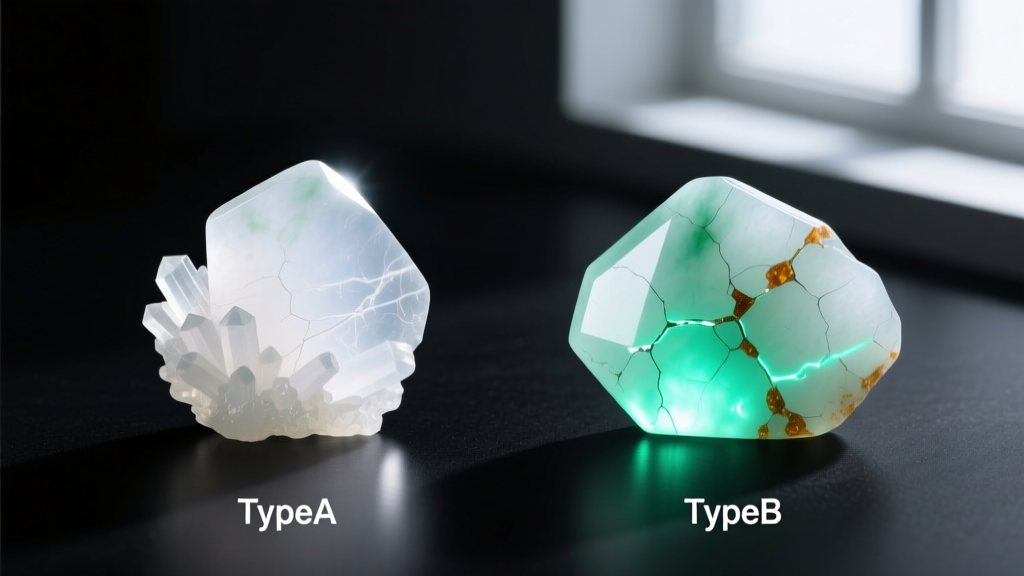
In the realm of white jadeite jewelry, the alphabet grading system dictates both the structural integrity and the financial value of the stone. This terminology, standardized by institutions like the Gemological Institute of America (GIA), refers strictly to the level of human intervention and chemical treatment the stone has undergone.
Type A (Untreated): This is natural, untreated jadeite. The only acceptable enhancement is the traditional application of a mild, colorless wax polish after cutting to smooth surface micro-fissures. Type A white jadeite, particularly pieces with high translucency (often termed "ice" or "glass" species), commands premium auction prices, frequently exceeding $10,000 per carat for flawless, icy-white cabochons.
Type B (Bleached and Polymer-Impregnated): Lower-quality jadeite with heavy brown or yellow matrix inclusions is soaked in strong hydrochloric or nitric acid to dissolve the impurities. This acid bath severely damages the granular crystal structure, leaving the stone porous and brittle. To restore structural integrity, the stone is vacuum-impregnated with a polymer resin (like Opticon) or epoxy. While Type B jade may look bright white and clean, the polymer will yellow and degrade over time, and the stone holds virtually no resale value.
Type C (Dyed): The stone has been artificially colored. While less common in purely "white" jade, some off-white stones are dyed to mimic rare lavender or green hues. Type B+C combines both acid bleaching, polymer impregnation, and dyeing.
The Pinnacle: Hetian "Mutton Fat" Nephrite
When discussing white nephrite, the undisputed apex of the market is Hetian "Mutton Fat" jade (Yangzhi Yu), sourced historically from the Kunlun Mountains in Xinjiang, China. The term "mutton fat" does not refer to a stark, opaque white; rather, it describes a highly specific visual and tactile phenomenon. True mutton fat nephrite possesses a minimum tremolite content of 95%, resulting in a dense, fine-grained matrix that exhibits a signature greasy luster and a subtle, warm translucency reminiscent of solidified animal fat.
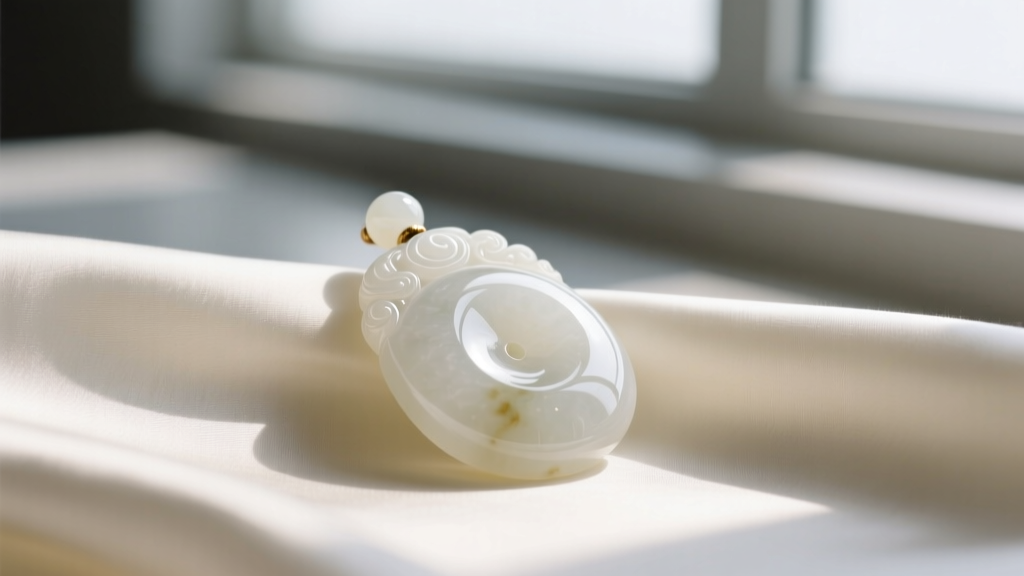
The pricing metrics for authentic, river-mined Hetian seed jade (Zi Yu) are staggering. While commercial-grade white nephrite from other global sources (such as British Columbia or Siberia) may trade for $10 to $50 per gram, certified top-tier Hetian mutton fat seed jade routinely trades between $3,000 and $15,000+ per gram in specialized Asian markets. Buyers must demand certification from reputable labs verifying the origin and the absence of secondary bleaching, as the market is currently saturated with Russian and Korean nephrite falsely marketed as premium Hetian.
Technical Verification: How to Spot Fakes
Identifying treatments and imitations in white jade jewelry requires a systematic gemological approach. Relying solely on visual inspection is insufficient, especially given the prevalence of high-quality glass and quartzite simulants. Here is the standard verification protocol used by appraisers:
- Hydrostatic Weighing (Specific Gravity): This is the fastest way to separate nephrite from jadeite and quartzite. A reading of 3.30 to 3.36 confirms jadeite, while 2.95 to 3.00 confirms nephrite. Quartzite (a common white jade simulant) will read much lower, around 2.65.
- Long-Wave UV Fluorescence: Shining a 365nm UV flashlight over the stone is critical for detecting Type B treatments. The polymer resins used to stabilize acid-bleached jadeite typically fluoresce with a chalky, bluish-white glow, particularly in surface-reaching fissures.
- Microscopic Surface Examination: Under 40x magnification, Type A jadeite will show a natural, slightly undulating "orange peel" effect on the polished surface due to the varying hardness of its interlocking grains. Type B jade often displays a "spiderweb" or "acid-etched" network of fissures where the acid ate away at the grain boundaries before polymer injection.
- Infrared Spectroscopy (FTIR): For definitive proof of polymer impregnation, a lab will use FTIR to detect the specific absorption bands of organic resins in the mid-infrared spectrum, which is the gold standard for identifying Type B jade.
Structural Integrity and Jewelry Settings
Designing settings for white jade jewelry requires an understanding of its unique mechanical properties. Because jade lacks true cleavage planes (unlike diamonds or topaz, which can split cleanly along specific crystallographic axes), it is incredibly resilient against pressure. However, it is susceptible to conchoidal fracturing from sharp, blunt impacts.
For rings and bracelets, which are subject to high impact, bezel settings in 18k gold or platinum are strongly recommended over prong settings. A bezel protects the vulnerable girdle and culet of the cabochon. Furthermore, jewelers must avoid using ultrasonic cleaners or steamers on any jade jewelry. Ultrasonic vibrations can exploit internal stress fractures in Type A stones, causing them to crack, and will rapidly degrade the polymer resins in Type B stones, leading to structural failure and surface clouding. Proper care involves nothing more than warm water, a mild pH-neutral soap, and a soft microfiber cloth to maintain the stone's natural luster.


