Jade Jewelry Meaning & Value: A Buyer's Pricing Guide
Discover the true jade jewelry meaning and how cultural significance impacts market value. Learn to grade, price, and authenticate jadeite and nephrite.

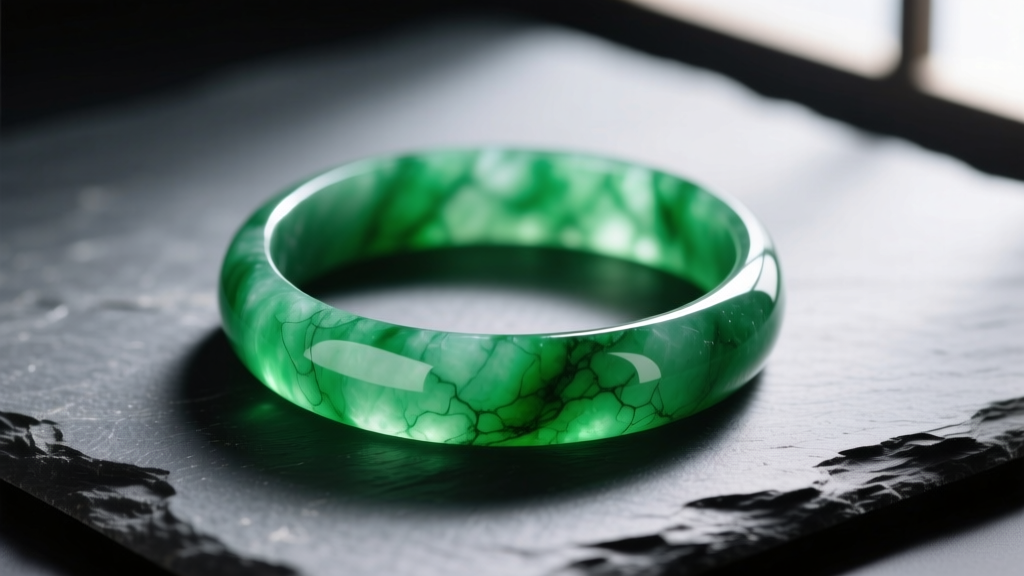
When collectors, investors, and spiritual seekers alike explore the jade jewelry meaning, they are often drawn to its ancient associations with protection, harmony, and eternal life. However, in the modern gemological market, metaphysical significance translates directly into hard currency. The profound cultural reverence for jade creates an inelastic demand curve for top-tier stones, making it one of the most complex and frequently counterfeited gemstones in the world.
As we navigate the 2026 gemstone market, understanding the intersection of jade's spiritual heritage and its rigorous mineralogical grading is essential for any buyer. This guide provides a deep-dive budget and value assessment, helping you separate genuine investment-grade jade from treated imitations, ensuring that the piece you purchase aligns with both your spiritual intent and your financial reality.
The True Jade Jewelry Meaning: Beyond Metaphysics to Market Value
The concept of jade in Eastern philosophy—particularly the Chinese reverence for Yu—is deeply intertwined with moral and spiritual virtues. Historically, Confucius likened jade to a gentleman, attributing to it qualities like benevolence, righteousness, wisdom, and courage. This profound jade jewelry meaning elevates the stone beyond mere ornamentation; it is considered a talisman that protects the wearer from harm and attracts prosperity.
"The cultural weight of jade means that top-tier, unblemished stones are not just jewelry; they are heirloom assets. The market prices the 'purity' of the stone as a direct reflection of its spiritual integrity."
From a value assessment perspective, this cultural premium means that fine jadeite often commands prices per carat that rival or exceed D-flawless diamonds. However, this premium applies strictly to natural, untreated stones. The market is flooded with chemically altered jade that retains the aesthetic look but entirely loses both its metaphysical 'purity' and its financial investment value.
Nephrite vs. Jadeite: The Mineralogical Baseline
To accurately assess your budget, you must first understand that 'jade' is an umbrella term for two distinct minerals: Nephrite and Jadeite. While both carry historical significance, their market values and gemological properties differ drastically.
| Property | Nephrite | Jadeite |
|---|---|---|
| Mineral Group | Amphibole (Calcium/Magnesium) | Pyroxene (Sodium/Aluminum) |
| Hardness (Mohs) | 6.0 - 6.5 | 6.5 - 7.0 |
| Toughness | Exceptional (Interlocking fibers) | High (Granular crystalline) |
| Primary Sources | China (Hetian), Canada, Russia | Myanmar (Hpakan), Guatemala |
| Value Tier | Generally lower, except rare white 'mutton fat' | Significantly higher, especially Imperial green |
| Refractive Index | 1.60 - 1.63 | 1.66 |
If your budget is under $1,000, you are largely looking at commercial-grade jadeite or high-quality nephrite. If you are seeking the translucent, vibrant greens associated with high-end jade jewelry meaning and luxury auctions, you are entering the realm of fine jadeite, where budgets start in the tens of thousands.
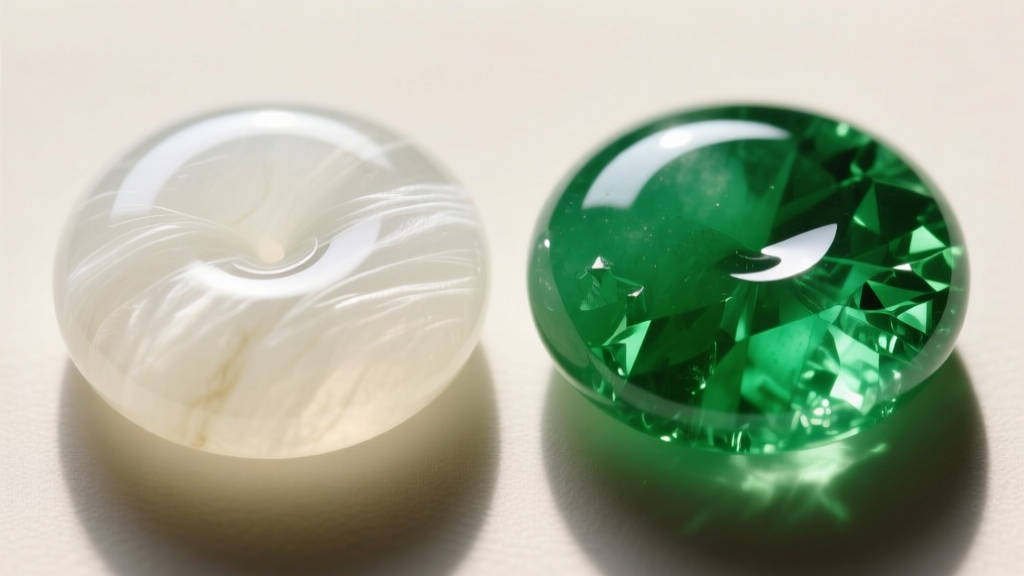
The ABCs of Jade Treatment: Where Value is Won or Lost
The most critical factor in jade value assessment is the treatment grade. The market categorizes jade into three distinct tiers, and buying blindly can result in severe financial loss.
Type A: The Investment Standard
Type A jade is 100% natural and untreated, save for traditional polishing with plum juice and beeswax. This is the only grade that holds long-term investment value and aligns with the pure, unadulterated jade jewelry meaning sought by collectors. Type A jadeite will appreciate over time, especially as Myanmar's mining restrictions continue to constrain supply.
Type B: The Structural Compromise
Type B jade has been soaked in hydrochloric acid to bleach out brown or yellow impurities, followed by vacuum-impregnation with polymer resin to fill the resulting structural voids. While it may look clean and vibrant to the untrained eye, the resin will yellow and degrade over 10 to 15 years. Type B jade has virtually zero resale value.
Type C: The Dyed Deception
Type C jade is chemically dyed to mimic expensive Imperial or Apple Green jadeite. The color is superficial and will fade when exposed to UV light and heat. Often, stones are both bleached and dyed (Type B+C). These stones are essentially worthless in the secondary market and are considered gemological fakes.
2026 Market Pricing Matrix: What You Will Actually Pay
Pricing jade is notoriously difficult because, unlike diamonds, there is no universal per-carat price sheet. Value is dictated by color saturation, translucency (water head), texture, and cut. Below is a realistic 2026 pricing matrix for Jadeite bangles and pendants, assuming Type A (untreated) authenticity.
| Jadeite Grade / Color | Translucency & Texture | Bangle Price Range (USD) | Pendant / Cabochon Price Range (USD) |
|---|---|---|---|
| Imperial Green | Highly translucent, emerald-like, chromium-rich | $80,000 - $500,000+ | $15,000 - $150,000+ |
| Apple Green | Semi-translucent, vibrant yellowish-green | $15,000 - $60,000 | $3,000 - $25,000 |
| Moss-in-Snow | Opaque white base with vivid green veins | $5,000 - $20,000 | $800 - $5,000 |
| Icy / Glassy (Colorless) | Highly transparent, lacks green pigment | $10,000 - $40,000 | $2,000 - $15,000 |
| Commercial Green | Opaque, dark or muted green, visible inclusions | $300 - $2,500 | $50 - $800 |
Note: Nephrite bangles generally range from $100 to $2,000, with the exception of museum-grade Hetian 'mutton fat' white nephrite, which is priced by the gram and can exceed $1,000/gram.
Gemological Verification: Protecting Your Investment
Given the prevalence of Type B and C treatments, relying on a seller's word or a generic 'certificate of authenticity' is a guaranteed path to financial loss. True value assessment requires independent gemological verification.
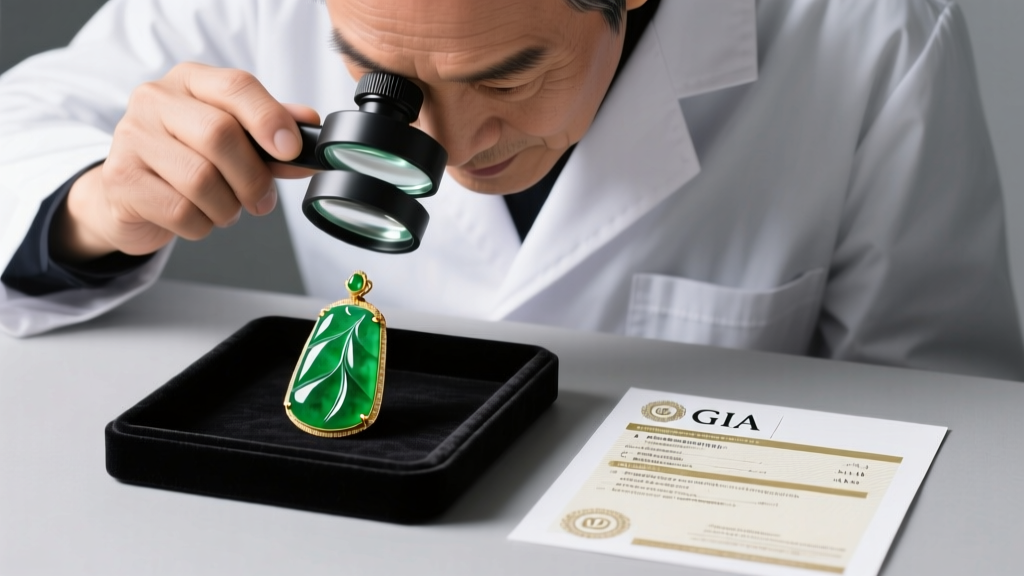
When evaluating a piece, professionals look for specific optical and physical markers. According to the Gemological Institute of America (GIA), jadeite will consistently show a refractive index of 1.66 on a refractometer and a specific gravity of 3.33 during hydrostatic weighing. Nephrite will read lower on both metrics (RI 1.60-1.63, SG 2.95).
However, standard tools cannot always detect advanced polymer impregnation. The definitive test for Type B jade is Fourier Transform Infrared (FTIR) Spectroscopy, which detects the specific absorption spectra of polymer resins within the stone's crystal lattice. Always demand a recent, verifiable report from a top-tier laboratory such as the GIA or the National Gemstone Testing Center (NGTC), which is the premier authority for jade authentication in Asia.
Red Flags in the Field
- Fluorescence: Under long-wave UV light, Type B jade often exhibits a chalky blue or greenish-white fluorescence due to the polymer resin. Type A jade is typically inert.
- Surface Pitting: Using a 10x loupe, examine the surface reflections. Acid-bleached jade often shows a network of microscopic surface pits or a 'spiderweb' effect where the acid ate away at the interlocking crystals.
- Price Discrepancy: If a translucent, vibrant green bangle is offered for $1,500, it is almost certainly Type B+C. The market does not allow for such arbitrage on Imperial-grade stones.
Aligning Spiritual Intent with Financial Reality
The jade jewelry meaning is rooted in authenticity, endurance, and natural harmony. Purchasing a chemically bleached and polymer-filled bangle contradicts the very essence of what jade represents. From a budget perspective, it is always wiser to purchase a smaller, flawless, Type A cabochon or a beautifully carved, opaque nephrite piece than to overspend on a large, translucent bangle that has been structurally compromised by acid.
As you navigate the market, let gemological data guide your wallet. Insist on spectroscopy-backed lab reports, understand the mineralogical differences between nephrite and jadeite, and respect the pricing matrix. By doing so, you ensure that your jade jewelry serves as both a genuine spiritual talisman and a resilient, heirloom-grade financial asset.


