Purple Turquoise Jewelry: Gemstone Truths & Material Comparisons
Discover the gemological truth behind purple turquoise jewelry. Compare dyed howlite, sugilite, and genuine turquoise properties and pricing.

The Gemological Reality: Does Purple Turquoise Exist?
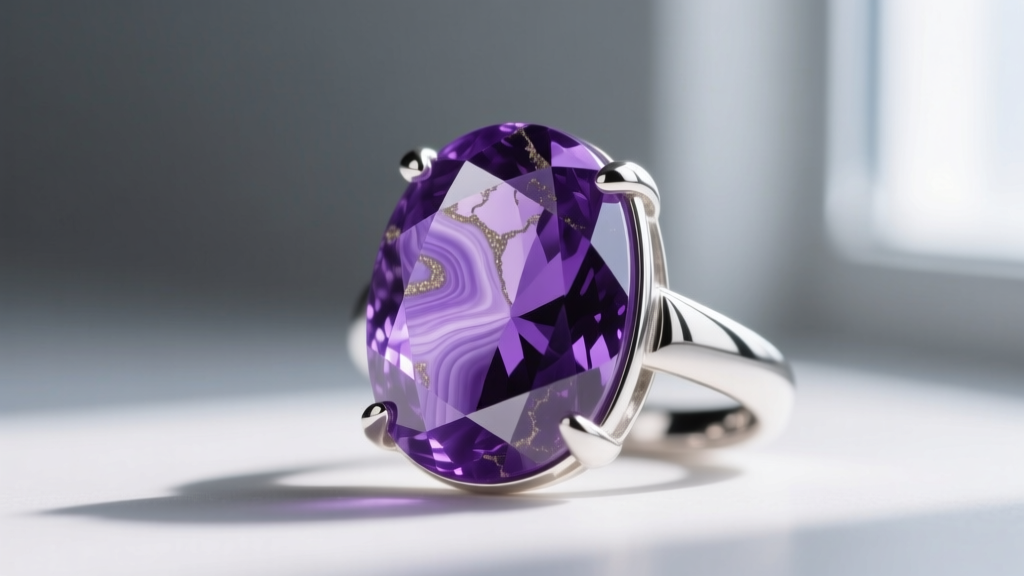
When browsing the market for purple turquoise jewelry, buyers are often captivated by the striking, violet-hued stones set in bohemian and artisan silver designs. However, from a strict gemological perspective, natural purple turquoise does not exist. Genuine turquoise is a hydrous phosphate of copper and aluminum (CuAl6(PO4)4(OH)8·4H2O). Its color spectrum is strictly dictated by its chromophores: copper yields classic sky blues, while iron substitution results in greens. Manganese or specific color centers, which are required to produce purple hues in minerals, are entirely absent from the turquoise crystal lattice.
So, what exactly are you buying when a retailer advertises purple turquoise? As of 2026, the jewelry market is saturated with misnomers, treated stones, and outright simulants. Understanding the material properties of these alternatives is critical for making informed purchasing decisions, assessing durability, and determining true market value. According to the Gemological Institute of America (GIA), turquoise is frequently imitated by dyed porous minerals, making gemological literacy your best defense against overpaying for treated simulants.
Material Breakdown: What You Are Actually Buying
To evaluate purple turquoise jewelry, we must deconstruct the three primary materials that are routinely sold under this misleading trade name.
1. Dyed Howlite and Magnesite (The Most Common Impostor)
The vast majority of "purple turquoise" on the market is actually howlite (a calcium borosilicate) or magnesite (magnesium carbonate). Both minerals are naturally white or gray with distinct gray-brown veining that closely mimics the matrix of genuine turquoise. Because howlite is highly porous and relatively soft (Mohs 3.5), it readily absorbs aniline dyes. Manufacturers tumble howlite chips or cabochons in vats of purple dye, creating a vibrant, uniform stone with dark, web-like matrix lines. While visually appealing, howlite lacks the structural integrity and specific gravity of true turquoise.
2. Reconstituted Turquoise with Purple Dye
Reconstituted turquoise is created by grinding low-grade, chalky turquoise dust and binding it with epoxy resins and synthetic dyes. While this material does contain actual turquoise, the introduction of purple epoxy and dyes alters its natural state entirely. The resulting blocks are cut into cabochons that feature a purple matrix or an overall purple tint. Gemologists classify this as a "simulant" or "assembled" stone rather than a natural gemstone, and it must be disclosed as such under Federal Trade Commission (FTC) guidelines.
3. Misidentified Purple Gemstones (Sugilite & Charoite)
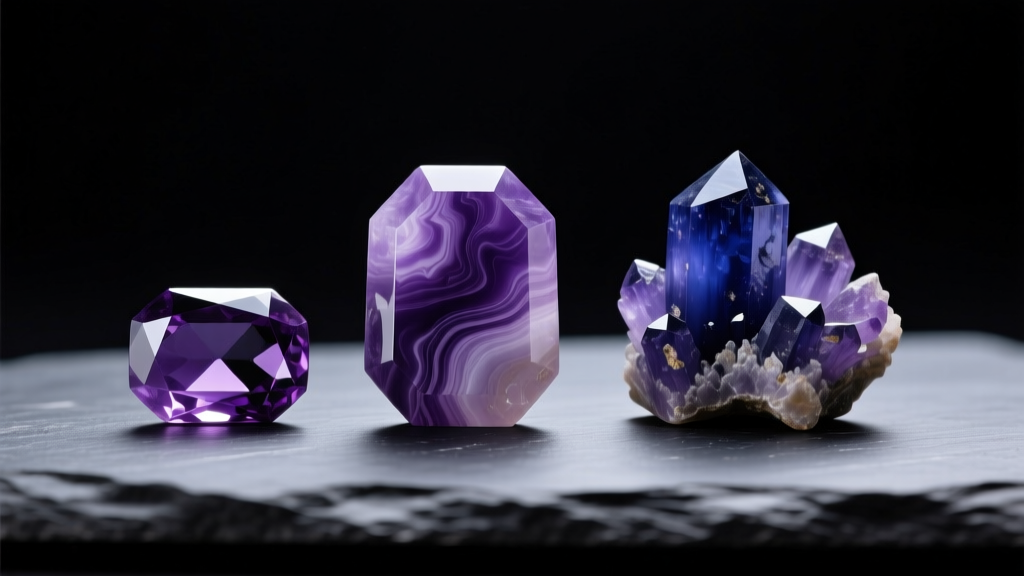
Occasionally, high-end artisan jewelers will use genuine purple gemstones like sugilite or charoite but mistakenly (or deceptively) label them as "purple turquoise" to capitalize on search trends. Sugilite (Mohs 6-6.5) is a rare manganese-rich silicate that naturally occurs in deep purples and violets. Charoite is a rare silicate from Siberia known for its swirling purple patterns. Both are authentic, valuable gemstones in their own right and do not require the misleading "turquoise" moniker.
Comparative Gemological Data Table
When assessing purple turquoise jewelry, gemological testing reveals stark differences between genuine turquoise and its common purple substitutes. The table below outlines the critical diagnostic properties used by gemologists to separate these materials.
| Material | Mohs Hardness | Specific Gravity (SG) | Refractive Index (RI) | Average Price (Per Carat) |
|---|---|---|---|---|
| Genuine Turquoise (Natural) | 5.0 - 6.0 | 2.60 - 2.90 | 1.61 - 1.65 | $20 - $150+ |
| Dyed Howlite (Simulant) | 3.5 | 2.53 - 2.59 | 1.58 - 1.60 | $0.10 - $0.50 |
| Reconstituted / Dyed Block | 4.0 - 5.0 | 2.00 - 2.40 (Varies) | N/A (Opaque) | $1.00 - $3.00 |
| Natural Sugilite | 6.0 - 6.5 | 2.74 | 1.60 - 1.61 | $50 - $200+ |
Note: Data sourced from Mindat.org and standard gemological reference texts. Specific gravity of reconstituted stones fluctuates heavily based on the ratio of epoxy resin to mineral dust.
How to Authenticate and Spot Dye Treatments
If you are evaluating a piece of purple turquoise jewelry, rely on these practical, actionable testing protocols to determine the stone's true identity:
- The Acetone Swab Test: Dip a cotton swab in pure acetone (nail polish remover) and rub it vigorously against an inconspicuous area of the stone. If the swab turns purple, the stone is dyed howlite, magnesite, or poorly stabilized reconstituted turquoise. Genuine turquoise will never release color to acetone.
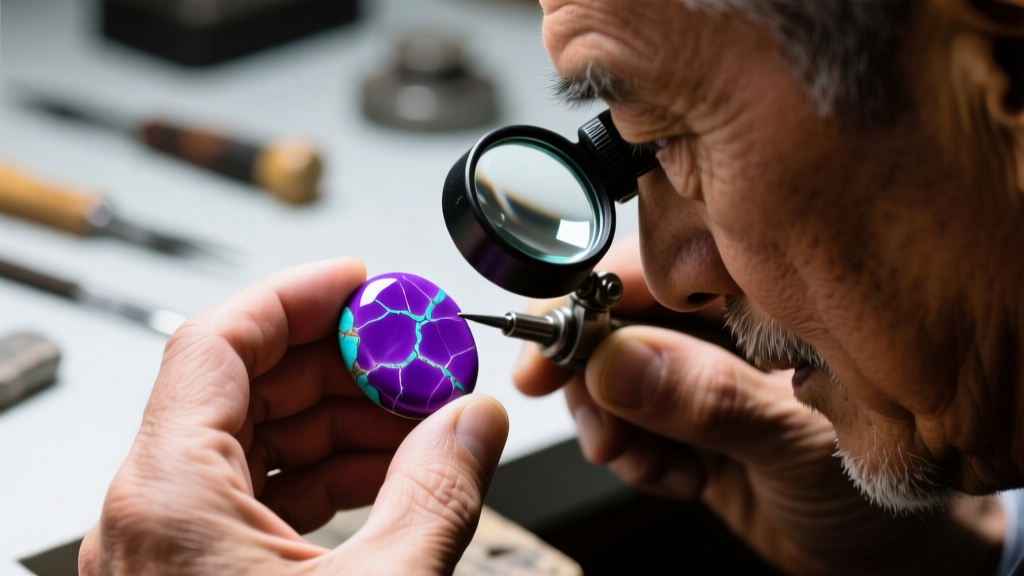
- Magnification (10x Triplet Loupe): Inspect the stone's surface under 10x magnification. In dyed howlite, you will observe dye concentrating heavily in the microscopic fractures, pits, and the web-like matrix lines, creating a "spidery" or "veined" purple effect. Natural stones exhibit uniform color distribution at the microscopic level.
- Ultraviolet (UV) Fluorescence: Under Long-Wave UV light (365nm), many synthetic aniline dyes used on howlite will exhibit a chalky, unnatural bright blue or greenish-white fluorescence. Natural turquoise is generally inert or shows a faint, natural greenish-yellow glow depending on its origin.
- Hot Point Testing (Destructive): While not recommended for finished jewelry, applying a heated needle to a hidden area of reconstituted turquoise will melt the epoxy binder, emitting a sharp, acrid plastic odor. Natural turquoise will not melt or smell of plastic.
Durability and Care Protocols for Treated Stones
The care requirements for purple turquoise jewelry depend entirely on the underlying material. Because most purple "turquoise" is actually dyed howlite (Mohs 3.5), it is exceptionally vulnerable to scratching, chemical degradation, and color fading.
What to Avoid
Never clean dyed howlite or reconstituted turquoise in an ultrasonic cleaner. The high-frequency vibrations and heat will fracture the porous stone and strip the dye from the matrix. Furthermore, avoid exposing these stones to harsh chemicals, including chlorine, bleach, perfumes, and even acidic skin oils, which can cause the purple dye to leach out and stain the skin or adjacent clothing.
Proper Maintenance
Clean purple simulant jewelry using only a dry, ultra-soft microfiber cloth. If mild soap is absolutely necessary, use a barely damp cloth with a pH-neutral soap, wipe gently, and dry immediately. Store these pieces in individual soft pouches to prevent harder gemstones (like quartz or diamonds) from gouging the soft howlite surface.
Ethical Sourcing and Market Pricing in 2026
The primary ethical issue surrounding purple turquoise jewelry is the lack of disclosure. Selling dyed howlite as "natural purple turquoise" without explicit treatment disclosure is a deceptive trade practice. When shopping, demand transparency from the jeweler. A reputable dealer will explicitly state: "Purple dyed howlite simulating turquoise" or "Reconstituted turquoise with purple dye."
In terms of pricing, a strand of dyed howlite beads should cost between $5 and $15 wholesale. If a retailer is charging $150+ for a "purple turquoise" necklace, they are either selling a high-grade natural sugilite mislabeled as turquoise, or they are engaging in severe price gouging. Genuine, high-grade Sleeping Beauty or Persian turquoise commands premium prices ($50 to $200+ per carat), but again, it will never be naturally purple.
Expert Insight: "The allure of purple turquoise is entirely a triumph of modern dye chemistry over natural geology. As collectors, we must appreciate dyed howlite for what it is—an affordable, colorful fashion accessory—rather than paying natural gemstone premiums for a treated simulant."
Final Verdict: Choosing the Right Purple Stone
If you are drawn to the aesthetic of purple turquoise jewelry, embrace it as a fun, fashion-forward accessory, provided you are paying simulant prices. However, if you are seeking a genuine, natural purple gemstone with structural integrity and investment value, pivot your search toward natural sugilite, high-grade charoite, or deep-colored amethyst. By understanding the gemological realities and material properties outlined above, you can navigate the 2026 gemstone market with confidence, ensuring your jewelry collection is built on truth, transparency, and authentic quality.


