Yellow Jade Jewelry: Nephrite vs Jadeite Properties Guide
Discover the material properties of yellow jade jewelry. Compare yellow nephrite and jadeite, learn about treatments, and master grading.

The Mineralogy of Yellow Jade: Nephrite vs. Jadeite
When navigating the market for yellow jade jewelry, the first and most critical step is understanding that 'jade' is not a single mineral. It is a gemological umbrella term encompassing two entirely distinct silicate minerals: nephrite and jadeite. While green jade dominates mainstream commercial markets, yellow jade holds a prestigious, often more exclusive position among serious collectors and gemologists. The yellow coloration in both stones is primarily driven by iron inclusions, specifically the presence of limonite and other iron oxides, but the way these elements manifest depends entirely on the host crystal structure.
Chemical Composition & Crystal Structure
Nephrite is a calcium magnesium iron silicate belonging to the amphibole group. Its microscopic structure consists of densely packed, interlocking fibrous crystals. This felt-like matrix gives nephrite its legendary toughness, making it incredibly resistant to chipping and breaking, which is why it has been the primary material for carved yellow jade jewelry and historical artifacts for millennia. According to the Mindat mineralogical database, the iron content in nephrite can subtly shift its hue from a pale lemon to a deep, earthy mustard.
Jadeite, conversely, is a sodium aluminum silicate from the pyroxene group. Its crystal structure is granular and interlocking, resembling a mosaic of tightly fused sugar grains. Jadeite is slightly harder and takes a higher, more vitreous polish compared to nephrite's waxy luster. Yellow jadeite is highly prized when it exhibits high translucency, often referred to in the trade as 'honey yellow' or 'imperial yellow' when the saturation is exceptionally vivid.
Comparative Material Properties
To accurately evaluate yellow jade jewelry, gemologists rely on a specific set of physical and optical properties. These metrics not only help in identifying the stone but also dictate how the material should be cut, set, and worn.
| Property | Yellow Nephrite | Yellow Jadeite |
|---|---|---|
| Mohs Hardness | 6.0 - 6.5 | 6.5 - 7.0 |
| Specific Gravity (Density) | 2.90 - 3.03 | 3.30 - 3.38 |
| Refractive Index | 1.60 - 1.63 | 1.66 |
| Luster | Greasy to Waxy | Vitreous to Sub-Vitreous |
| Fracture Toughness | Exceptional (Highest of any gem) | Very High |
| Cleavage | None (but has parting) | None (but has parting) |
As noted by the Gemological Institute of America (GIA), specific gravity is one of the most reliable non-destructive tests for separating the two. A yellow jadeite bangle will feel noticeably heavier in the hand than a nephrite bangle of the exact same dimensions due to jadeite's higher density.
The Color Science: Natural vs. Treated Yellow Jade
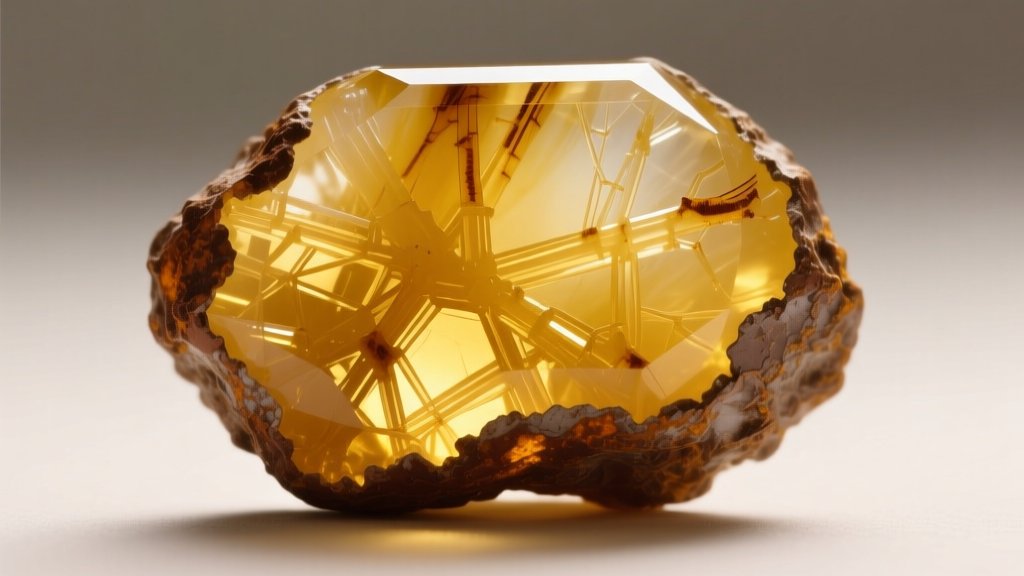
The genesis of yellow color in jade is fundamentally a secondary process. In nature, yellow jade rarely forms with a uniform, vivid yellow core. Instead, the yellow hue is typically the result of 'sugar jade' (tang yu) phenomena, where iron-rich groundwater permeates the outer layers of the rough stone over millions of years, oxidizing to form a yellow to brownish-red rind. Gem cutters must skillfully carve the stone to incorporate this natural rind, often leaving a gradient from creamy white to deep honey-yellow in the finished yellow jade jewelry.
Type A, B, and C Jade Treatments
Because natural, uniformly saturated yellow jadeite is exceptionally rare, the market is flooded with treated alternatives. Understanding the ABC grading system is non-negotiable for buyers:
- Type A (Untreated): The stone is entirely natural, only cut, shaped, and polished using traditional waxing to enhance surface luster. This is the only grade that holds long-term investment value.
- Type B (Bleached and Polymer-Impregnated): Brown or muddy yellow jadeite is soaked in strong acids to dissolve iron impurities and improve translucency. The acid destroys the crystal structure, so the stone is then vacuum-impregnated with epoxy resin or Opticon to bind it together. Over time, the resin yellows and degrades, ruining the jewelry.
- Type C (Dyed): Pale or colorless jade is artificially dyed using chemical yellow dyes. Under magnification, the dye concentrates in the micro-fractures and grain boundaries, creating a spiderweb pattern that is easily identifiable to a trained gemologist.
Always demand a laboratory report from a reputable gemological institute (such as GIA, Gubelin, or SSEF) when purchasing high-value yellow jadeite jewelry to confirm Type A status and rule out polymer impregnation.
Market Value and Pricing Metrics
The pricing of yellow jade jewelry is highly stratified, driven by the mineral type, translucency, and color saturation. In the realm of nephrite, 'Hetian Huang Yu' (Yellow Hetian Jade) from China's Xinjiang province is considered the pinnacle. True mutton-fat yellow nephrite is rarer than white nephrite, with top-tier masterwork carvings or bangles commanding upwards of $1,000 to $3,000 per gram in the current collector's market. Commercial-grade yellow nephrite bead bracelets, often sourced from Qinghai or Russia, typically range from $150 to $600.
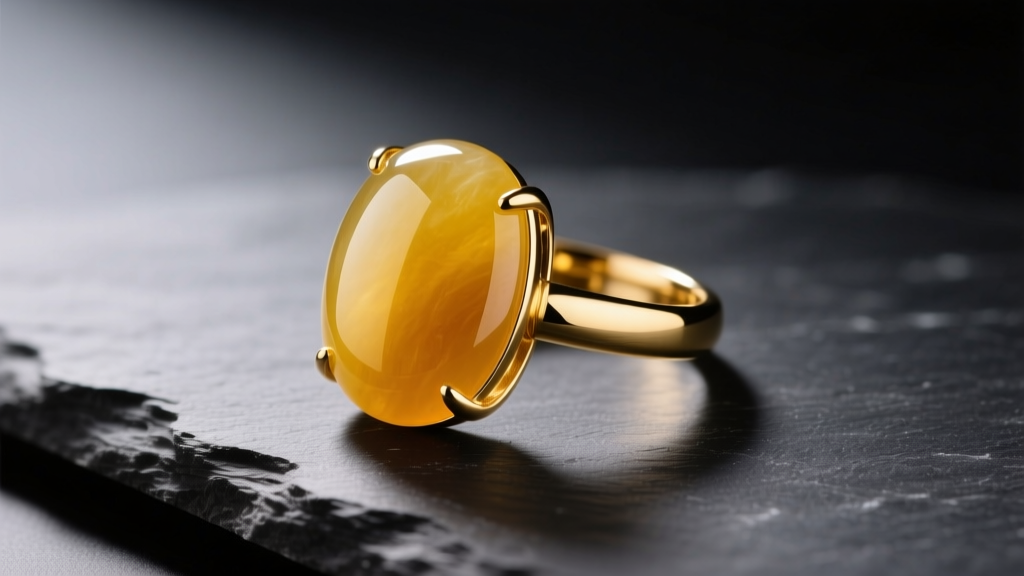
For yellow jadeite, Burmese origin is the standard. A highly translucent, vivid 'honey yellow' jadeite cabochon ring (Type A) can easily fetch between $1,500 and $5,000, depending on the exact dimensions and lack of internal inclusions. Opaque or heavily included yellow jadeite pendants and beads are much more accessible, generally retailing between $200 and $800. The presence of natural, unenhanced 'sugar' rinds carved into the design can actually increase the value, as it proves the natural origin of the color to discerning collectors.
Practical Identification & Care Framework
Caring for yellow jade jewelry requires an understanding of its physical limitations. While nephrite and jadeite are incredibly tough (resistant to breaking), they are not infinitely hard. They can be scratched by quartz (Mohs 7), which is present in everyday household dust.
Setting Considerations for Jewelers
When setting yellow jade cabochons or bangles, jewelers must avoid tension settings. Although jade lacks true cleavage, it has structural parting planes. Extreme point pressure from tension prongs can cause internal stress fractures. Bezel settings in 18k gold or platinum are highly recommended, as they distribute pressure evenly and protect the girdle of the stone from impact.
Daily Maintenance Protocol
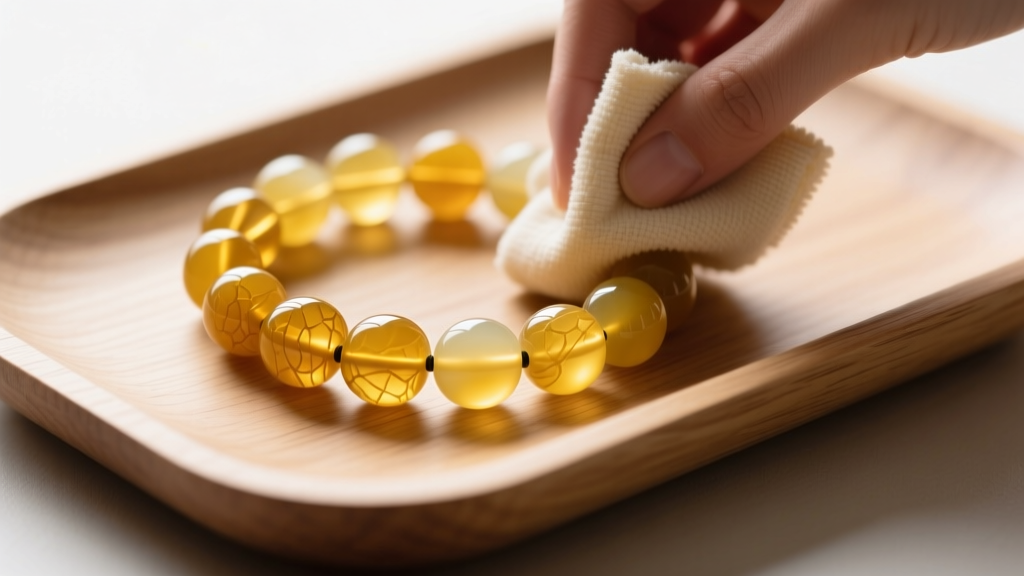
- Cleaning: Use only lukewarm water, a mild pH-neutral dish soap, and a soft microfiber cloth. Never use ultrasonic cleaners, as the high-frequency vibrations can exploit microscopic internal fractures, especially in Type B treated stones.
- Thermal Shock: Avoid sudden temperature changes. Leaving a yellow jadeite ring on a cold windowsill in winter and then immediately exposing it to hot water can cause thermal shock fracturing.
- Chemical Exposure: Remove yellow jade jewelry before swimming in chlorinated pools or using household cleaners. Chlorine can react with the iron oxides that create the yellow color, potentially dulling the surface luster over time.
By mastering the mineralogical differences, understanding the implications of treatments, and adhering to strict care protocols, collectors and enthusiasts can confidently navigate the complex and rewarding world of yellow jade jewelry.