14kt Gold Jewelry Trends 2026: The Ultimate Style Analysis
Discover the definitive 2026 style analysis for 14kt gold jewelry. Explore emerging trends, karat comparisons, and expert styling frameworks.

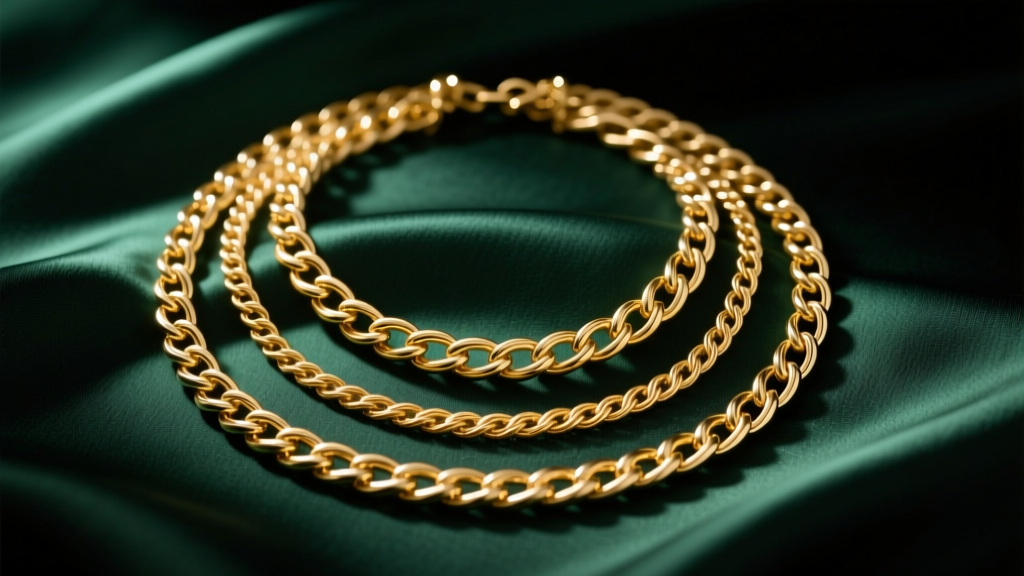
The Metallurgical Shift: Why 14kt Gold Dominates 2026
In 2026, the fine jewelry market has decisively pivoted toward 14kt gold, driven by a convergence of record-high spot prices and a consumer demand for high-durability daily wear. While 18kt gold has historically been the standard for luxury bridal jewelry, 14kt gold jewelry has emerged as the undisputed champion of modern, wearable aesthetics. Composed of 58.3% pure gold and 41.7% alloy metals—typically a precise blend of copper, silver, and zinc—14kt gold offers a superior strength-to-weight ratio that softer karats simply cannot match.
According to data from the World Gold Council, the sustained elevation of gold spot prices hovering above $2,500 per ounce has made 18kt and 24kt pieces prohibitively expensive for the average consumer looking for substantial, solid-gold statement pieces. Consequently, designers and manufacturers are leaning heavily into 14kt alloys, optimizing the copper-to-silver ratios to achieve richer, warmer yellow hues that mimic the look of higher karats while maintaining structural integrity.
Karat Comparison: Durability and Market Position
To understand the styling advantage of 14kt gold, one must look at the metallurgical hardness. The Vickers Hardness (HV) scale measures a metal's resistance to scratching and deformation. Below is a comparative breakdown of how 14kt gold jewelry stacks up against its counterparts in the current market:
| Karat | Gold Purity | Vickers Hardness (HV) | 2026 Market Position | Best Application |
|---|---|---|---|---|
| 24kt | 99.9% | ~60 HV | Niche / Investment | Soft bangles, cultural jewelry |
| 18kt | 75.0% | ~115 HV | Premium Bridal | Engagement rings, luxury watches |
| 14kt | 58.3% | ~135 HV | Everyday Luxury / Trend | Chains, ear curation, signet rings |
| 10kt | 41.7% | ~160 HV | Entry-Level / Mass Market | Class rings, basic studs |
As noted by the Gemological Institute of America (GIA), the 135 HV rating of 14kt yellow gold makes it exceptionally resilient against the micro-abrasions of daily life, ensuring that polished finishes and intricate milgrain details remain intact for years longer than their 18kt equivalents.
Dominant 14kt Gold Jewelry Aesthetics
1. The Liquid Metal Herringbone Chain
The herringbone chain has experienced a massive resurgence, cementing itself as a cornerstone of the 'quiet luxury' movement. In 2026, the focus is on medium-weight, Italian-manufactured 14kt gold herringbone chains ranging from 3mm to 5mm in width. The flat-die extrusion process used to create these chains allows them to lay perfectly flush against the collarbone, catching the light in a continuous, liquid-like ribbon.
However, styling a herringbone requires specific knowledge. Because the links are flat and densely packed, they are highly susceptible to kinking if bent at a sharp angle. Expert stylists recommend storing these chains flat or hanging them vertically, and avoiding pairing them with heavy pendants that could stress the flat links. A 4mm, 18-inch 14kt herringbone chain remains the most versatile iteration, offering enough visual weight to stand alone while remaining delicate enough to layer under unbuttoned silk blouses or crisp poplin shirts.
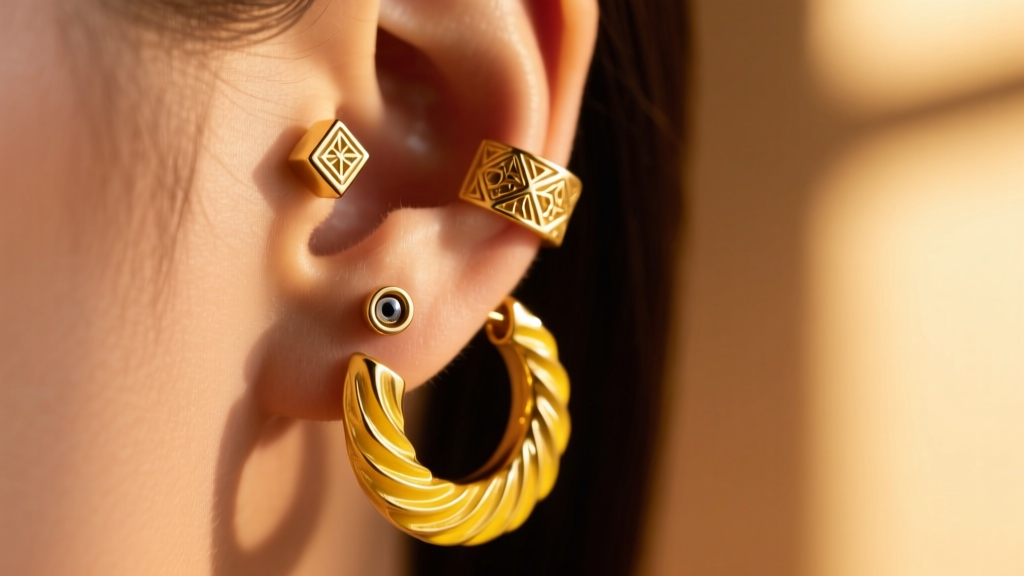
2. Asymmetric Ear Curation and Threadless Systems
The curated ear has evolved from a niche subculture into a mainstream styling staple, and 14kt gold jewelry is the primary medium for high-end piercings. The trend for 2026 moves away from matching sets and embraces deliberate asymmetry—mixing high-polish 14kt yellow gold hoops with matte-finished or hammered textures on the opposite ear.
Crucially, the mechanics of ear curation have shifted toward threadless, push-pin systems. Flat-back labrets in 16-gauge (1.2mm) and 14-gauge (1.6mm) thicknesses, crafted from solid 14kt gold, are replacing traditional internally threaded options. The threadless tension-fit mechanism ensures that decorative ends—such as bezel-set lab-grown diamonds or raw uncut sapphires—never unscrew and fall out. While implant-grade titanium remains the standard for fresh piercings, seasoned collectors are upgrading their healed piercings to 14kt gold flat-backs for the superior warmth and biocompatibility of high-quality gold alloys.
The Two-Tone Renaissance
After years of being dominated by monochromatic yellow or white gold, the market is seeing a sophisticated revival of two-tone 14kt gold jewelry. Unlike the stark, high-contrast two-tone pieces of the 1990s, the 2026 interpretation is nuanced and architectural. Designers are interweaving 14kt yellow gold with rhodium-plated 14kt white gold in geometric signet rings and woven chainmail bracelets.
"Two-tone 14kt gold allows the wearer to bridge their existing jewelry collection. It acts as a visual neutral, seamlessly tying together silver-toned and yellow-toned accessories in a single, cohesive statement piece."
— Lead Metalsmith & Trend Forecaster, Jewel Style Radar
When investing in two-tone 14kt pieces, it is vital to understand the maintenance requirements. The white gold portions are alloyed with palladium or nickel and plated with rhodium to achieve a bright white finish. Over time, friction will wear this plating down, revealing the naturally warm, yellowish undertone of the 14kt white gold beneath. Plan to have two-tone pieces professionally re-rhodanized every 18 to 24 months to maintain the crisp contrast.
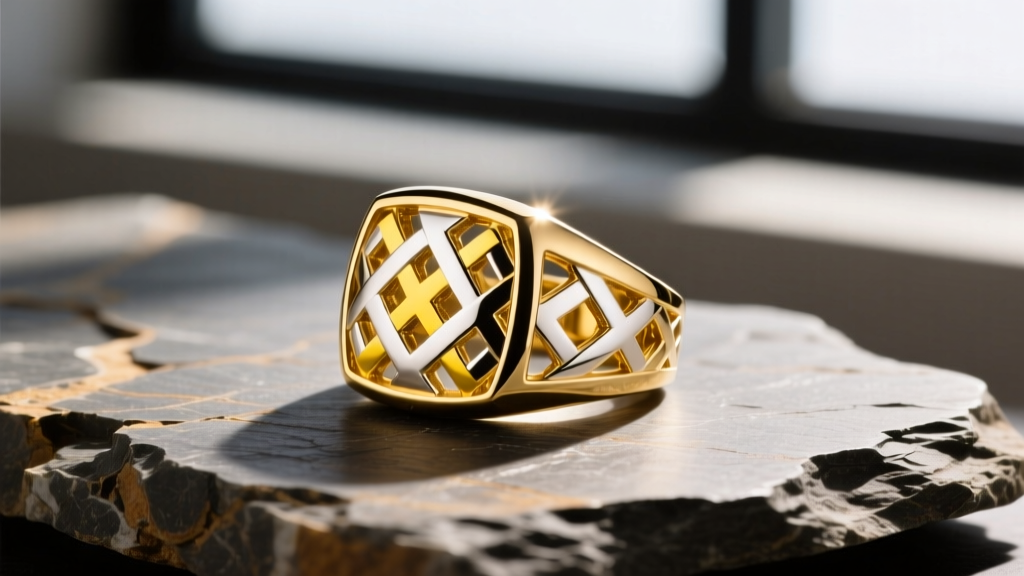
2026 Buying Framework: Melt Value vs. Craftsmanship
As gold prices remain elevated, savvy buyers are utilizing a melt-value framework to evaluate the pricing of 14kt gold jewelry. Understanding the intrinsic metal value versus the craftsmanship premium is essential for making informed purchasing decisions.
- Calculate the Melt Value: Multiply the current spot price of pure gold per gram by 0.583 (the purity of 14kt), then multiply by the item's total gram weight. For example, if pure gold is $80/gram, the 14kt melt value is roughly $46.64/gram.
- Acceptable Premiums for Chains: For basic, machine-made chains (like cable, curb, or rope), a retail markup of 1.5x to 2.5x the melt value is standard and fair. Anything exceeding 3x is generally overpriced unless it features specialized artisanal clasps.
- Acceptable Premiums for Cast Rings: Signet rings and cast bands involve significant labor, mold-making, and finishing. Markups of 3x to 5x the melt value are justified by the craftsmanship and design overhead.
- Hollow vs. Solid: Always verify that chains and hoops are solid. Electroformed or hollow 14kt gold jewelry offers a lower price point but dents easily and cannot be repaired by a jeweler if crushed.
Sourcing and Authenticity in the Modern Market
With the rise of sophisticated counterfeit alloys, verifying the authenticity of 14kt gold jewelry is more critical than ever. Legitimate pieces will bear a hallmark stamp—typically '14k', '14kt', or the European standard '585'. However, stamps can be easily forged.
When sourcing vintage or secondhand 14kt pieces, rely on reputable dealers who utilize X-ray Fluorescence (XRF) spectrometers to verify the exact elemental composition of the alloy without damaging the piece. As highlighted by industry analysts at JCK Online, the secondary market for solid 14kt gold has expanded rapidly, offering buyers the opportunity to acquire discontinued, high-quality artisanal pieces at prices closer to their intrinsic metal value. By prioritizing structural integrity, understanding alloy mechanics, and applying a strict valuation framework, you can navigate the 2026 gold market with absolute confidence.


