Smart Buyer Guide: Settings & How to Clean Jewelry Gold and Diamonds
Discover what settings to buy for easy maintenance and learn exactly how to clean jewelry gold and diamonds safely with our expert guide.

The Intersection of Purchasing and Upkeep
When investing in fine jewelry, most buyers focus exclusively on the 4Cs of diamonds or the karat purity of gold. However, from a long-term ownership perspective, the structural design of the piece dictates its daily wearability and maintenance requirements. Understanding how to clean jewelry gold and diamonds effectively begins at the point of purchase. The setting style, the specific gold alloy, and the diamond's treatment history all form a complex matrix that determines which cleaning methods are safe and which will cause catastrophic damage.
Prong vs. Bezel: The Dirt Trap Factor
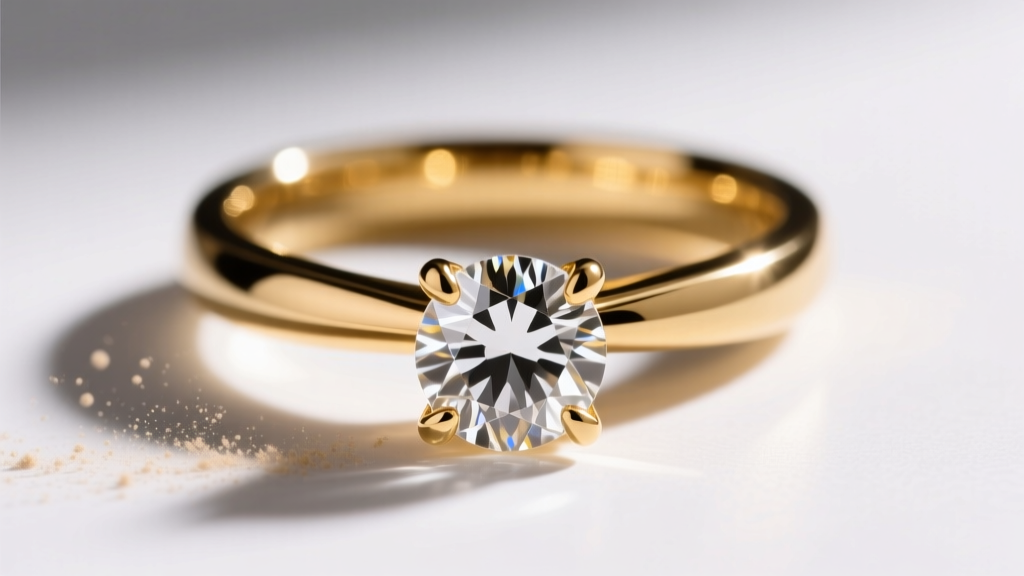
Diamonds are naturally lipophilic, meaning they attract and hold onto oils from your skin, cosmetics, and lotions. When you pair this trait with a high-profile prong setting, you create a microscopic debris trap. A standard six-prong solitaire features an open gallery beneath the diamond. While this allows maximum light return, it also acts as a catch-basin for sebum and dead skin cells, which quickly dull the stone's brilliance. If you lead an active lifestyle or frequently use heavy hand creams, a bezel setting is a vastly superior choice. A bezel encircles the diamond in a continuous metal rim, eliminating the under-gallery trap and making the cleaning process as simple as wiping the surface.
Material Grades: How Karat Weight Dictates Cleaning Protocols
Gold purity fundamentally alters the chemical resilience of your jewelry. Pure gold (24k) is highly resistant to tarnish but far too soft for diamond settings. Therefore, diamonds are almost exclusively set in 18k, 14k, or 10k gold. The remaining percentage consists of alloy metals like copper, silver, zinc, and sometimes nickel. These alloys are the weak link when exposed to harsh cleaning chemicals.
| Karat | Gold Content | Common Alloys | Chemical Sensitivity | Safe Cleaning Agents |
|---|---|---|---|---|
| 18k Yellow | 75.0% | Silver, Copper | Moderate (Avoid strong acids) | Mild dish soap, diluted ammonia |
| 14k Rose | 58.5% | High Copper, Silver | High (Copper oxidizes easily) | Mild dish soap only |
| 14k White | 58.5% | Nickel/Palladium, Zinc | Moderate (Rhodium plating wears) | Mild dish soap, avoid ultrasonics |
| 10k Yellow | 41.7% | Silver, Copper, Zinc | High (Prone to tarnish) | Mild dish soap, commercial gold dips |
According to the Gemological Institute of America (GIA), while diamonds themselves can withstand almost any chemical, the gold alloys holding them cannot. For instance, using a harsh chlorine bleach solution will permanently pit and discolor the copper and zinc alloys in 14k rose gold, potentially weakening the prongs until the diamond falls out.
Step-by-Step: How to Clean Jewelry Gold and Diamonds at Home
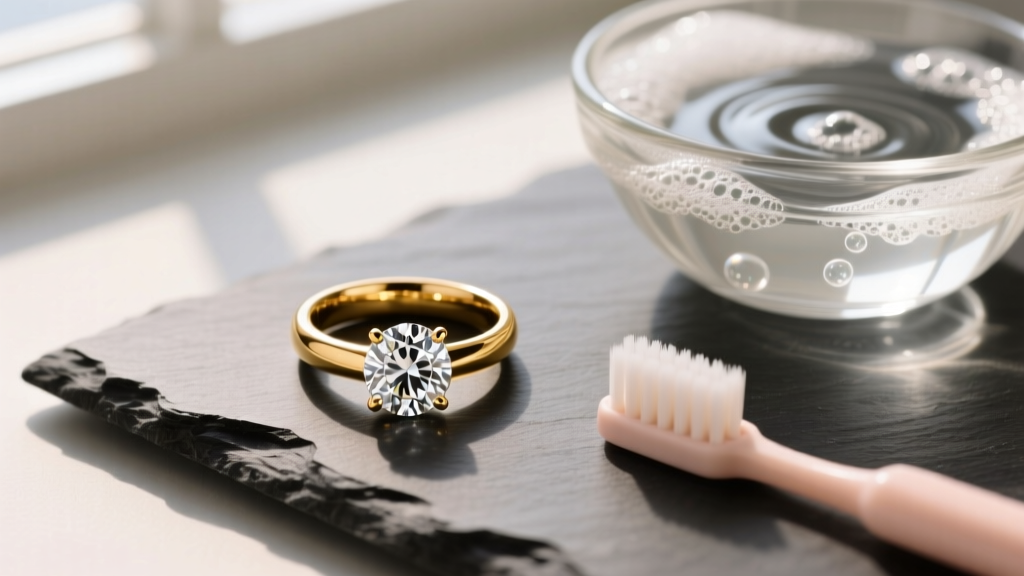
For routine maintenance, you do not need expensive commercial solutions. The most effective, universally safe method relies on breaking down the lipophilic oils coating the diamond's pavilion (the bottom facets). Here is the exact protocol used by professional jewelers for safe at-home care.
The Ultimate Soak Solution
- The Mixture: Combine 1 cup of lukewarm water (approximately 95°F to 100°F) with 1/4 teaspoon of a mild, non-detergent liquid dish soap (such as original Dawn). Avoid soaps with heavy moisturizers or abrasive micro-beads.
- The Soak: Submerge the jewelry completely for 20 to 40 minutes. This dwell time is critical; it allows the surfactants to emulsify the hardened sebum trapped under the diamond's girdle.
- The Agitation: Use an extra-soft baby toothbrush (bristle diameter of 0.12mm or less). Gently brush the underside of the diamond and the interior of the band. Never use a standard adult toothbrush, as the stiff nylon bristles can micro-scratch high-polish 18k gold.
- The Rinse: Rinse thoroughly under a gentle stream of lukewarm water. Always place a mesh strainer over the drain to prevent catastrophic loss.
- The Dry: Pat dry with a 100% cotton, lint-free jeweler's cloth. Avoid paper towels, as their wood-pulp fibers can leave microscopic scratches on the gold and lint on the prongs.
Advanced Cleaning: Ultrasonic and Steam Machines
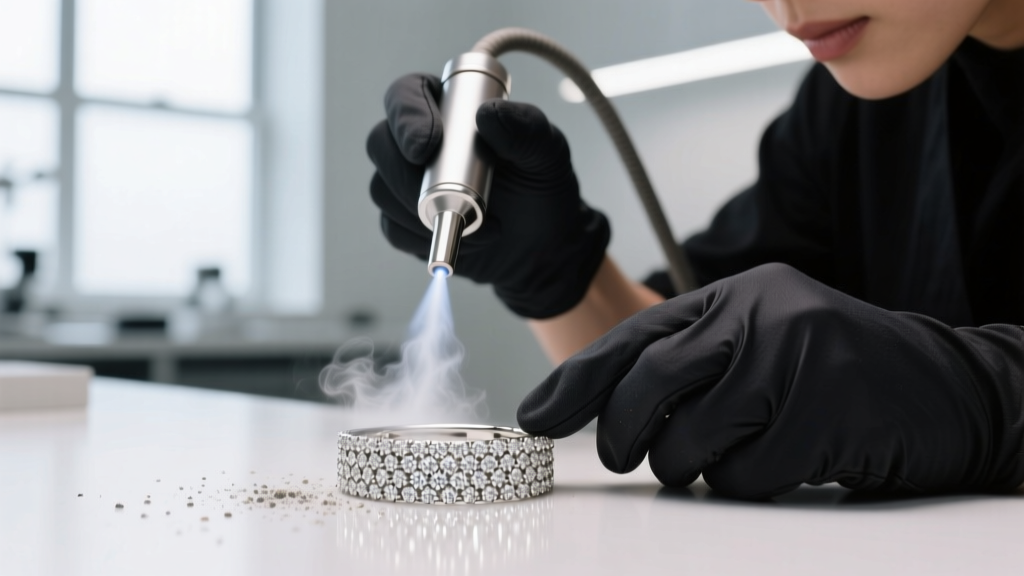
Many buyers purchase at-home ultrasonic cleaners, assuming they are the ultimate solution for learning how to clean jewelry gold and diamonds. These machines use high-frequency sound waves to create microscopic cavitation bubbles in a liquid solvent, which implode and blast dirt away from the metal. While highly effective for solid 18k yellow gold and untreated diamonds, they are incredibly dangerous for certain jewelry types.
Warning: Never place fracture-filled diamonds, clarity-enhanced diamonds, or diamonds with deep internal feathers into an ultrasonic cleaner. The intense vibrational energy can cause the glass-like fillers to cloud or the stone to fracture entirely. Furthermore, the vibrations can shake loose diamonds from pave or micro-prong settings if the prongs are even slightly worn.
Steam cleaners, which shoot high-pressure vapor at 212°F, are excellent for blasting away the final residue after a chemical soak. However, the Federal Trade Commission (FTC) notes that sudden thermal shock can damage certain gemstones. While diamonds are highly resistant to thermal shock, the gold settings are not immune to warping if the metal is exceptionally thin. Always steam clean only heavy-cast, solid gold pieces.
What to Avoid: Common Mistakes That Ruin Jewelry
The internet is saturated with DIY cleaning hacks that cause irreversible damage. To protect your investment, strictly avoid the following practices:
- Toothpaste and Baking Soda: Both are highly abrasive. Diamonds rank a 10 on the Mohs scale, but gold is exceptionally soft. Scrubbing gold with toothpaste will strip the high-polish finish, leaving a dull, matte texture that requires professional re-polishing to fix.
- Chlorine and Bleach: Chlorine reacts violently with the alloy metals in karat gold, creating a chemical process called stress corrosion cracking. This makes the gold brittle, often resulting in prong failure.
- Boiling Water: While boiling water can clean diamonds, it can melt the specialized jeweler's wax or epoxies sometimes used in temporary settings or antique jewelry, causing stones to drop out.
By selecting the right setting at the point of purchase and adhering to these precise, chemistry-backed cleaning protocols, your gold and diamond jewelry will maintain its maximum optical brilliance and structural integrity for generations.


