How to Tell If Jewelry Is Real Gold: Expert Testing Guide
Learn how to tell if jewelry is real gold using expert testing methods. Discover acid tests, magnet checks, and hallmark decoding for 10k to 24k pieces.

The Metallurgy of Gold: Understanding Alloys and Counterfeits
When evaluating precious metals, understanding the underlying metallurgy is the first step in authentication. Pure 24-karat gold is exceptionally dense (19.32 g/cm³) but too soft for daily wear, scoring a mere 2.5 on the Mohs hardness scale. To create durable jewelry, metallurgists alloy pure gold with metals like copper, silver, zinc, and palladium. This alters both the color and the specific gravity of the final piece. For instance, 18k yellow gold contains 75% pure gold and 25% alloy metals, dropping its density to approximately 15.60 g/cm³.
Counterfeiters exploit these metallurgical properties. The most sophisticated fakes utilize tungsten, which possesses a specific gravity of 19.25 g/cm³—nearly identical to pure gold. This makes tungsten-cored chains and coins virtually immune to basic water-displacement density tests. Other common base metals used in deceptive gold plating include brass (8.40 g/cm³) and stainless steel (7.90 g/cm³), which are easily unmasked through precise density calculations and magnetic resonance. To accurately determine authenticity, one must move beyond superficial visual checks and employ a multi-tiered testing framework.
Visual Inspection and Hallmark Decoding
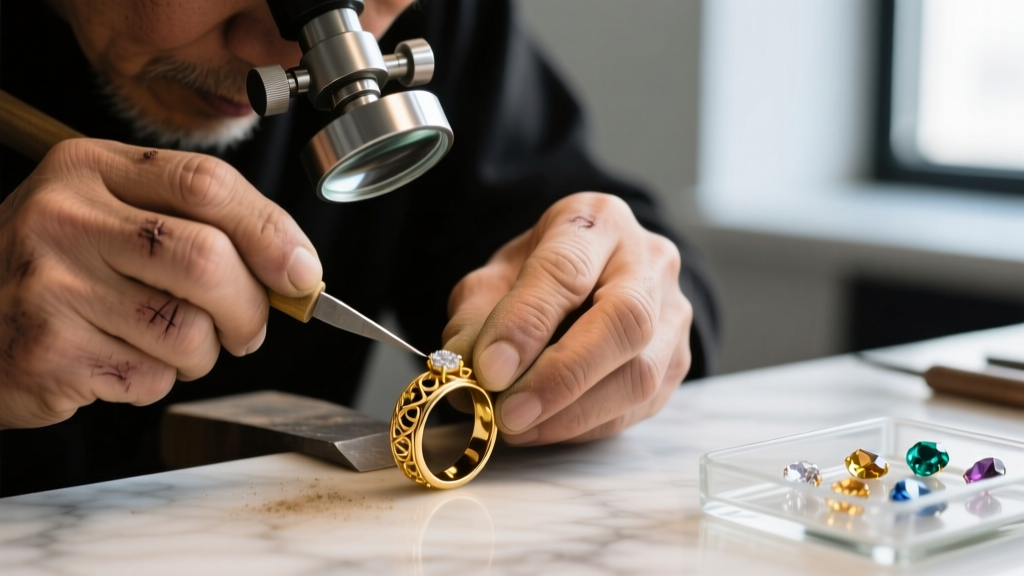
The first line of defense in determining authenticity is a meticulous visual inspection using a 10x or 20x triplet jeweler's loupe. You are looking for two distinct stamps: the quality mark (karat or fineness) and the maker's mark (trademark).

Decoding Karat vs. Millesimal Fineness
In the United States, gold purity is typically denoted in karats (10k, 14k, 18k). In Europe and Asia, the millesimal fineness system is standard, representing parts per thousand of pure gold. According to the Federal Trade Commission Jewelry Guides, if a piece of jewelry sold in the US bears a quality mark (like 14k), it must legally be accompanied by a registered manufacturer's trademark. If you see a "14K" stamp with no accompanying maker's mark, the piece's authenticity is immediately suspect.
- 10k / 417: 41.7% pure gold. Highly durable, pale yellow hue.
- 14k / 585: 58.5% pure gold. The US standard for engagement rings and daily wear.
- 18k / 750: 75.0% pure gold. Rich color, softer, standard in European luxury jewelry.
- 22k / 916: 91.6% pure gold. Very soft, deep orange-yellow, common in Indian and Middle Eastern markets.
Use your loupe to examine the edges of the stamp. Genuine hallmarks are stamped with high-pressure hydraulic presses or laser-engraved, resulting in crisp, clean edges. Counterfeit stamps often appear mushy, shallow, or slightly crooked, indicating they were cast into the mold rather than struck post-production.
Non-Destructive At-Home Testing Methods
Before resorting to chemicals, you can perform non-destructive physical tests to rule out common base metals.
The N52 Neodymium Magnet Test
Gold is diamagnetic, meaning it is slightly repelled by magnetic fields, though this repulsion is too weak to feel by hand. However, if a piece is attracted to a magnet, it contains ferromagnetic metals like iron, nickel, or cobalt. You must use a high-grade N52 neodymium magnet for this test. Note that brass and copper are also non-magnetic, so passing the magnet test does not guarantee the piece is gold; it merely rules out steel and iron cores.
Specific Gravity (Density) Testing
For solid pieces (never hollow or gem-set jewelry), the water displacement method is highly effective. You will need a highly sensitive digital scale (accurate to 0.01g) and a cup of distilled water.
- Weigh the dry piece in the air (Weight A).
- Suspend the piece in water using a fine thread, ensuring it is fully submerged but not touching the bottom or sides, and weigh it (Weight B).
- Calculate the specific gravity:
Weight A / (Weight A - Weight B).
| Material | Specific Gravity (g/cm³) | Magnetic? |
|---|---|---|
| 24k Pure Gold | 19.32 | No |
| 18k Yellow Gold | 15.20 - 15.90 | No |
| 14k Yellow Gold | 12.90 - 14.60 | No |
| Tungsten (Fake Core) | 19.25 | No |
| Brass (Fake Core) | 8.40 - 8.73 | No |
| Stainless Steel | 7.70 - 8.00 | Varies |
Destructive and Chemical Testing: The Professional Standard
When physical tests are inconclusive, or when dealing with heavy gold-plated items, chemical and spectrometric testing becomes mandatory. The Gemological Institute of America (GIA) notes that while non-destructive tech is advancing, chemical acid testing remains a cornerstone of bench-jeweler verification.
The Touchstone and Nitric Acid Test
This method involves intentionally abrading the jewelry to test the underlying metal. Rub the piece firmly across a black basalt touchstone to leave a visible metallic streak. Apply a single drop of nitric acid testing solution formulated for the suspected karat (e.g., 14k acid) directly onto the streak.

- No Reaction: The streak remains bright. The metal is real gold of that karat or higher.
- Milky/Cloudy Reaction: Indicates the presence of silver. The piece may be gold-plated silver or a very low-karat alloy.
- Green/Fizzing Reaction: The acid is eating the copper or brass base metal. The piece is heavily plated or entirely fake.
Warning: Always wear nitrile gloves and eye protection when handling nitric and hydrochloric acid mixtures (aqua regia), as they cause severe chemical burns.
XRF Spectrometry and Its Limitations
X-Ray Fluorescence (XRF) analyzers are the gold standard for pawn shops and refineries. They blast the metal with X-rays and measure the fluorescent light emitted to determine elemental composition down to the decimal. However, XRF has a critical blind spot: penetration depth. Standard XRF guns only read the top 10 to 50 microns of a material. A sophisticated counterfeiter can use a thick layer of 18k gold electroplating over a tungsten or lead core. The XRF will read "18k Gold" with 100% accuracy, completely missing the fraudulent core. This is why XRF must always be paired with a specific gravity test or an ultrasonic thickness gauge.
Advanced Red Flags: Plated, Filled, and Vermeil Deception
Not all fake gold is meant to be malicious; sometimes, the confusion lies in misunderstood terminology. It is vital to differentiate between solid gold and gold alternatives.
Gold Plated (GP / HGE): A microscopic layer of gold (often less than 0.5 microns) applied via electroplating over brass or copper. It will wear off quickly and holds zero melt value.
Gold Filled (GF): A thick layer of solid gold (legally required to be at least 5% of the total weight) mechanically bonded to a brass core via heat and pressure. Highly durable, but not solid gold.
Gold Vermeil: A heavy gold plating (minimum 2.5 microns) over a solid sterling silver base. Valuable, but the gold layer will eventually wear through.
Inspect the clasps and jump rings closely. Counterfeiters often use real 14k gold spring-ring clasps on plated chains to deceive buyers who only test the clasp. Always test the main body of the chain or the pendant bail, preferably on a worn edge where plating is most likely to have rubbed away.
Conclusion: Building a Verification Framework
Knowing how to tell if jewelry is real gold requires a systematic approach. Never rely on a single test. Start with a loupe inspection for hallmarks and maker's marks, proceed to the N52 magnet and specific gravity tests, and reserve acid testing for final verification of questionable pieces. By understanding the exact densities of gold alloys and the legal requirements for stamping, you can confidently navigate the secondary market, protect your investments, and spot sophisticated counterfeits before they reach your vault.


