The Definitive Guide to Buying Gold Arm Cuff Jewelry
Discover how to choose the perfect gold arm cuff jewelry. Learn about karats, sizing, fit, and pricing to make a smart, lasting investment.


The Anatomy of a Gold Arm Cuff
When collectors, stylists, and fine jewelry enthusiasts refer to gold arm cuff jewelry, they are predominantly talking about the bicep bracelet. While wrist cuffs exist, the true arm cuff is designed to sit snugly on the upper arm, between the shoulder and the elbow. This striking accessory has a rich history, dating back to ancient civilizations. According to The Metropolitan Museum of Art, Hellenistic gold arm bands were often forged with intricate repoussé work, symbolizing status and power. Today, the modern arm cuff remains a bold statement piece, but buying one requires a deep understanding of metallurgy, biomechanics, and structural engineering.
Unlike a necklace or a pair of earrings, an arm cuff must interact dynamically with the human body. The bicep expands and contracts, the skin shifts, and gravity constantly pulls the metal downward. As we navigate the luxury jewelry market in 2026, where gold spot prices have elevated solid pieces into serious investment territory, understanding the structural nuances of arm cuffs is critical to avoiding expensive mistakes like metal fatigue, poor fit, and structural snapping.
Selecting the Right Gold Karat for Structural Integrity
The purity of gold dictates not just its color and value, but its tensile strength and malleability. The Gemological Institute of America (GIA) notes that pure gold is exceptionally soft, which is a major liability for a piece of jewelry that relies on tension and friction to stay on the arm. Choosing the right karat is a balancing act between luxury, color saturation, and mechanical durability.
Why 24K and 22K Are Problematic for Arm Cuffs
While 24K (99.9% pure) and 22K (91.6% pure) gold offer that rich, buttery yellow hue prized in high jewelry, they are fundamentally unsuited for the mechanical stress of a bicep cuff. An arm cuff must be squeezed slightly to slide over the widest part of the bicep and then spring back to grip the arm. Pure gold lacks "memory" and will permanently deform, bending out of shape after just a few wears. Furthermore, the soft metal will easily dent against doorframes or furniture.
The Sweet Spot: 18K and 14K Gold
For gold arm cuff jewelry, 18K (75% gold) and 14K (58.3% gold) are the industry standards. 18K offers a luxurious, warm color and sufficient durability for occasional or high-fashion wear. However, 14K gold, alloyed with copper, silver, and zinc, provides the ideal tensile strength for an everyday arm cuff. The alloying metals introduce a "springiness" that allows the cuff to flex slightly and return to its original shape without suffering permanent deformation.
| Karat | Gold Purity | Tensile Strength | Best Use Case | Relative Price Tier |
|---|---|---|---|---|
| 24K | 99.9% | Very Low (Bends easily) | Investment bars, non-tension rings | Premium |
| 22K | 91.6% | Low (Prone to scratching) | Occasional wear, wide rigid bands | High |
| 18K | 75.0% | Moderate (Good flex) | Luxury event wear, high fashion | High |
| 14K | 58.3% | High (Excellent spring) | Daily wear, active lifestyles | Moderate |
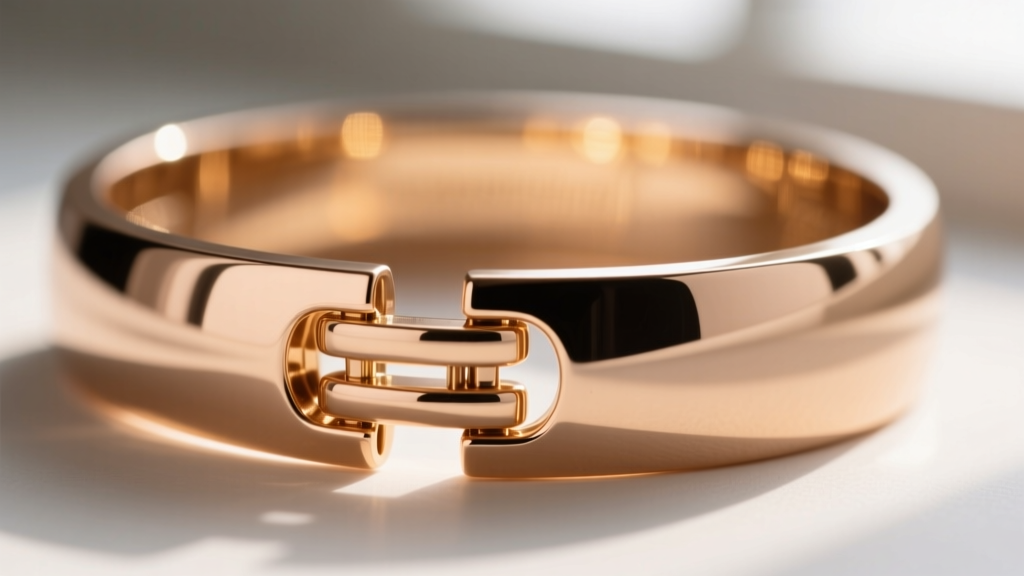
The Biomechanics of Fit: Sizing Your Bicep
The most common failure point when buying gold arm cuff jewelry online is incorrect sizing. Unlike a wrist, which has a prominent bone structure (the ulna styloid process) to stop a bracelet from sliding off, the arm is a tapered cylinder. If a cuff is too loose, it will slide down to the elbow. If it is too tight, it will restrict blood flow and cause discomfort.
How to Measure for an Arm Cuff
To get an accurate measurement, you need a flexible tailor's measuring tape. Measure the circumference of your bicep while your arm is completely relaxed. Then, flex your bicep and measure again. The difference between these two numbers can be anywhere from 0.5 to 1.5 inches, depending on your muscle mass.
A well-fitted rigid gold arm cuff should have an internal circumference that matches your relaxed bicep measurement, minus the width of the gap at the front. For example, if your relaxed bicep is 12 inches, and the cuff has a 1.5-inch gap at the front, the total inner circumference of the metal band should be roughly 10.5 inches. This gap allows you to slide the cuff over your flexed bicep and rotate it into place.
The "Slide and Rotate" Application Method
Never attempt to squeeze a solid gold arm cuff open like a bangle. Instead, use the slide and rotate method: slide the cuff up your arm from the wrist (where the arm is narrowest), push it past the elbow joint, and rotate it 90 degrees so the gap sits on the inner or outer part of your arm, not directly over the bicep peak. This prevents the metal from stretching outward over time.

Construction Methods: Cast vs. Fabricated
When evaluating gold arm cuff jewelry, how the piece is made is just as important as what it is made of. The manufacturing method dictates the metal's grain structure, which directly impacts its resistance to metal fatigue.
The Dangers of Cast Cuffs
Many mass-produced gold cuffs are created using lost-wax casting. While casting is excellent for intricate, detailed designs, it produces a porous, brittle metal structure at the microscopic level. When a cast gold cuff is repeatedly bent to be put on and taken off, microscopic fractures form along the crystalline grain boundaries. Over time, this leads to catastrophic failure—the cuff will simply snap in half without warning. If you are buying a wide, heavy cast cuff, ensure it has a steel or titanium core hidden inside the gold to provide structural memory.
The Superiority of Fabricated and Forged Cuffs
For a pure gold arm cuff that will last generations, look for pieces that are fabricated from rolled sheet metal or forged by hand. Rolling and forging align the metal's crystalline structure and "work-harden" the gold. This process increases the tensile strength and gives the metal a natural springiness. A hand-fabricated 14K or 18K gold cuff will flex gracefully and return to its exact original shape thousands of times without cracking.
Pricing Expectations and Weight Metrics
In 2026, the price of gold arm cuff jewelry is heavily dictated by its gram weight. Because the upper arm requires a wider surface area to look proportionate (typically 15mm to 30mm in width), these pieces require a significant amount of metal.
- Hollow / Electroformed Cuffs ($400 - $900): These are lightweight and visually large but are extremely fragile. A single drop onto a hard floor can dent them irreparably. They are strictly for occasional, careful wear.
- Semi-Solid / Medium Weight Cuffs ($1,200 - $2,500): Usually weighing between 25 and 40 grams, these offer a good balance of presence and durability. They are often die-struck or cast with reinforced cores.
- Heavyweight Solid Cuffs ($3,500 - $8,000+): Weighing 50 to 100+ grams, these are solid, hand-fabricated pieces. They sit heavily on the arm, feel luxurious, and will easily outlast the wearer. The price is primarily driven by the intrinsic melt value of the gold plus the artisan's labor.
Care, Maintenance, and Avoiding Metal Fatigue
Gold is a noble metal and will not tarnish, but the alloys mixed with it (like copper and silver) can react to environmental factors. To maintain the high-polish or satin finish of your arm cuff, wipe it down with a microfiber cloth after wearing it to remove skin oils, lotions, and sweat, which can dull the luster over time.
The greatest threat to your gold arm cuff jewelry is metal fatigue. To extend the life of your piece, commit to the "slide and rotate" method every single time you wear it. Never let a friend "help" you put it on by squeezing the sides, as uneven pressure from untrained hands can warp the circular geometry into an oval, ruining the fit and weakening the structural integrity. When not in use, store the cuff in a soft velvet pouch, separate from diamond jewelry, which can easily scratch the gold surface during transit.
By prioritizing structural fabrication, choosing the correct karat for your lifestyle, and meticulously measuring your bicep, you can acquire a gold arm cuff that is not only a stunning sartorial anchor but a resilient, lifelong heirloom.


