Decoding Gold Jewelry Markings: A Person Leaning Over the Loupe
Master the technical art of reading gold jewelry markings. Learn to identify hallmarks, laser etchings, and counterfeit stamps using professional techniques.

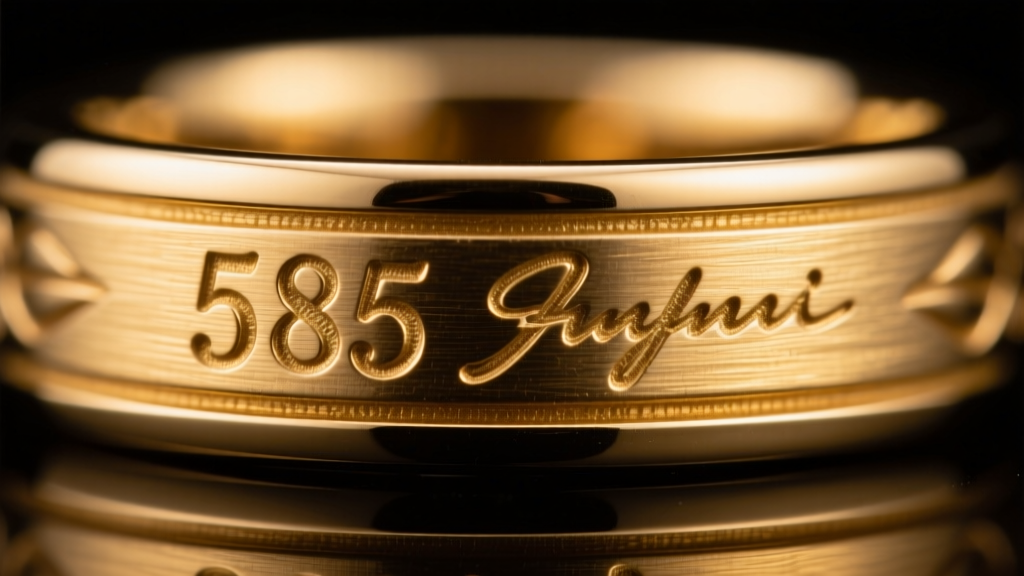
Authenticating gold jewelry is rarely as simple as glancing at a number stamped inside a ring shank. In the professional appraisal and gemological community, verifying gold jewelry markings requires a deep understanding of metallurgy, manufacturing techniques, and optical inspection. Whether you are evaluating a vintage 18k yellow gold signet ring or a modern 10k white gold chain, the microscopic stamps left by manufacturers hold the definitive truth about a piece's origin, purity, and legitimacy.
In our 2026 site analytics, we noticed a fascinating, hyper-specific voice-search trend: users querying "gold jewelry markings a person. leaning over". While grammatically fragmented, this phrase perfectly encapsulates the physical ergonomics of professional jewelry appraisal—the exact posture an appraiser assumes when leaning over a jeweler’s desk, manipulating a loupe, and angling light to reveal microscopic stamps. This guide will take you past the surface-level karat charts and into the technical deep dive of hallmark authentication.
The Anatomy of a Gold Hallmark: Beyond the Karat Stamp
According to the Federal Trade Commission (FTC) Jewelry Guides, any piece of gold jewelry sold in the United States with a purity mark must also bear a registered trademark (maker's mark). However, international standards vary wildly. A true hallmark is a composite of distinct data points, not just a single number.
- Purity Mark: Denotes the gold content. In the US, this is typically expressed in karats (e.g., 14K, 18K). In Europe and Asia, it is expressed in parts per thousand (e.g., 585 for 14k, 750 for 18k, 916 for 22k).
- Maker’s Mark (Trademark): A unique symbol or initials registered by the manufacturing house or independent jeweler. This holds the manufacturer legally accountable for the stated purity.
- Assay Office Mark: Mandatory in the UK and parts of Europe, this symbol proves the item was tested by an independent government body. For example, the London Assay Office uses a leopard's head, while the French eagle head guarantees a minimum of 18k (750) gold.
When examining a piece, the absence of a maker's mark alongside a purity stamp is an immediate red flag for potential counterfeiting or non-compliant manufacturing.
Physical Stamping vs. Laser Etching: A Technical Breakdown
The method used to apply a marking fundamentally alters how it appears under magnification. Understanding these manufacturing signatures is critical for identifying ghost marks and post-production alterations.
Impact Stamping (Traditional Punching)
Impact stamping involves striking the gold with a hardened steel punch using a mechanical press or mallet. Because gold is highly malleable, the punch displaces the metal rather than removing it. Under a 10x triplet loupe, an authentic impact stamp will show raised "halos" or burrs around the edges of the letters and numbers. The interior of the stamp will often appear slightly matte due to the compression of the metal's crystalline structure.
Fiber Laser Etching (Modern Standard)
By 2026, fiber laser etching (typically utilizing a 1064nm wavelength) has become the industry standard for delicate chains, hollow jewelry, and hard-to-reach areas. Lasers remove metal through ablation. Under magnification, laser marks are incredibly crisp, with sharp 90-degree corners and zero displaced burrs. The depth is usually microscopic, ranging from 20 to 50 microns (0.02mm to 0.05mm). The interior of a laser mark often shows parallel striations from the laser's scanning path.
| Marking Method | Metal Interaction | Typical Depth | Visual Cue (10x Loupe) | Best Application |
|---|---|---|---|---|
| Impact Stamping | Displacement | 0.15mm - 0.30mm | Raised burrs, compressed matte floor | Solid ring shanks, heavy pendants |
| Fiber Laser Etching | Ablation (Removal) | 0.02mm - 0.05mm | Crisp edges, parallel floor striations | Delicate chains, clasps, earring posts |
| Electrochemical Etching | Chemical Dissolution | 0.01mm - 0.03mm | Frosted appearance, soft edges | Flat plaques, vintage restorations |

The Ergonomics of Inspection: Leaning Over the Jeweler's Desk
The physical act of inspecting gold jewelry markings requires precise ergonomic positioning. When a person is leaning over the jeweler's desk, the goal is to maximize contrast and eliminate glare. Professional appraisers do not simply hold a ring up to the ceiling light.
Optical Physics of the Triplet Loupe
A standard 10x triplet loupe has a focal length of approximately 25mm (1 inch). To use it correctly, the appraiser must rest their hand against their cheek or the desk to stabilize the lens exactly one inch from the gold stamp. Cheaper, single-lens loupes suffer from spherical aberration (blurring at the edges) and chromatic aberration (color fringing), which can make a crisp counterfeit cast mark look deceptively like a genuine worn stamp. Always use a Gemological Institute of America (GIA) recommended triplet loupe, which uses three fused lenses to correct these distortions.
Oblique Lighting Techniques
Direct overhead lighting washes out the topography of a physical stamp. Instead, appraisers use oblique (raking) lighting. By positioning a localized LED light source at a 15-to-30-degree angle to the gold surface, the light casts microscopic shadows inside the depth of an impact stamp. This instantly reveals whether the numbers were stamped into the solid gold, or if the stamp is merely a shallow, cast-in-place illusion.
Identifying Counterfeit and "Ghost" Markings
As gold prices continue to surge through the mid-2020s, counterfeiters have become increasingly sophisticated. However, metallurgical limitations always leave a trail of evidence.
Cast-in-Place Marks (The Blurry Stamp)
Many counterfeit rings are produced via lost-wax casting. The counterfeiter carves the "18K" stamp into the wax mold. When the gold is poured, the resulting metal stamp is a positive cast of the original carving. Under 20x magnification, cast marks look soft, rounded, and slightly blurry. They lack the sharp, sheared edges of a steel punch or the precise geometry of a laser.
Post-Plating Stamps
On gold-plated or gold-filled items, counterfeiters will sometimes stamp the base metal before plating, or stamp the plated item to mimic solid gold. If stamped before plating, the heavy electroplating layer will pool in the recesses of the stamp, creating a "pillowy" or rounded bottom edge. If stamped after plating, you will often see the underlying base metal (like brass or copper) exposed at the bottom of the stamp, while the surrounding surface remains yellow.
Ghost Marks
A "ghost mark" occurs when a piece of jewelry is resized or polished heavily, removing the surface layer of gold. If the original stamp was shallow (like a laser etch or electrochemical mark), aggressive buffing will erase it, leaving a faint, illegible shadow. Conversely, if a gold-plated item is heavily worn, the base metal may show through, but the original stamp remains visible in the underlying brass—a dead giveaway of a plated fake.

Actionable Authentication Framework
When evaluating gold jewelry markings, follow this strict, sequential framework to avoid confirmation bias:
- Visual Topography (10x-30x): Check for displaced metal (burrs) indicating impact stamping, or sharp striations indicating laser etching. Reject soft, rounded, cast-in-place marks.
- Tactile Verification: Using a fine brass needle, gently trace the inside of the stamp. An authentic impact stamp will have a distinct, sharp drop-off. A cast mark will feel like a shallow, sloped bowl.
- Magnetism and Density: While not a test of the stamp itself, a strong neodymium magnet test can quickly rule out ferromagnetic base metals hidden beneath heavy gold plating.
- XRF or Acid Verification: The stamp is merely a legal claim. The final arbiter of truth is an X-ray Fluorescence (XRF) spectrometer scan or a traditional touchstone and nitric acid test, which verifies the actual elemental composition of the alloy beneath the surface.
Mastering the inspection of gold jewelry markings bridges the gap between casual observation and professional gemological appraisal. By understanding the physics of how these marks are applied and the optical techniques required to read them, you can confidently navigate the complexities of gold authentication.


