Gold Fever Jewelry Baltimore MD: Gold Alloy Guide
Explore the metallurgical properties of 10k, 14k, and 18k gold alloys, inspired by the appraisal standards of Gold Fever Jewelry Baltimore MD.

The world of gold jewelry is defined not just by its luster, but by the complex metallurgy that transforms a soft, malleable element into enduring wearable art. When evaluating estate pieces, appraising vintage finds, or commissioning custom work at prominent local establishments like Gold Fever Jewelry Baltimore MD, understanding the exact material properties of gold alloys is essential. Pure gold is virtually useless for structural jewelry; it is the precise addition of alloying metals like copper, silver, zinc, and palladium that dictates a piece's color, tensile strength, and melting point. In this comprehensive 2026 material guide, we dissect the metallurgical realities of gold karats, exploring the science that local jewelers and appraisers rely on every day.
The Metallurgy of Gold Alloys: Pure Gold vs. Alloyed Reality
To understand why alloying is necessary, we must first look at pure 24-karat gold. On the Vickers hardness scale (HV), 24k gold registers at a mere 25 HV. To put this in perspective, a human fingernail is roughly 2.5 on the Mohs scale, and pure gold is so soft that it can be permanently deformed by the simple pressure of a firm handshake or the clasp of a heavy pendant. According to the Gemological Institute of America (GIA), pure gold's extreme malleability makes it impossible to securely hold gemstones in prong settings, as the metal will easily bend and release the stone over time.
Alloying solves this structural deficit. By introducing base metals into the molten gold, jewelers alter the crystalline grain structure of the metal. The added atoms disrupt the uniform lattice of the gold atoms, creating internal friction that dramatically increases hardness and tensile strength. However, this comes at a cost to the metal's purity, color, and sometimes its biocompatibility. The exact ratio of these alloying metals is what separates a brittle, tarnish-prone ring from a durable, heirloom-quality piece.
10k, 14k, and 18k: A Baltimore Market Comparison
The United States market heavily favors 14k gold, but high-end custom jewelers and estate buyers frequently encounter 18k and 10k pieces. Below is a metallurgical comparison of the most common gold alloys, detailing their exact compositions and physical properties.
| Karat | Gold Content | Typical Alloy Mix (Yellow) | Vickers Hardness (HV) | Melting Point (°C) | Primary Market Use |
|---|---|---|---|---|---|
| 10k | 41.7% | 58.3% (Copper, Zinc, Silver) | ~160 HV | ~810°C | Budget fashion, class rings |
| 14k | 58.3% | 41.7% (Silver, Copper) | ~140 HV | ~850°C | Standard US engagement & daily wear |
| 18k | 75.0% | 25.0% (Silver, Copper) | ~125 HV | ~900°C | High-end bridal, luxury estate |
| 22k | 91.6% | 8.4% (Silver, Copper) | ~60 HV | ~950°C | Cultural jewelry, investment coins |
Notice the inverse relationship between gold purity and Vickers hardness. While 18k gold offers a richer, deeper yellow hue due to its higher gold concentration, it is inherently softer than 14k. For a tension-set diamond or a pavé band subjected to daily mechanical stress, a master jeweler will often recommend 14k or even a specially hardened 18k alloy to prevent stone loss.
Color Alloys: The Science Behind Yellow, White, and Rose
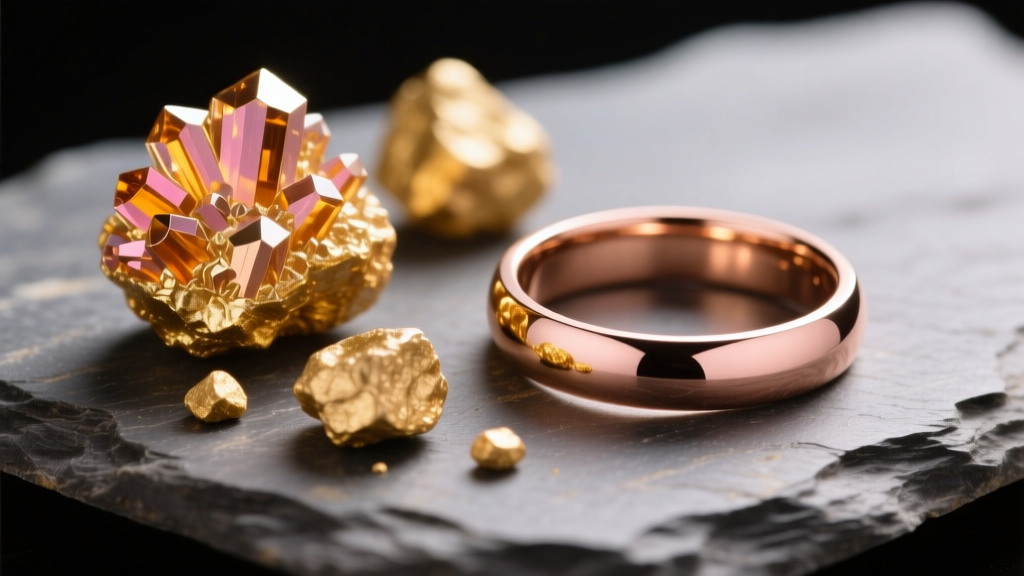
The color of gold jewelry is entirely dependent on the secondary metals introduced during the smelting process. Yellow gold is not simply 'pure gold'; it is a carefully calibrated mixture. A standard 18k yellow gold alloy consists of 75% gold, 12.5% silver, and 12.5% copper. The silver and copper balance each other out, maintaining the warm yellow hue while providing structural integrity.
White Gold: Nickel vs. Palladium
White gold is an alloy designed to mimic the look of platinum. Historically, nickel was the primary bleaching agent used to strip the yellow from gold. However, nickel is a known sensitizer, causing contact dermatitis in approximately 10% to 15% of the population. Today, premium jewelers utilize palladium-based white gold alloys. An 18k palladium white gold mix (75% Au, 25% Pd) is completely hypoallergenic and possesses a naturally whiter, grayer undertone than nickel alloys, requiring less frequent rhodium plating to maintain its bright white finish.
Rose Gold: The Copper Factor
Rose gold derives its distinct pinkish-red hue from a high copper content. A standard 18k rose gold alloy contains 75% gold, 22.25% copper, and 2.75% silver. The high copper content not only changes the color but also increases the alloy's durability and lowers its melting point slightly. However, copper is prone to oxidation; over decades, high-copper rose gold can develop a subtle patina, which many estate collectors highly prize for its vintage character.
Appraisal and Authenticity Testing at Local Jewelers
When bringing inherited or purchased pieces to local experts, the methods used to verify gold content are critical. The Federal Trade Commission (FTC) Jewelry Guides strictly regulate how gold purity can be marked and sold in the US, requiring accurate karat stamping and allowing for a small tolerance (usually 3 parts per thousand for soldered items). To verify these stamps, modern appraisers rely on advanced, non-destructive testing.
- X-Ray Fluorescence (XRF) Spectrometry: This is the gold standard for modern appraisal. XRF machines shoot X-rays into the metal and measure the fluorescent light emitted by the atoms, providing an exact elemental breakdown in seconds. It is non-destructive but only reads the surface layer (up to 20 microns deep), meaning heavily plated items can sometimes fool the machine if not carefully prepped.
- Specific Gravity Testing: Utilizing Archimedes' principle, jewelers weigh the piece in air and then in water. Because pure gold has a specific gravity (SG) of 19.32, an 18k gold piece will register an SG of roughly 15.5, while 14k will sit around 13.0. This test is excellent for detecting hollow interiors or heavy tungsten cores, as tungsten shares a nearly identical specific gravity to pure gold but behaves differently in alloy mixes.
- Acid Testing: The traditional method involves scratching the item on a touchstone and applying nitric acid of varying strengths. While effective for scrap buying, it is destructive and less precise than XRF, making it less ideal for high-value estate appraisals.
Custom Casting Properties and Wearability
For those commissioning bespoke pieces, understanding how different gold alloys behave during the lost-wax casting process is vital. Gold alloys exhibit different shrinkage rates and fluid dynamics when molten. 14k gold, with its higher zinc and copper content, flows exceptionally well into intricate mold details, making it a favorite for highly detailed filigree work. Conversely, 18k white gold containing palladium has a significantly higher melting point and a thicker molten viscosity, requiring specialized high-heat casting equipment and carefully controlled cooling rates to prevent porosity (tiny air bubbles trapped inside the metal).
'The longevity of a custom gold piece is determined long before it is polished; it is decided in the crucible. The grain structure established during the cooling phase of casting dictates whether a prong will hold a diamond for ten years or ten days.' — Master Bench Jeweler
Furthermore, wearability is heavily influenced by the alloy's reaction to environmental factors. Chlorine, found in swimming pools and household cleaners, is the mortal enemy of gold alloys. It attacks the copper and zinc atoms in the alloy matrix, leading to a phenomenon known as 'stress corrosion cracking.' This is particularly prevalent in lower-karat golds (10k and 14k) that have higher base-metal content. An 18k or 22k piece, having fewer base metals, is far more resistant to chemical degradation, though it remains physically softer.
Final Thoughts on Material Selection
Choosing the right gold alloy is an exercise in balancing aesthetics, budget, and mechanical requirements. Whether you are browsing the estate cases at Gold Fever Jewelry Baltimore MD or working with a custom CAD designer, look beyond the karat stamp. Consider the specific alloy mix, the intended daily wear of the piece, and the setting style. A heavy, bezel-set cabochon pendant can safely be crafted in soft, rich 22k gold, while a delicate micro-pavé engagement ring demands the structural rigidity of a well-formulated 14k or hardened 18k alloy. By understanding the deep metallurgical properties of gold, you ensure your jewelry is not just beautiful, but engineered to last generations.