Gold Hallmarks Jewelry Guide: What Buyers Must Look For
Master the hidden language of gold hallmarks jewelry. Learn to decode purity stamps, maker's marks, and assay symbols to guarantee authenticity.

The Hidden Language of Gold Jewelry
When you are investing in fine jewelry, the visual appeal of a piece is only half the story. The true narrative of its origin, authenticity, and material integrity is etched into the metal itself. Understanding gold hallmarks jewelry is not just a skill for antique appraisers; it is a critical defense mechanism for modern buyers navigating a market flooded with sophisticated counterfeits and misleading plating techniques. As we move through 2026, with gold prices reaching historic highs, the incentive for bad actors to misrepresent gold purity has never been stronger.
A hallmark is essentially a metal's passport. It provides a legally binding guarantee of the precious metal's fineness, traces the piece back to its manufacturer, and often reveals the exact year and location of its assay. However, the global landscape of hallmarking is notoriously fragmented. A stamp that guarantees solid 18-karat gold in London might be entirely absent on an equally pure piece crafted in New York. This comprehensive buying guide will decode the anatomy of gold hallmarks, teach you how to spot deceptive red flags, and equip you with the knowledge to buy with absolute confidence.
The Anatomy of a True Hallmark
To the untrained eye, the tiny stamps inside a ring band or on a necklace clasp look like a random jumble of numbers and symbols. In regions with strict regulatory oversight, a full traditional hallmark consists of three or four distinct marks, each serving a specific legal function. According to the UK Assay Office, a legally recognized hallmark must contain the following elements:
- The Sponsor's or Maker's Mark: This is the registered trademark of the company or individual who submitted the piece for hallmarking. It is usually contained within a unique shield shape (like a rectangle or diamond) and consists of two or three initials.
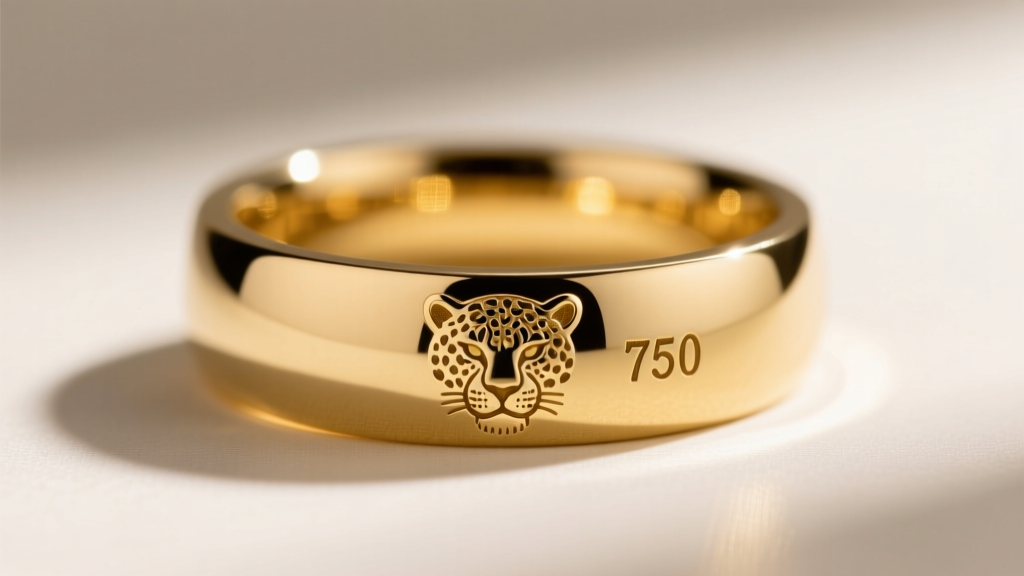
- The Standard (Purity) Mark: This indicates the millesimal fineness of the metal. For example, '750' means the piece is 75% pure gold, which equates to 18 karats. This number is often enclosed in a specific shape, such as an octagon for gold.
- The Assay Office Mark: This symbol identifies which regional office tested and certified the metal. In the UK, this could be a leopard's head for London, an anchor for Birmingham, a rose for Sheffield, or a castle for Edinburgh.
- The Date Letter (Optional but common in antiques): A specific letter in a specific font and shield shape that denotes the exact year the piece was hallmarked. This letter changes annually.
Global Purity Marks: Navigating Regional Differences
One of the most confusing aspects of buying gold hallmarks jewelry internationally is the clash between the Karat system (used primarily in the United States) and the Millesimal system (used in Europe and most of the world). Furthermore, the legal tolerances for purity vary drastically by country.
In the United States, the National Stamping Act of 1906 dictates that a piece marked '14K' must be within 3/1000ths of pure gold if unsoldered, or 7/1000ths if soldered. However, the US does not require an independent assay office stamp; the maker's mark alone acts as the guarantor of purity. In contrast, the UK's Hallmarking Act 1973 makes it a criminal offense to sell an item described as gold unless it has been independently tested and stamped by an official assay office.
| Karat Rating | Millesimal Stamp | Pure Gold Percentage | Primary Market Regions | Common Alloy Metals |
|---|---|---|---|---|
| 10K | 416 or 417 | 41.7% | United States | Copper, Silver, Zinc |
| 14K | 583 or 585 | 58.3% - 58.5% | US, Middle East, Parts of Europe | Copper, Silver, Palladium |
| 18K | 750 | 75.0% | Global Standard for Fine Jewelry | Copper, Silver, Palladium |
| 22K | 916 | 91.6% | India, Middle East, Southeast Asia | Copper, Silver |
| 24K | 999 | 99.9% | China, Investment Bullion | None (Pure Gold) |
Decoding Maker's Marks and Traceability

While the purity mark tells you what the jewelry is made of, the maker's mark tells you who is responsible for it. In the US, the Federal Trade Commission (FTC) mandates that if a piece of jewelry is stamped with a quality mark (like 14K or 585), it must also bear a registered trademark or maker's mark. This is your primary recourse if a piece is later found to be under-karated.
Tracing a maker's mark can be a fascinating journey, especially with estate or vintage jewelry. American maker's marks are registered with the US Patent and Trademark Office (USPTO), while European marks are registered with local assay offices or chambers of commerce. When examining a vintage piece, look for the 'recut' of the shield. If a maker's mark appears blurry or the shield shape is distorted, it may indicate that the stamp was applied after the piece was cast, or that the original die was heavily worn—a common trait in mid-century manufacturing. For modern buyers, a crisp, laser-sharp maker's mark alongside a millesimal stamp is a strong indicator of high-end, precision manufacturing.
Red Flags: Spotting Fake or Misleading Hallmarks
The most dangerous hallmarks are not the missing ones, but the deceptive ones. Unscrupulous manufacturers often use legitimate-looking stamps to sell gold-plated or gold-filled items as solid gold. The Gemological Institute of America (GIA) warns consumers to be highly vigilant of the following abbreviations, which indicate surface treatments rather than solid metal:
- HGE or HGP: Heavy Gold Electroplate or Heavy Gold Plated. This means a microscopic layer of gold is bonded to a base metal like brass. It holds virtually no melt value.
- GF: Gold Filled. While more durable than plating, gold-filled jewelry consists of a base metal core with a thick outer layer of gold (legally required to be at least 5% of the total weight). It is not solid gold.
- EP or EPNS: Electroplated or Electroplated Nickel Silver. Common in vintage costume jewelry, these marks denote base metals with a flash of gold or silver.
- Vermeil: This is gold plating over sterling silver. While higher quality than brass-based plating, it will eventually wear through to the silver beneath.
Expert Warning: If you see a stamp that reads '18K HGE', the '18K' refers only to the purity of the microscopic plating layer, not the core metal. Always read the entire stamp cluster, not just the karat number.
Tools and Techniques for Verifying Hallmarks

Relying solely on visual inspection of a hallmark is no longer sufficient in 2026, as counterfeit stamps can be easily applied with hardened steel punches. Professional jewelers and serious collectors employ a tiered approach to verification:
1. The 10x Triplet Loupe
Every gold buyer should own a 10x triplet loupe (which corrects for color and spherical distortion). Use it to examine the edges of the hallmark. A genuine stamp applied during the manufacturing process will have clean, sharp edges and consistent depth. A fake stamp applied post-production often shows 'haloing' (displaced metal around the edges) or inconsistent striking depth.
2. The Touchstone and Acid Test
The traditional touchstone test involves rubbing the gold against a black basalt stone to leave a streak, then applying nitric acid of varying strengths. If the streak dissolves immediately, the item is base metal. If it resists the 14K acid but dissolves under 18K acid, you have accurately identified the purity. This is a destructive test on a microscopic level and should only be performed on an inconspicuous area.
3. XRF (X-Ray Fluorescence) Scanning
For high-value transactions, XRF scanners are the gold standard. These handheld devices shoot X-rays into the metal and measure the fluorescent energy that bounces back, providing an exact elemental breakdown in seconds without damaging the piece. While commercial XRF scanners cost between $15,000 and $40,000, most reputable estate buyers and pawn shops in 2026 have them on-site. Always ask to have high-ticket items XRF tested before purchasing.
Frequently Asked Questions
Is it illegal to sell gold jewelry without a hallmark?
It depends on the country. In the UK, it is strictly illegal to sell gold over a certain weight without an official hallmark. In the US, it is perfectly legal to sell unmarked solid gold, but if a piece is marked with a karatage, it must legally be accompanied by a maker's trademark.
What does a '925' stamp mean on a gold-colored ring?
A '925' stamp indicates sterling silver. If the ring is gold in color but stamped 925, it is gold vermeil or gold-plated silver, not solid gold.
Can hallmarks be faked?
Yes. Counterfeiters frequently punch fake '18K' or '750' stamps onto brass or tungsten alloys. This is why physical hallmarks must always be verified with secondary testing methods like acid tests, magnetic tests (gold is non-magnetic), or XRF scanning.
Final Thoughts for the Informed Buyer
Decoding gold hallmarks jewelry is a vital skill that bridges the gap between appreciating beautiful design and making a sound financial investment. By understanding the differences between regional purity systems, recognizing the legal weight of a maker's mark, and remaining highly skeptical of deceptive abbreviations like HGE, you insulate yourself from costly mistakes. Always carry a 10x loupe, demand transparency from your jeweler, and remember that a true hallmark is a promise of quality backed by centuries of metallurgical tradition.


