Selecting the Ideal Gold Jewelry Stand: A Technical Guide
Discover the material science behind choosing the perfect gold jewelry stand. Learn about load limits, contact linings, and VOC-safe display engineering.


The Metallurgical Reality: Why Gold Needs Specialized Support
When curating a high-end collection, the display hardware is just as critical as the pieces themselves. A premium gold jewelry stand is not merely an aesthetic choice; it is an archival necessity. To understand why, we must look at the metallurgical properties of gold. Pure 24k gold sits at a mere 2.5 to 3 on the Mohs hardness scale. Even alloyed 18k gold (typically mixed with copper, silver, or zinc) only reaches a hardness of about 2.75 to 3.5. For context, a standard glass display case sits at 5.5, and unpolished steel hardware sits between 4 and 4.5.
Because gold is exceptionally dense (19.3 g/cm³) yet remarkably soft, resting heavy gold chains or solid bangles on unlined metallic or rough wooden displays creates a high-pressure contact point. Over time, the microscopic friction caused by ambient vibrations or simple placement will result in micro-abrasions, dulling the polish and removing precious metal mass. According to the Gemological Institute of America (GIA), the malleability of high-karat gold makes it highly susceptible to surface wear when subjected to improper mechanical stress. Therefore, selecting a display stand requires a deep understanding of material science, load-bearing mechanics, and chemical off-gassing.
Base Material Engineering: Acrylic, Brass, and Hardwoods
The structural base of your stand dictates both its longevity and its chemical safety. Cheap displays often utilize MDF (medium-density fiberboard) or unsealed woods that emit volatile organic compounds (VOCs), which can react with the copper alloys in 14k or 18k rose gold, causing localized surface discoloration. Conservation-grade displays rely on three primary materials:
Cast Acrylic (PMMA)
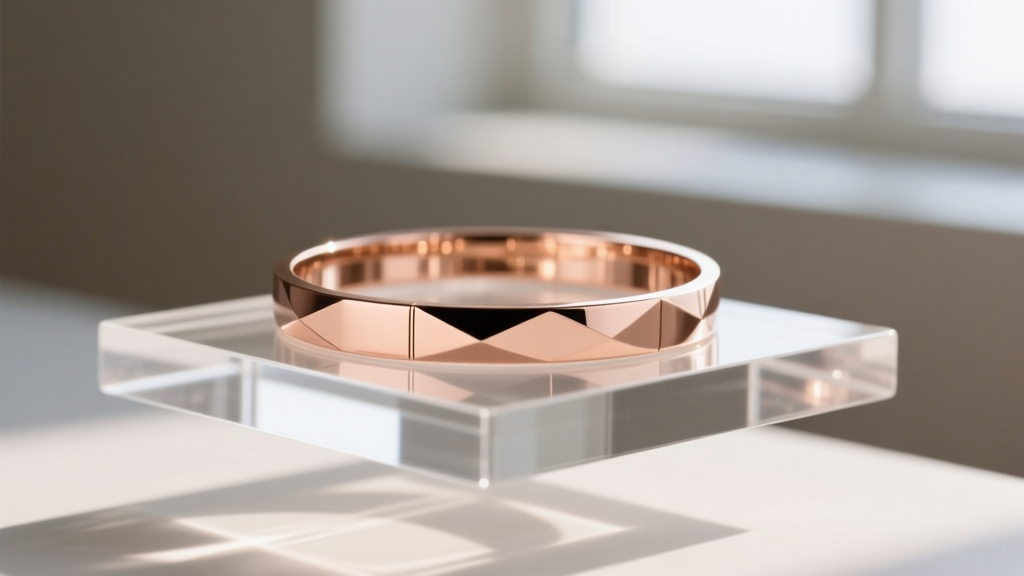
Poly(methyl methacrylate) is chemically inert and passes rigorous Oddy tests for archival safety. Cast acrylic is preferred over extruded acrylic because it can be polished to a glass-like finish without internal stress fractures. It is exceptionally stable, UV-resistant, and will not off-gas sulfur or chlorides that could compromise white gold alloys.
Solid Brass with Protective Lacquers
Brass provides the necessary mass to prevent toppling when draped with heavy gold chains. However, raw brass tarnishes and can transfer patina to porous jewelry components. A high-quality brass stand must be sealed with a baked-on acrylic polymer lacquer to create an impermeable barrier between the display metal and the environment.
Sealed Hardwoods (Walnut and Maple)
Woods like oak and cherry naturally emit acetic acid as they age, which is highly corrosive to the copper and silver alloys found in lower-karat gold. Black walnut and hard maple are preferred due to their low acidity, provided they are sealed with a water-based, non-yellowing polyurethane rather than oil-based finishes that remain tacky and trap dust.
| Material | Weight Capacity | VOC / Acid Risk | Best Gold Pairing |
|---|---|---|---|
| Cast Acrylic (PMMA) | Up to 800g (reinforced) | Zero (Archival Safe) | White Gold, Platinum blends |
| Lacquered Solid Brass | Up to 1.5kg | Zero (if sealed properly) | Yellow Gold (22k, 24k) |
| Sealed Black Walnut | Up to 2kg | Low (if water-sealed) | Rose Gold, Vintage pieces |
| Unsealed Oak / MDF | Variable | High (Acetic Acid / VOCs) | Avoid entirely |
Contact Point Chemistry: Preventing Friction and Tarnish
The exact point where the gold meets the stand is the most critical failure point in display engineering. You must eliminate hard-surface contact using specialized linings. The American Institute for Conservation emphasizes the use of Oddy-tested materials to ensure display environments do not induce chemical degradation.
Silicone Pads (Shore A 30-40)
For rigid gold bangles or heavy signet rings, platinum-cured silicone pads are the industry standard. A durometer rating of Shore A 30 to 40 provides enough cushion to absorb impact without being so soft that heavy gold pieces sink in and become trapped. Crucially, you must use platinum-cured silicone, as tin-cured silicones can release trace acetic acid during their curing process.
Polyethylene Foam vs. Polyurethane
Many commercial stands use polyurethane foam covered in velvet. This is a critical error for archival gold storage. Polyurethane degrades over time, releasing sulfur compounds that cause severe tarnishing in gold alloys containing silver or copper. Always verify that the internal padding is closed-cell polyethylene (PE) foam, which is chemically stable and completely sulfur-free.
Load-Bearing Mechanics for Heavy Karat Gold
Gold's density means that seemingly delicate pieces carry surprising weight. A standard 24-inch solid 18k gold Cuban link chain can easily weigh between 150 and 300 grams. When suspended on a T-bar or necklace bust, this weight creates significant tensile stress on the display's vertical axis.
- Vertical Rod Thickness: Avoid hollow aluminum or thin wire T-bars. The vertical support rod must be a minimum of 4mm in diameter if made of stainless steel, or 6mm if made of solid brass, to prevent bowing under a 300g dynamic load.
- Center of Gravity: Necklace busts must feature a weighted base. The base width should be at least 60% of the total height of the stand to prevent forward-tipping when a heavy pendant shifts the center of mass outward.
- Hook Geometry: The top curve of a T-bar should have a minimum radius of 15mm. Sharp, tight bends (under 5mm radius) will force heavy gold chains into unnatural kinks, potentially weakening the soldered links over time.
Aesthetic Pairing: Matching Stand Finishes to Gold Alloys
Beyond structural integrity, a premium gold jewelry stand must optimize the visual impact of the metal. The refractive index and color temperature of the display background dramatically alter how gold is perceived by the human eye.
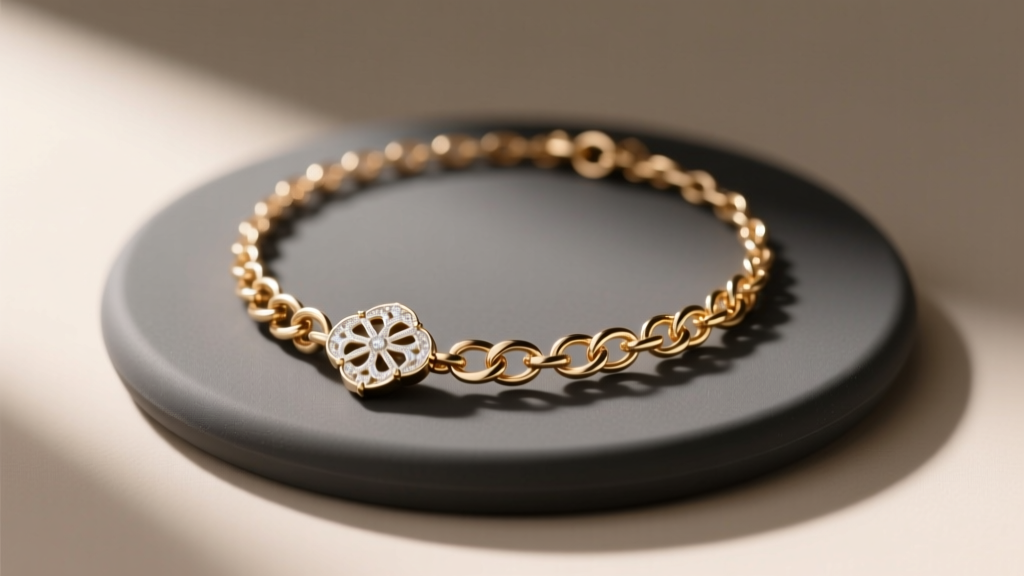
Expert Display Rule: Never display high-polish yellow gold on bright white or mirrored surfaces. The high contrast causes optical glare that washes out the warm undertones of the metal. Instead, utilize deep, matte backgrounds to absorb ambient light and force the eye to focus solely on the gold's natural luster.
Color Theory for Gold Alloys
Yellow Gold (18k - 24k): Pairs best with deep charcoal grey silicone, matte black acrylic, or dark walnut wood. These dark, warm-neutral backgrounds absorb stray light, making the yellow gold appear richer and more saturated.
White Gold (14k - 18k): White gold relies on its rhodium plating for a cool, steely finish. Display these pieces on cool-toned backgrounds like slate grey, navy blue, or frosted clear acrylic to enhance the icy brilliance of the alloy.
Rose Gold (14k - 18k): The copper content in rose gold gives it a warm, pinkish hue. To prevent it from looking muddy, display rose gold on soft, warm-neutral backgrounds such as cream, blush pink microfiber, or light beige suede.
Final Verdict: Building an Archival-Grade Display
Investing in high-karat gold jewelry requires an equal commitment to how it is presented and stored. A true archival-grade gold jewelry stand marries the chemical inertness of cast acrylic or sealed hardwoods with the mechanical cushioning of platinum-cured silicone and polyethylene foams. By respecting the Mohs hardness of the metal and calculating the load-bearing requirements of dense gold chains, you ensure that your collection remains pristine, untarnished, and structurally sound for generations. Always demand material safety data from your display manufacturer, and never compromise on the chemistry of the contact points.


