Navigating Gold Knox Jewelry & Coin Exchange: An Expert Guide
Master the mechanics of gold appraisal and numismatic trading with our expert guide to Gold Knox Jewelry & Coin Exchange valuation protocols.


In the rapidly evolving precious metals market of 2026, the intersection of estate jewelry appraisal and numismatic coin trading requires a highly specialized approach. Establishments like Gold Knox Jewelry & Coin Exchange serve as critical hubs for collectors, investors, and inheritors looking to liquidate or acquire physical gold assets. However, the difference between a profitable transaction and a severe financial loss lies entirely in understanding the technical mechanics of metallurgical assay, melt value calculations, and numismatic premiums. As a domain expert in gold jewelry and bullion markets, I have deconstructed the exact operational frameworks used by top-tier exchanges to evaluate, authenticate, and price gold assets. This deep dive will equip you with the actionable data and scientific testing protocols necessary to navigate any high-level gold exchange with absolute authority.
The Metallurgy of Estate Jewelry Appraisals
When you present estate jewelry to a specialized exchange, the appraisal process transcends simple visual inspection. The foundational metric for any gold jewelry piece is its precise alloy composition. Gold purity is measured in karats, with 24k representing 99.9% pure gold. However, because pure gold is too malleable for structural jewelry, it is alloyed with metals like copper, silver, zinc, and nickel. A standard 14k gold ring contains exactly 58.5% pure gold, while an 18k piece contains 75.0%. Understanding these exact percentages is non-negotiable when calculating melt value.
Historically, exchanges relied on Schwerter's solution and nitric acid scratch tests to determine karatage. While still used as a secondary verification method, modern elite exchanges utilize X-ray Fluorescence (XRF) spectrometry. According to GIA's precious metals education resources, XRF technology bombards the gold surface with X-rays, measuring the fluorescent energy emitted by the alloy's constituent elements to provide a precise elemental breakdown to the nearest 0.1%. This is crucial for identifying deceptive gold-filled or heavily plated items that might pass a superficial acid test.

Calculating Exact Melt Value
To determine the baseline payout for scrap or estate jewelry, exchanges use a strict mathematical formula tied to the live spot price. You can replicate this matrix before approaching the counter:
- Step 1: Weigh the item in grams using a calibrated digital scale (exclude any gemstone weights, as diamonds and semi-precious stones hold no melt value).
- Step 2: Multiply the total gram weight by the karat purity decimal (e.g., 0.585 for 14k, 0.750 for 18k, 0.417 for 10k).
- Step 3: Multiply the resulting pure gold weight by the current spot price per gram (derived by dividing the troy ounce spot price by 31.1035).
- Step 4: Apply the exchange's refining discount, typically ranging from 15% to 25% below melt to cover overhead, assay costs, and refining margins.
For example, if the spot price is $75 per gram, a 10-gram 14k gold chain contains 5.85 grams of pure gold. The gross melt value is $438.75. A reputable exchange will offer a payout matrix reflecting 80% to 85% of this gross melt, yielding approximately $351 to $372 in hand.
Numismatic Coins vs. Bullion: Understanding the Premiums
While jewelry is evaluated primarily on its metallurgical melt value, the coin exchange desk operates on a dual-pronged valuation system: bullion weight and numismatic rarity. Bullion coins are valued strictly on their precious metal content plus a modest market premium. Numismatic coins, however, derive their value from historical significance, mint marks, mintage figures, and state of preservation.
When trading at a specialized hub, it is vital to recognize the exact premium structures applied to different gold coin categories. Below is a technical breakdown of standard gold coins and their typical market behavior in 2026.
| Coin Type | Purity / Fineness | Typical Premium Over Spot | Numismatic Potential |
|---|---|---|---|
| American Gold Eagle (1 oz) | 91.67% (22k) | 3% - 6% | Low (Bullion) |
| Canadian Gold Maple Leaf | 99.99% (24k) | 4% - 7% | Low (Bullion) |
| South African Krugerrand | 91.67% (22k) | 2% - 5% | Moderate (Vintage Years) |
| Pre-1933 Saint-Gaudens ($20) | 90.0% (21.6k) | 10% - 50%+ | High (Date/Mint Dependent) |
The Role of PCGS and NGC Slabs
In the modern numismatic market, raw coins carry a significant authenticity risk and liquidity discount. Top-tier exchanges heavily prefer coins encapsulated by the Professional Coin Grading Service (PCGS) or the Numismatic Guaranty Company (NGC). According to the PCGS CoinFacts database, a Pre-1933 Saint-Gaudens Double Eagle graded MS63 commands a vastly different premium than the exact same coin graded MS65. The exponential jump in value between high-mint-state grades means that expert exchanges will scrutinize the slab's barcode, hologram, and certification number against the grading service's secure database before authorizing a high-value numismatic payout.
Advanced Authentication Protocols: Defeating Counterfeits
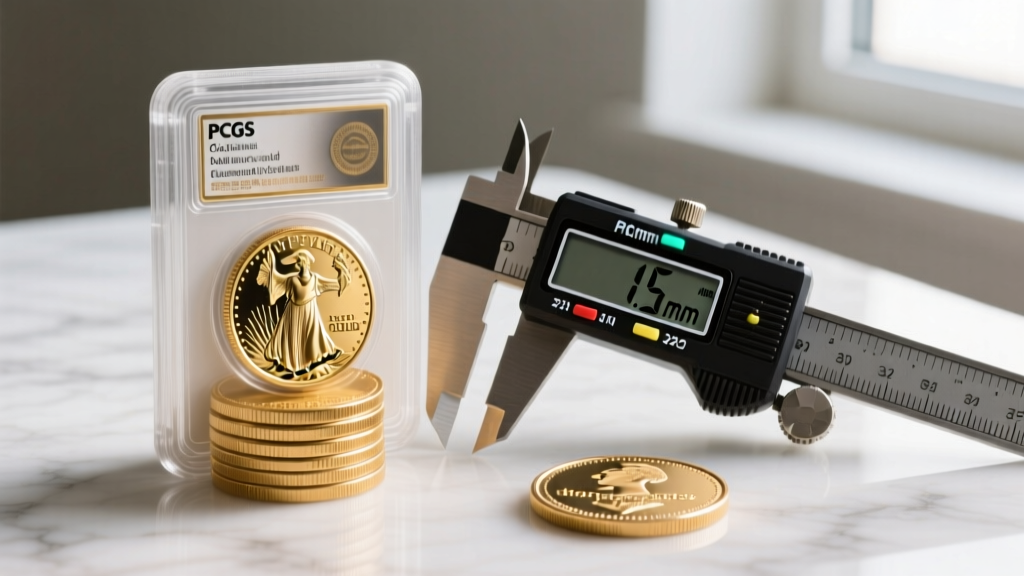
The proliferation of sophisticated counterfeit gold coins and jewelry necessitates advanced authentication protocols. The most dangerous counterfeits in 2026 utilize tungsten cores. Because tungsten shares a nearly identical specific gravity to gold (19.25 g/cm³ for tungsten vs. 19.32 g/cm³ for pure gold), standard weight and dimension checks using digital calipers will fail to detect a tungsten-cored coin.
To combat this, elite coin exchanges deploy a combination of XRF and ultrasonic thickness testing. While XRF verifies the surface composition, it only penetrates a few microns deep. Ultrasonic testing sends high-frequency sound waves through the coin; if a dense tungsten core is present, the acoustic velocity will deviate significantly from the expected speed of sound through solid gold alloys. Furthermore, for high-value estate jewelry, specific gravity testing using distilled water and a laboratory-grade scale remains a foolproof method to verify the overall density of a piece, ensuring that lead or tungsten inclusions are not hiding beneath a thick layer of gold electroplating.
Calculating Your Payout: The Seller's Matrix
To maximize your return when liquidating assets at a jewelry and coin exchange, you must separate your items into distinct valuation categories before approaching the counter. Mixing high-numismatic coins with scrap jewelry allows less scrupulous buyers to apply blanket melt-value pricing to your entire lot. Follow this expert matrix:
- Segregate by Type: Separate bullion coins, numismatic coins, and karat gold jewelry into distinct piles.
- Verify Spot Pricing: Check Kitco's live spot data immediately before your appointment to establish your baseline metric.
- Remove Non-Gold Components: If selling scrap, understand that heavy enamel, steel springs in watch bands, and large gemstones will be deducted from your gram weight. Some exchanges offer a higher percentage payout if you pre-remove these elements.
- Demand Itemized Assays: A reputable exchange will weigh and test each item individually in your presence, providing an itemized receipt that lists the gram weight, karatage, spot price used, and the exact percentage of melt offered.
Expert Verdict & Market Strategy
Whether you are liquidating a multi-generational estate collection or rotating your physical gold portfolio, understanding the technical underpinnings of the appraisal process is your greatest leverage. Establishments operating at the highest level utilize a transparent blend of XRF metallurgical analysis, ultrasonic counterfeit detection, and strict adherence to live spot matrices. By mastering the math behind karatage melt values and recognizing the distinct premium structures of numismatic versus bullion coins, you transform from a passive seller into an informed market participant. Always demand transparency, verify the testing methodologies, and never accept a bulk lot offer without an itemized, scientifically backed breakdown of your gold assets.


