How Can You Tell If Jewelry Is Gold? Expert Testing Methods
Discover exactly how can you tell if jewelry is gold using expert metallurgical tests like XRF spectrometry, acid assays, and specific gravity.

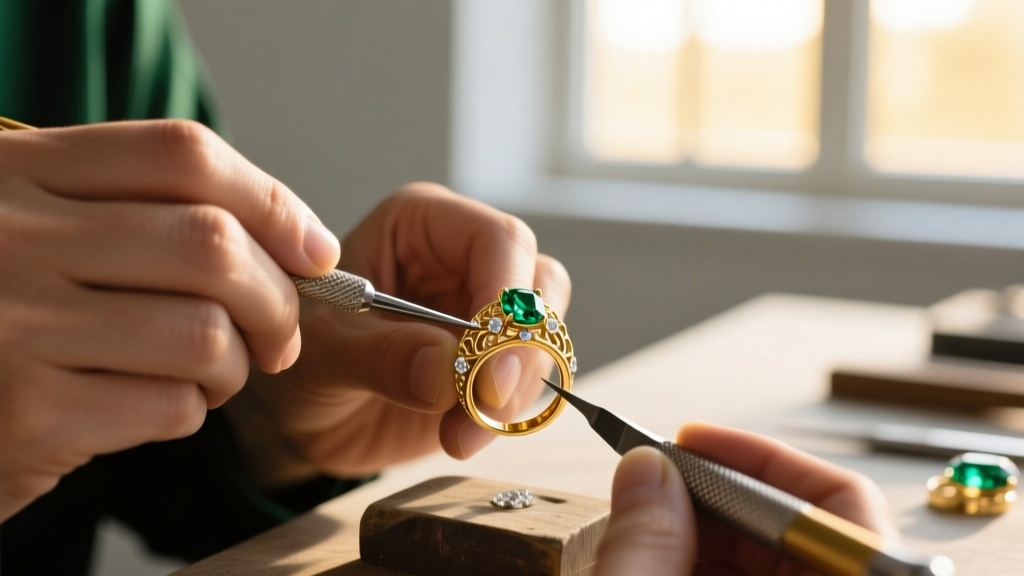
When evaluating precious metals, the question of how can you tell if jewelry is gold extends far beyond viral internet hacks or simple visual inspections. As counterfeit manufacturing techniques have evolved—utilizing tungsten cores, thick gold electroplating, and sophisticated alloy mimics—relying on the 'magnet test' or the 'ceramic plate scratch' is not just inadequate; it is actively destructive to your pieces. To truly authenticate gold jewelry in 2026, professional jewelers and metallurgists rely on a triad of scientific verification methods: X-Ray Fluorescence (XRF) spectrometry, chemical acid assays, and hydrostatic specific gravity testing.
According to the Gemological Institute of America (GIA), gold is rarely used in its pure 24-karat form for jewelry due to its extreme malleability. It is alloyed with metals like copper, silver, zinc, and nickel to achieve structural integrity and varied colors. Understanding these metallurgical realities is the first step in professional authentication.
The Metallurgical Reality: Why Visual and Viral Tests Fail
Before diving into professional testing, it is crucial to understand why common at-home methods fail. Gold is a diamagnetic metal, meaning it is slightly repelled by magnetic fields. However, so are copper, silver, and aluminum. A gold-plated copper chain will pass a magnet test flawlessly, yielding a false positive. Similarly, the 'bite test' relies on the Mohs hardness scale, but pure lead is softer than gold, and modern dental work poses a health risk.
Furthermore, visual inspection is easily fooled by micron-thickness. Modern electroplating can apply up to 2.5 microns of 18k gold over a brass or steel core—thick enough to survive years of wear and pass a superficial polish test, but entirely devoid of intrinsic melt value. True authentication requires penetrating the surface or measuring the atomic structure of the piece.
X-Ray Fluorescence (XRF) Spectrometry: The Non-Destructive Standard
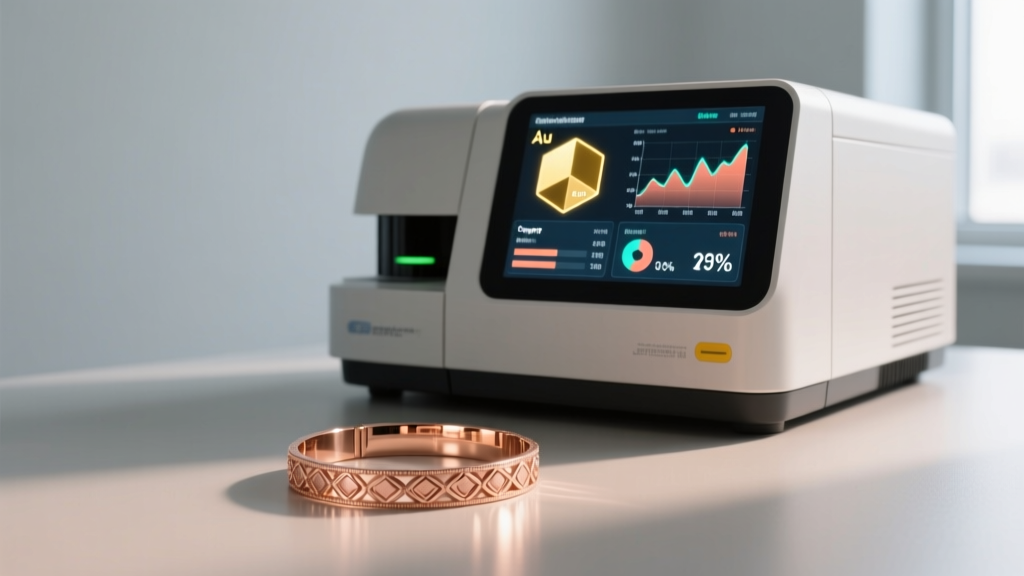
In professional assay offices and high-end refineries, X-Ray Fluorescence (XRF) is the undisputed king of non-destructive testing. An XRF analyzer bombards the jewelry with primary X-rays, exciting the inner-shell electrons of the atoms within the metal. As these electrons return to their stable state, they emit secondary (fluorescent) X-rays at energy levels unique to each specific element.
How XRF Detects Counterfeits
- Surface vs. Core Analysis: While standard XRF penetrates only 10 to 50 microns, advanced units can detect the distinct atomic signature of underlying base metals if the plating is thin.
- Alloy Breakdown: XRF provides an exact percentage breakdown of the alloy. A genuine 14k yellow gold piece will typically show ~58.5% gold, with the remainder split between silver, copper, and zinc. If the machine detects high levels of nickel or tin beneath a gold signature, the piece is plated.
- Rhodium Interference: White gold is almost always plated with rhodium. XRF easily distinguishes between the rhodium flash (atomic number 45) and the underlying gold alloy (atomic number 79), preventing false 'platinum' readings.
While the World Gold Council notes that XRF is the industry standard for rapid verification, it cannot detect a solid tungsten core encased in a thick layer of solid gold, as tungsten's density mimics gold and the X-rays cannot penetrate the thick outer shell. For that, we turn to specific gravity.
Specific Gravity (SG) and Hydrostatic Weighing
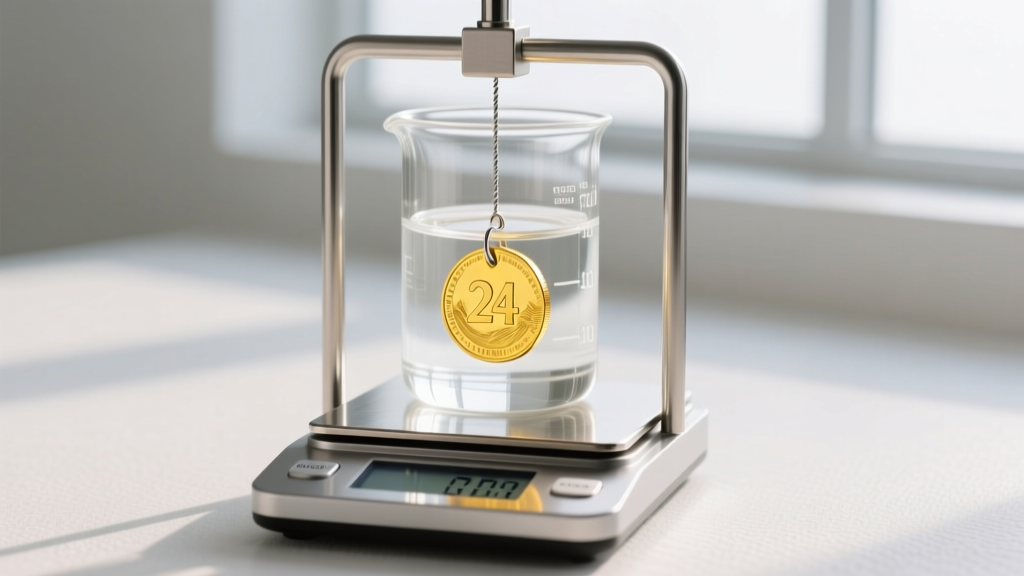
Archimedes' principle remains one of the most effective ways to catch dense counterfeit cores, particularly tungsten. Specific gravity (SG) measures the density of a material relative to water. Pure 24k gold has an SG of 19.32 g/cm³. Because alloying metals are lighter, the SG drops predictably as karat purity decreases.
"Specific gravity testing is the only non-destructive method capable of identifying a tungsten core inside a heavy gold coin or thick chain, as it measures the total volumetric displacement of the entire object."
The Hydrostatic Formula
To perform this test, jewelers use a hydrostatic scale. The piece is weighed in the air, then weighed while fully suspended in distilled water. The formula is:
SG = Weight in Air / (Weight in Air - Weight in Water)
| Gold Karat | Typical Alloy Mix | Expected Specific Gravity (SG) |
|---|---|---|
| 24k | 99.9% Pure Gold | 19.32 |
| 22k | 91.6% Gold, 8.4% Copper/Silver | 17.70 - 17.80 |
| 18k Yellow | 75% Gold, 15% Copper, 10% Silver | 15.20 - 15.90 |
| 14k Yellow | 58.5% Gold, 25% Copper, 16.5% Zinc | 12.90 - 13.60 |
| 10k | 41.7% Gold, 58.3% Base Metals | 11.00 - 11.60 |
If an 18k gold chain yields an SG of 16.5 or higher, it strongly indicates the presence of a denser, non-gold core, as no standard jewelry alloy would produce that reading.
The Touchstone and Acid Assay: Chemical Verification
For definitive surface-level alloy verification, the acid scratch test remains a staple. This requires a novaculite touchstone and precisely calibrated concentrations of nitric acid ($HNO_3$) and aqua regia (a mix of nitric and hydrochloric acid).
Executing the Streak Test
- The jeweler rubs the jewelry firmly against the black novaculite stone, leaving a microscopic streak of metal dust.
- A drop of testing acid is applied directly to the streak.
- The chemical reaction (or lack thereof) is observed under bright, neutral lighting.
| Acid Used | Target Karat | Chemical Reaction & Visual Result |
|---|---|---|
| Standard Nitric Acid | 10k - 14k | 10k turns dark brown/greenish. 14k turns dark brown but remains visible. Base metals dissolve instantly into a green fizz. |
| Standard Nitric Acid | 18k | The streak remains bright and unchanged; nitric acid alone is not strong enough to dissolve 75% pure gold. |
| Aqua Regia | 18k - 24k | 18k dissolves slowly, turning a rich golden-yellow liquid. 24k dissolves rapidly, creating a vibrant, deep orange-yellow solution. |
This test is semi-destructive, as it requires filing through the surface layer (especially on chains or rings that may be gold-filled) to ensure the acid is reacting with the core metal and not just a plated exterior.
Destructive Assay: Fire Assay and Cupellation
When absolute, legally binding certainty is required—such as in international bullion trading or estate liquidation—refiners use fire assay. This involves melting the jewelry down with lead oxide in a porous bone-ash cupel. The lead oxidizes and is absorbed into the cupel, taking base metals like copper and silver with it. What remains is a pure bead of gold and silver, which is then parted in nitric acid to dissolve the silver, leaving only pure gold to be weighed. This method destroys the jewelry but provides a 99.99% accurate measurement of total gold content.
Conclusion: Trust the Science, Not the Hack
Understanding how can you tell if jewelry is gold requires abandoning parlor tricks in favor of applied physics and chemistry. Whether you are evaluating a vintage estate piece or verifying a modern bullion coin, relying on XRF spectrometry for elemental breakdown, hydrostatic weighing for density verification, and acid assays for chemical reactivity ensures your investment is genuinely backed by the earth's most enduring precious metal.