How Do You Clean Gold Filled Jewelry Without Ruining The Finish
Learn how do you clean gold filled jewelry safely. Troubleshoot tarnish, green skin, and dullness with our expert restoration and care matrix.

The Anatomy of Gold-Filled: Why It Demands Specific Care
Before addressing the question of how do you clean gold filled jewelry, it is critical to understand what you are actually cleaning. Unlike gold-plated jewelry, which features a microscopically thin layer of gold applied via electroplating (often less than 0.5 microns thick), gold-filled jewelry is constructed through a mechanical bonding process. According to the Federal Trade Commission (FTC), an item can only be legally stamped and sold as 'gold-filled' in the United States if the solid gold layer constitutes at least 5% of the total weight of the metal.
Typically, this involves a core of jeweler's brass or copper that is subjected to extreme heat and pressure to bond a thick outer layer of 12k or 14k solid gold. In the industry, this is often denoted as '14/20' gold-filled, meaning it is 14k gold comprising 1/20th (or 5%) of the total weight. While this makes gold-filled pieces incredibly durable and capable of lasting decades, the brass core remains the Achilles' heel. If the outer gold layer is worn away through friction or stripped by harsh chemicals, the exposed brass will rapidly oxidize, leading to stubborn tarnish and the dreaded 'green skin' reaction. Therefore, your cleaning protocol must be aggressive enough to remove grime, yet gentle enough to preserve that vital 5% gold layer.
The Daily Reset: How Do You Clean Gold Filled Jewelry Safely?
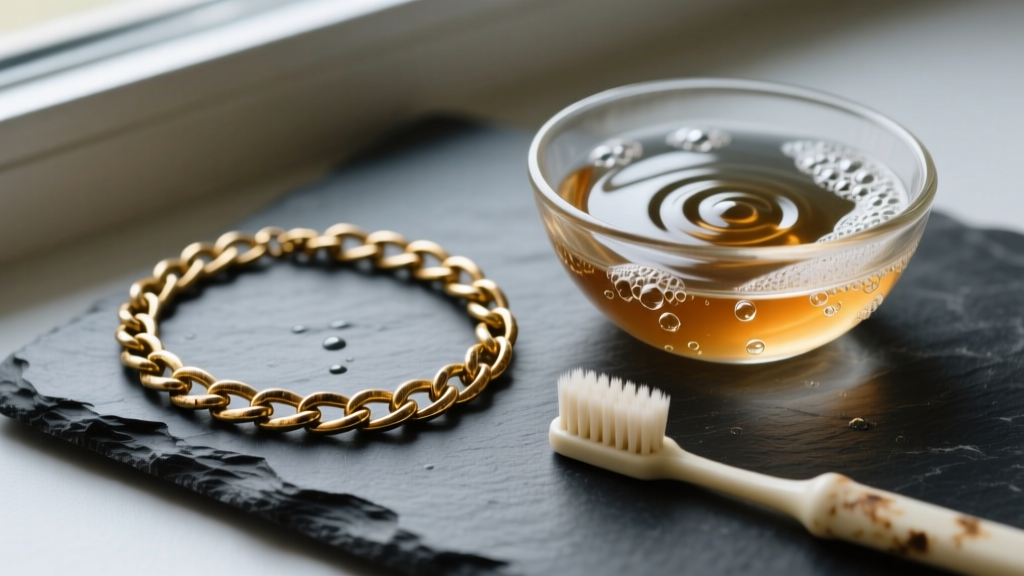
Routine maintenance is the best troubleshooting tool. When lotions, sebum, and environmental dust accumulate in the crevices of a chain link or under a gemstone setting, they trap moisture against the metal, accelerating tarnish. Here is the exact protocol for a safe, deep clean that restores brilliance without compromising the gold layer.
The 5-Step Mild Cleansing Protocol
- Prepare the Solution: Mix three parts lukewarm water (never hot, as extreme heat can weaken mechanical bonds over time) with one part mild, phosphate-free dish soap. Dawn Ultra or a similar gentle degreaser works best to break down body oils.
- Soak Briefly: Submerge the jewelry for exactly 3 to 5 minutes. Do not exceed 10 minutes, as prolonged water exposure can seep into microscopic micro-fissures in the gold layer.
- Agitate Gently: Use an ultra-soft baby toothbrush (bristle hardness under 0.1mm). Brush in small, circular motions, paying special attention to the back of pendants and the clasps of chains where debris accumulates.
- Rinse Thoroughly: Run the piece under lukewarm distilled water. Tap water contains chlorine and trace minerals that can leave hard water spots or react with the gold alloy.
- Dry Completely: Pat dry with a lint-free microfiber cloth, then lay the piece on a paper towel in a well-ventilated area for 30 minutes to ensure all hidden moisture evaporates before storage.
Troubleshooting Matrix: Tarnish, Green Skin, and Dullness
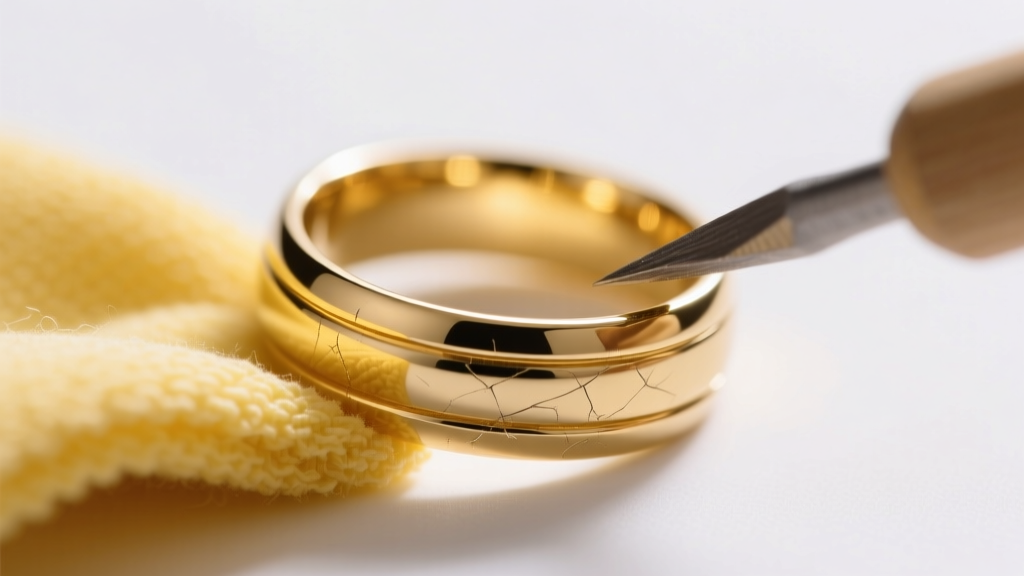
When standard washing isn't enough, you are likely dealing with chemical reactions rather than simple dirt. Use this troubleshooting matrix to diagnose and fix the most common gold-filled jewelry failures.
| Problem | Root Cause | Actionable Solution | What to Avoid |
|---|---|---|---|
| Dark/Reddish Tarnish | Sulfur or oxygen reacting with the copper/brass core through micro-pores in the gold. | Wipe gently with a specialized untreated jewelry polishing cloth (e.g., Pacific Silvercloth). | Baking soda pastes or abrasive polishing compounds that strip the gold layer. |
| Green Skin Staining | Copper oxidation (copper chloride) from the brass core reacting to acidic sweat (pH 4.5-6.0). | Coat the inside of the ring/bangle with a thin layer of clear nail polish or jewelry shield to create a barrier. | Wearing the piece during heavy exercise or while swimming in chlorinated pools. |
| Dull, Cloudy Finish | Buildup of silicone-based lotions, hairspray, or hard water minerals. | Soak in a 50/50 mix of distilled water and white vinegar for exactly 2 minutes, then rinse. | Leaving the piece in vinegar for extended periods, which can etch the gold alloy. |
| Black Spots / Pitting | Chemical burn from chlorine or bleach, causing the copper core to corrode rapidly. | Irreversible. The piece must be professionally re-plated or retired. | Attempting to sand or buff out the pitting, which will expose more core. |
Fix 1: Reversing Surface Tarnish Safely
If your gold-filled piece has developed a reddish or brownish tint, the brass core is oxidizing through microscopic gaps in the gold layer. You might read online about the 'aluminum foil and baking soda' electrochemical bath. Do not use this method on gold-filled jewelry. While it works wonders for solid sterling silver, the galvanic reaction can actually accelerate the corrosion of the brass core if it is exposed anywhere on the piece. Instead, rely on a dry, untreated microfiber polishing cloth. If you must use a treated cloth, ensure it is specifically formulated for gold and use it with zero downward pressure—let the chemical treatment on the cloth do the work, not friction.
Fix 2: The 'Green Skin' Copper Reaction
Many consumers mistakenly believe that green skin indicates an allergy or a 'fake' piece of jewelry. In reality, it is a simple chemical equation. Human sweat contains lactic acid and urea. When this acidic moisture penetrates to the brass core (which is roughly 60-70% copper), it creates copper chloride, a green salt that transfers to your skin. To troubleshoot this, first clean the jewelry using the protocol above to remove existing oxidation. Then, apply a barrier. For rings, painting the inner band with a specialized jewelry coating like Jewelry Shield will prevent the acid-metal reaction entirely.
The Danger Zone: Cleaning Methods That Destroy Gold-Filled Pieces
In the pursuit of restoring shine, many well-meaning owners accidentally destroy the mechanical bond of their gold-filled jewelry. According to gemological care guidelines from the Gemological Institute of America (GIA), gold alloys require specific handling to prevent structural damage. Here are the methods you must absolutely avoid:
- Ultrasonic Cleaners: These machines use high-frequency sound waves to create cavitation bubbles in a liquid solution. When these bubbles collapse against the metal, they create micro-shockwaves. On solid gold, this is fine. On gold-filled jewelry, these shockwaves can cause the 5% gold layer to delaminate, blister, or peel away from the brass core.
- Toothpaste and Baking Soda: Both of these household staples are highly abrasive. Toothpaste contains silica particles, and baking soda ranks at a 2.5 on the Mohs hardness scale. Scrubbing gold-filled jewelry with these will act like sandpaper, permanently wearing through the gold layer and exposing the brass underneath.
- Chlorine and Bleach: Chlorine is the ultimate enemy of gold alloys. It reacts with the copper and zinc in the 14k gold layer, causing a phenomenon known as 'stress corrosion cracking.' Never clean your jewelry in a bathroom where bleach-based cleaners are frequently used, and never wear it in a hot tub.
Long-Term Storage to Prevent Future Tarnish
Troubleshooting is reactive; proper storage is proactive. The primary catalyst for gold-filled tarnish is airborne sulfur and high humidity. To keep your pieces in pristine condition between wears, you must control their micro-environment.
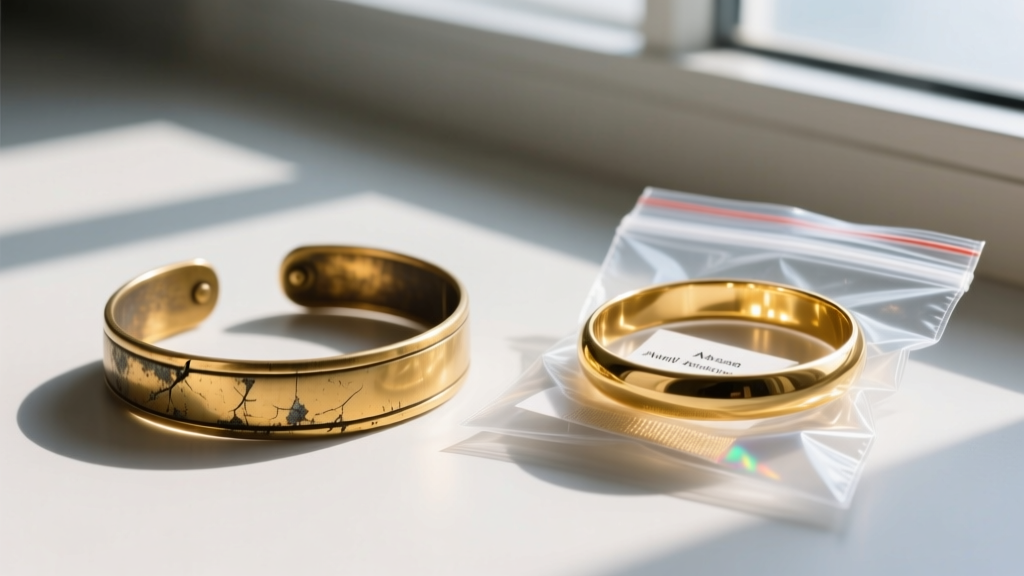
Store each gold-filled piece individually in an airtight, zip-top polyethylene bag. Squeeze out all excess air before sealing. Drop in a 3M Anti-Tarnish strip or a piece of activated charcoal to absorb ambient sulfur and moisture. Keep the bags in a dark drawer, away from direct sunlight and humidity sources like bathrooms.
By limiting the jewelry's exposure to oxygen and sulfur, you effectively pause the oxidation clock, meaning you will have to clean and troubleshoot your pieces far less frequently.
When to Retire the Piece: Recognizing Core Exposure
Gold-filled jewelry is incredibly durable, but it is not immortal. High-friction areas, such as the inside of ring bands or the links of a bracelet that rubs against a desk, will eventually wear through the 5% gold layer. Once the brass core is visibly exposed—appearing as a dull, yellowish-brown or silver-grey patch—cleaning will no longer restore the piece. At this stage, the exposed brass will continuously tarnish and stain your skin. Your only options are to take the piece to a professional jeweler for a thick layer of gold electroplating (which can be costly and may not perfectly match the original 14k hue) or to retire the item. Understanding these limits is the final step in mastering the care and maintenance of your gold-filled collection.


