How to Know If Jewelry Is Gold: Expert Testing & Hallmarks
Learn how to know if jewelry is gold with expert metallurgical tests. Discover specific gravity, XRF analysis, and hallmark decoding techniques.

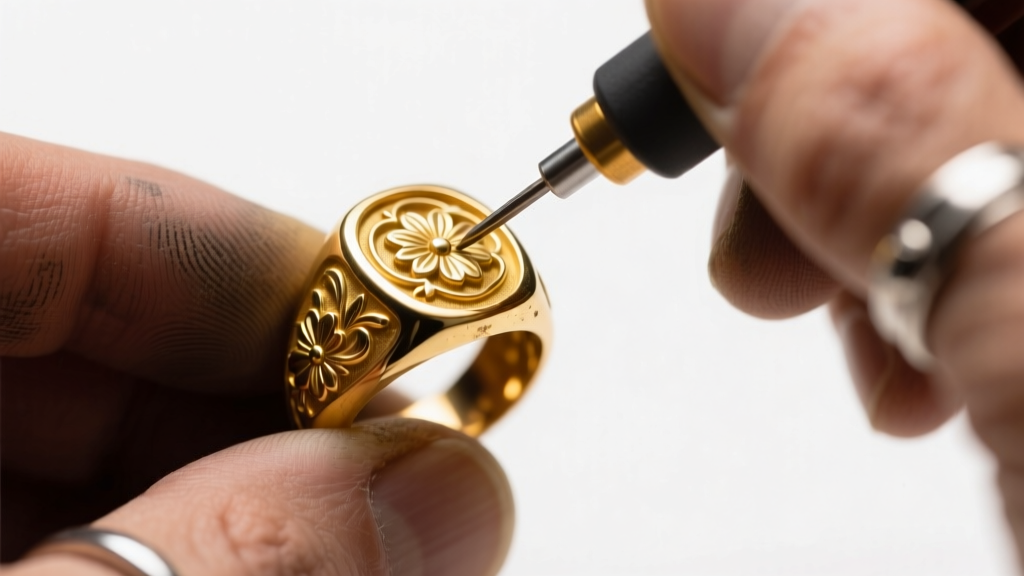
Beyond the Magnet: Why Amateur Gold Tests Fail
When attempting to figure out how to know if jewelry is gold, the internet is flooded with destructive and inaccurate parlor tricks. Biting the metal, scratching it on unglazed ceramic, or holding a neodymium magnet to it will not provide definitive proof of authenticity. Gold is diamagnetic, meaning it is slightly repelled by magnetic fields, but so are silver, copper, and platinum. Furthermore, modern counterfeiters frequently use non-magnetic base metals like brass or copper cores plated with thick layers of gold to easily bypass the magnet test.
As a domain expert in metallurgical jewelry analysis, I advise discarding these amateur methods. They risk damaging the piece's patina or structural integrity while yielding false positives. To truly authenticate gold jewelry, we must rely on a combination of hallmark decoding, specific gravity calculations, chemical reactivity, and advanced spectroscopy.
Decoding Hallmarks and Maker's Marks
The first step in authentication is a visual inspection under a 10x or 20x jeweler's loupe. However, a stamp that reads '14K' or '18K' is merely a claim, not a guarantee. In the United States, the Federal Trade Commission (FTC) mandates that if a piece is stamped with a karat quality mark, it must also bear a registered maker's mark or trademark. If you see a '14K' stamp with no accompanying maker's mark, the piece's authenticity is immediately suspect.
European jewelry relies on the millesimal fineness system, which denotes the parts per thousand of pure gold in the alloy. Understanding these international standards is critical for evaluating estate and imported jewelry.
| Karat Stamp | Millesimal Fineness | Pure Gold Percentage | Common Alloy Metals |
|---|---|---|---|
| 24K | 999 | 99.9% | None (Pure Gold) |
| 22K | 916 | 91.6% | Copper, Silver |
| 18K | 750 | 75.0% | Copper, Zinc, Silver, Palladium |
| 14K | 585 | 58.5% | Copper, Nickel, Zinc |
| 10K | 417 | 41.7% | Copper, Nickel, Zinc |
Be highly suspicious of stamps like 'HGE' (Heavy Gold Electroplate) or 'GF' (Gold Filled). While these contain real gold, they are not solid gold alloys and hold a fraction of the intrinsic melt value.
The Specific Gravity (Density) Test
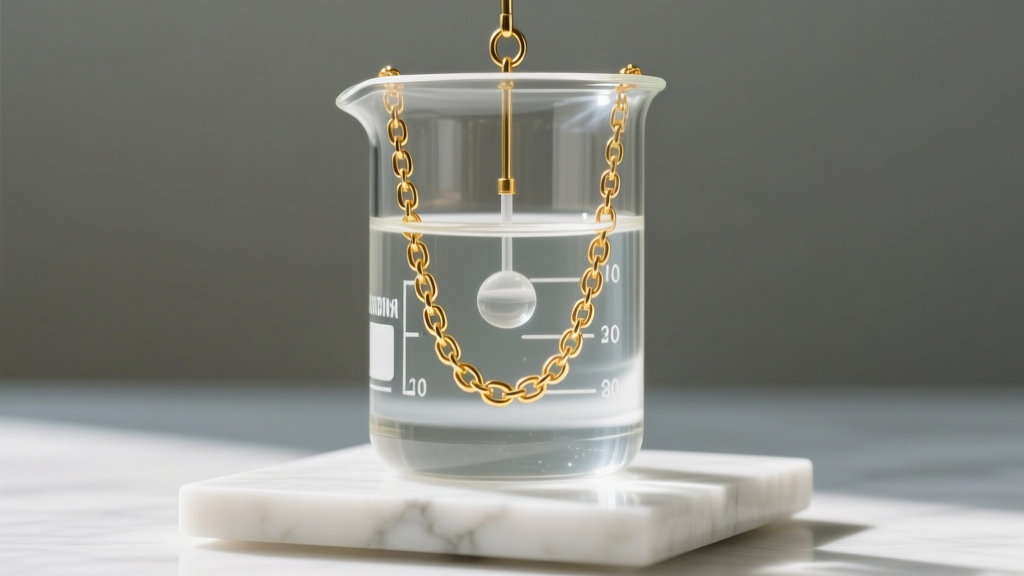
Physics provides one of the most reliable non-destructive methods for testing solid gold: the specific gravity test. Gold is an exceptionally dense element. Pure 24k gold has a specific gravity of 19.32 g/cm³. By measuring the displacement of water, we can calculate the density of the alloy and compare it to known karat standards.
How to Calculate Specific Gravity
You will need a digital scale accurate to 0.01 grams, a beaker of distilled water, and a fine nylon thread.
- Weigh in Air: Weigh the dry piece of jewelry on the scale. Record this weight (e.g., 20.00g).
- Weigh in Water: Suspend the jewelry in the distilled water using the thread, ensuring it is fully submerged but not touching the bottom or sides of the beaker. Record this weight (e.g., 1.80g).
- Calculate Displacement: Subtract the water weight from the air weight (20.00 - 1.80 = 18.20g).
- Divide: Divide the air weight by the displacement weight (20.00 / 18.20 = 1.09). This is incorrect. The formula is: Air Weight / (Air Weight - Water Weight). Wait, the standard formula is:
Density = Weight in Air / (Weight in Air - Weight in Water). Let's use accurate numbers: Air weight = 30.00g. Submerged weight = 28.10g. Displacement = 1.90g. Density = 30.00 / 1.90 = 15.78 g/cm³.
A result of 15.78 g/cm³ strongly indicates 18k yellow gold, which typically ranges between 15.2 and 15.9 g/cm³ depending on the exact copper-to-silver alloy ratio. According to the Gemological Institute of America (GIA), understanding these alloy densities is crucial because 14k white gold (alloyed with dense metals like nickel or palladium) will have a higher specific gravity than 14k yellow gold.
Chemical Acid Testing: The Destructive Standard
When non-destructive tests yield ambiguous results, professional jewelers turn to chemical acid testing. This method relies on the noble nature of gold; it does not easily oxidize or dissolve in standard acids. However, the alloys mixed with gold (like copper, zinc, and nickel) do react.
Warning: Acid testing is micro-destructive. It requires filing a small notch into the jewelry to bypass potential surface plating. Never perform this on antique, hollow, or gemstone-set jewelry without professional supervision.
The Chemistry of the Scratch Test
The test utilizes a black touchstone and varying concentrations of nitric acid (HNO3) and aqua regia (a mixture of nitric and hydrochloric acid).
- 10K and 14K Testing: The jewelry is rubbed on the stone to leave a microscopic streak. A drop of 14K nitric acid is applied. If the streak remains bright and unchanged, it is at least 14K. If it slowly dissolves and turns a milky green, it is a lower karat or base metal.
- 18K and 24K Testing: Standard nitric acid will not dissolve high-purity gold. For these, we use aqua regia. The hydrochloric acid provides chloride ions that complex with the gold ions, allowing the nitric acid to oxidize the metal. If an 18K acid solution dissolves the streak, the piece is under 18K.
Acid testing is highly effective for identifying gold-filled or gold-plated items. If the acid eats through the microscopic surface layer and hits a brass core, the reaction will immediately produce a violent green effervescence due to the copper content in the brass.
Advanced Non-Destructive Tech: XRF and Electronic Testers
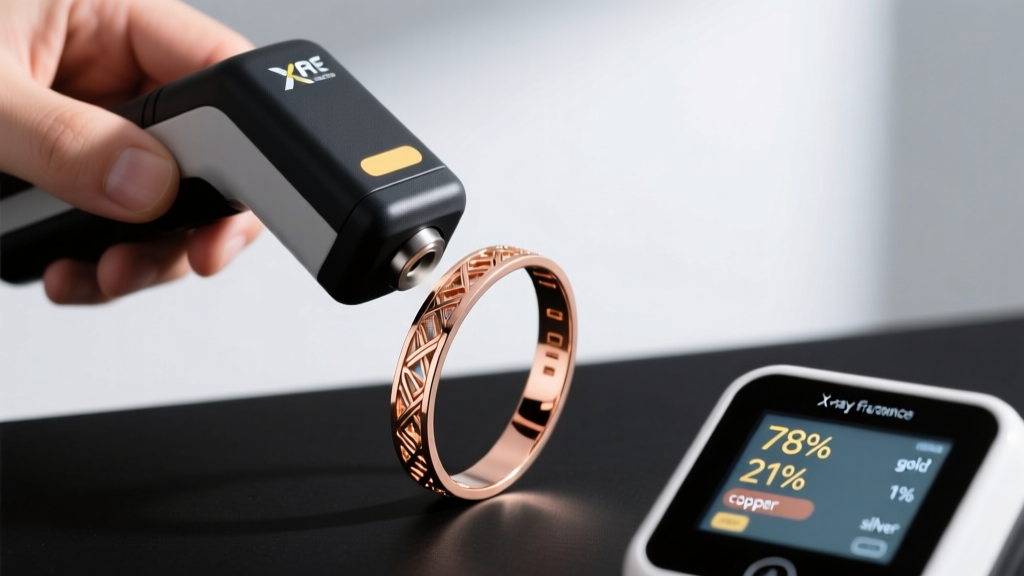
As of 2026, technology has democratized access to high-end metallurgical analysis. For high-value items, estate appraisals, and pawn shops, X-Ray Fluorescence (XRF) is the gold standard for authentication.
How XRF Spectroscopy Works
An XRF analyzer fires primary X-rays into the jewelry. This energy excites the atoms in the metal, causing them to emit secondary (fluorescent) X-rays. Because every element on the periodic table emits a unique energy signature, the XRF sensor reads these emissions and instantly calculates the exact elemental breakdown.
An XRF scan will tell you that a piece is exactly 58.6% gold, 20.1% copper, 15.3% silver, and 6.0% zinc, confirming it as genuine 14k yellow gold. The World Gold Council notes that XRF is vital for modern supply chain transparency, ensuring recycled gold meets precise karat standards. However, XRF only penetrates the surface (roughly 50 to 100 microns deep). It cannot detect a thick gold shell wrapped around a dense core.
Electronic Conductivity Testers
To bridge the gap between destructive acid tests and expensive XRF machines, electronic gold testers (like the Kee Gold Tester or Tri Electronics) measure electrical conductivity. Gold has a very specific electrical resistance. These devices pass a harmless, low-voltage current through the metal via a specialized electrolytic fluid. The microprocessor compares the conductivity reading against an internal database of gold alloys, providing a digital karat readout. This is highly effective for testing chains and solid bangles without scratching them.
Spotting Advanced Counterfeits: The Tungsten Trap
The most dangerous counterfeit in the modern market is the tungsten-core gold bar or heavy chain. Tungsten has a specific gravity of 19.25 g/cm³, which is nearly identical to pure 24k gold (19.32 g/cm³). Therefore, a tungsten item plated in thick 24k gold will perfectly pass the specific gravity water displacement test, the magnet test, and the XRF surface scan.
How do experts beat the tungsten trap?
- Ultrasonic Testing: Jewelers use ultrasonic thickness gauges. Sound waves travel through pure gold at 3,240 meters per second, but they travel through tungsten at over 5,000 meters per second. The discrepancy in acoustic velocity instantly reveals the fake core.
- Ping Testing: Tungsten is incredibly hard and brittle. When struck, a solid gold coin or thick medallion produces a long, high-pitched resonant 'ping'. A tungsten core produces a dull, short 'thud' due to its different acoustic dampening properties.
Summary: The Expert's Authentication Protocol
Knowing how to know if jewelry is gold requires a systematic approach. Never rely on a single test. Start with a loupe inspection of the hallmarks and maker's marks. Proceed to the specific gravity test to verify the overall density of the piece. If doubts remain, use an electronic conductivity tester or perform a micro-destructive acid test on an inconspicuous area. For high-value investments, insist on an XRF scan paired with an ultrasonic thickness check. By applying these metallurgical principles, you can confidently separate genuine precious metals from modern, sophisticated counterfeits.


