How to Identify and Buy Authentic Ancient Egyptian Gold Jewelry
Learn how to authenticate, source, and legally acquire ancient Egyptian gold jewelry with our expert step-by-step guide on motifs, alloys, and provenance.

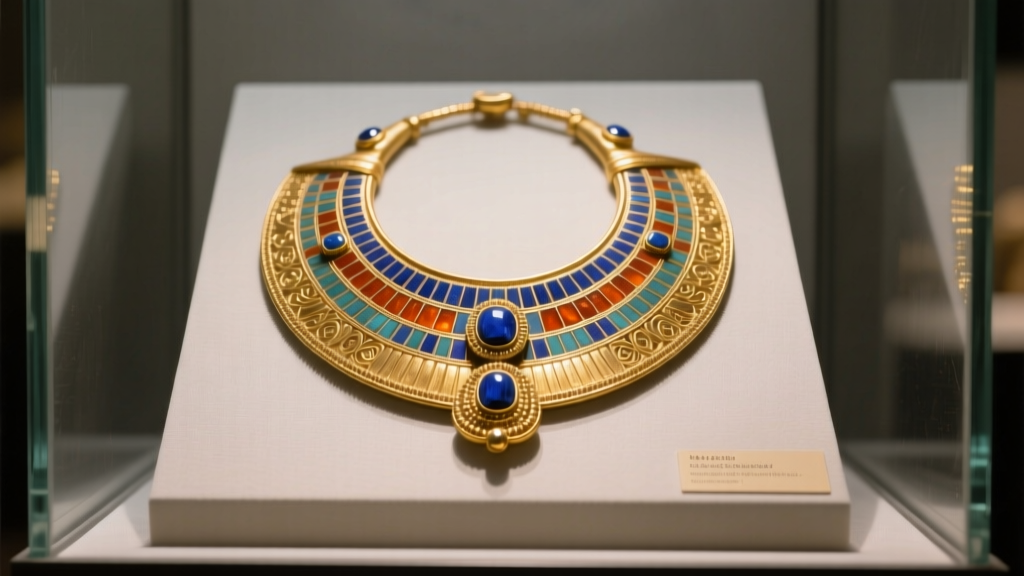
The Allure and Danger of the Antiquities Market
The market for ancient Egyptian gold jewelry is as captivating as it is treacherous. For collectors and historians, owning a genuine artifact from the time of the pharaohs represents the pinnacle of antiquities collecting. However, the intersection of high financial value and scarce supply has created an environment rife with sophisticated forgeries. According to the Metropolitan Museum of Art, ancient Egyptian goldsmiths possessed metallurgical skills that rival modern techniques, making visual inspection alone entirely insufficient for authentication. Whether you are looking at a New Kingdom signet ring or a Ptolemaic broad collar, acquiring these pieces requires a rigorous, multi-step methodology encompassing metallurgical science, iconographic analysis, and strict legal due diligence.
Step 1: Decode Ancient Egyptian Metallurgy and Alloys
To authenticate ancient Egyptian gold jewelry, you must first understand what it is actually made of. The modern karat system (10k, 14k, 18k, 24k) did not exist in antiquity. Instead, Egyptian goldsmiths primarily worked with native gold, which naturally contained varying amounts of silver and copper.
Electrum and the Parting Process
Much of the early gold sourced from Nubia and the Eastern Desert was actually electrum—a natural alloy of gold and silver containing up to 20% or more silver. This gave early pieces a distinct pale, greenish-yellow hue. By the New Kingdom (c. 1550–1070 BCE), artisans had mastered a cementation process using salt and brick dust to separate silver from gold, allowing them to produce richer, purer yellow gold. If a piece purportedly from the Old Kingdom exhibits the deep, rich color of refined 22k gold without any trace of silver, it is an immediate metallurgical red flag.
The Cloisonné Technique
Ancient Egyptian gold jewelry is rarely just gold. The most iconic pieces utilize cloisonné inlay work, where delicate gold wire cells (cloisons) are soldered onto a gold backing and filled with semi-precious stones. The holy trinity of Egyptian inlay materials includes lapis lazuli (dark blue), turquoise (light blue-green), and carnelian (reddish-orange).
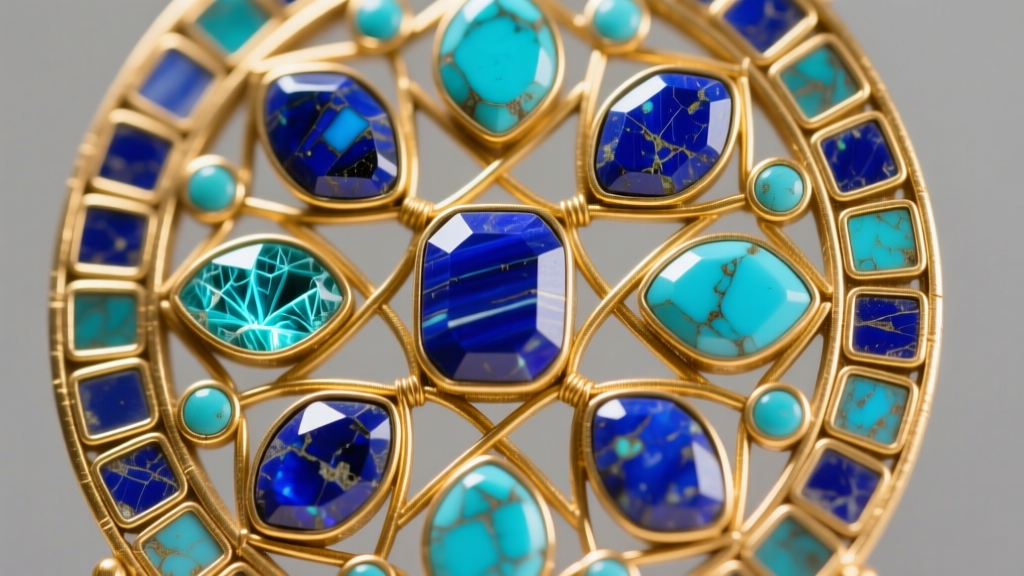
Under microscopic examination, genuine ancient inlays will show hand-cut stone fragments with slight irregularities, often bedded in a natural resin or bitumen adhesive. Forgeries frequently use dyed howlite, synthetic glass, or perfectly uniform, machine-cut stones set with modern epoxy.
Step 2: Verify Iconography and Motifs
Ancient Egyptian jewelry was deeply symbolic, functioning as much for magical protection in the afterlife as for earthly adornment. The British Museum notes that specific motifs were strictly codified. When evaluating a piece, check for historical accuracy in the following areas:
- The Scarab Beetle (Khepri): Representing rebirth and the morning sun. Genuine scarab rings feature hieroglyphs carved into the flat base (the plinth). In fakes, these carvings are often too deep, perfectly symmetrical, or historically nonsensical (gibberish hieroglyphs).
- The Udjat Eye (Eye of Horus): A symbol of protection and healing. The proportions of the teardrop and the spiral cheek line must match the specific artistic canons of the claimed dynasty.
- Cartouches: Oval name rings enclosing royal names. A piece claiming to be from the 18th Dynasty should not bear the cartouche of Ramesses II (19th Dynasty). Cross-referencing the throne name (prenomen) with established king lists is mandatory.
Step 3: The Scientific Authentication Process
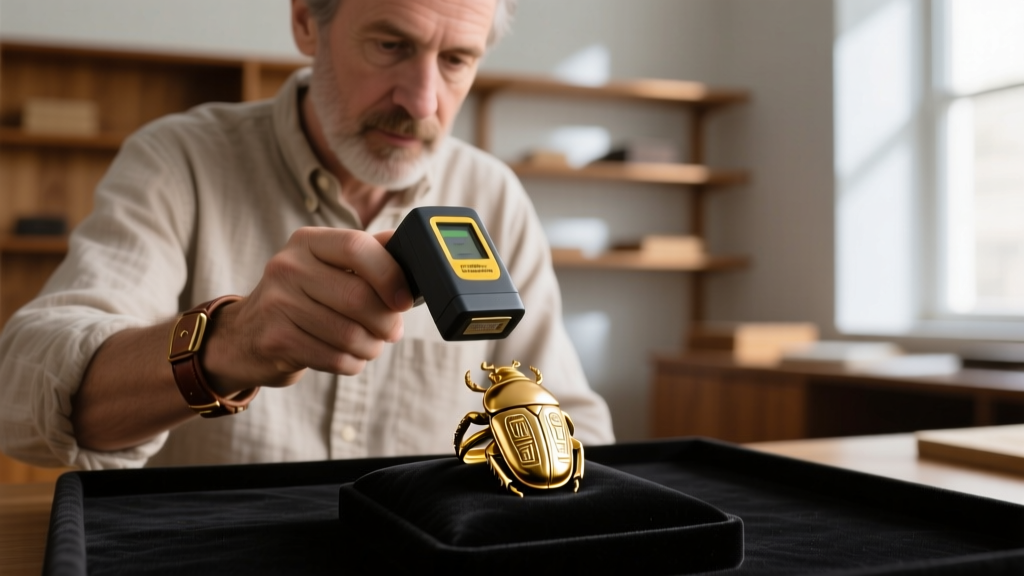
Visual appraisal is only the beginning. Serious collectors and institutions rely on non-destructive scientific testing to verify the age and origin of ancient gold. Below is the standard framework used by top-tier antiquities laboratories.
| Testing Method | Purpose | What to Look For (Genuine vs. Fake) |
|---|---|---|
| XRF (X-ray Fluorescence) | Elemental composition analysis | Genuine: Gold, Silver, Copper, trace Platinum/Palladium. Fake: Presence of Zinc (Zn) or Aluminum (Al), indicating modern brass or duralumin. |
| Microscopic Tool Mark Analysis | Evaluating manufacturing techniques | Genuine: Directional scratching from pumice/sand polishing, irregular hammer marks. Fake: Uniform rotary tool marks, laser welding spots. |
| Thermoluminescence (TL) | Dating associated organic/resin materials | Genuine: Resins or core clays date to antiquity. Fake: Modern synthetic adhesives or recently fired clay cores inside gold beads. |
| Patina and Encrustation Analysis | Assessing burial environment interaction | Genuine: Hard, crystalline soil accretions that require mechanical removal. Fake: Soft, painted-on "dirt" or acid-etched artificial oxidation. |
Step 4: Spotting Common Forgery Red Flags
Even without a laboratory, trained eyes can spot the most common mistakes made by modern forgers operating in tourist markets and unverified online auctions.
The Zinc Tell
Zinc was not used as a deliberate alloying agent in Egyptian gold metallurgy. If an XRF test reveals a zinc content higher than 1%, you are likely looking at a modern brass-based forgery that has been heavily gold-plated.
Soldering Anomalies
Ancient goldsmiths used a hard solder made of gold, silver, and copper, applied with a blowpipe. This leaves a distinct, slightly raised seam that matches the color of the surrounding metal. Modern fakes often utilize lead-based soft solders or exhibit the microscopic, perfectly circular craters left by modern laser welders.
The "Perfect" Wear Pattern
Genuine ancient jewelry worn for decades in antiquity will show directional wear, particularly on the inner shanks of rings or the suspension loops of pendants. Forgers often tumble their pieces in abrasive media to simulate age, resulting in a uniform, matte "sandblasted" texture that rounds off the sharp edges of hieroglyphic carvings—a detail an ancient artisan would never allow.
Step 5: Navigating Legalities and Provenance
This is arguably the most critical step in the acquisition process. The legal landscape surrounding antiquities is incredibly strict. Egypt’s Law No. 117 of 1983 (heavily amended and enforced in 2018) declares that all antiquities found in Egypt are the property of the state, and their trade or export is strictly prohibited.
Therefore, for a piece of ancient Egyptian gold jewelry to be legally bought or sold on the international market today, it must possess an unbroken, documented provenance proving it left Egypt prior to 1983, and ideally prior to the 1970 UNESCO Convention on the Means of Prohibiting and Preventing the Illicit Import, Export and Transfer of Ownership of Cultural Property.
The Provenance Paper Trail
Acceptable provenance documentation includes:
- Pre-1970 auction catalogs from recognized houses (Sotheby’s, Christie’s, Bonhams).
- Export licenses issued by the Egyptian Department of Antiquities prior to 1983.
- Verifiable collection records from established, named historical collectors (e.g., the collection of Lord Carnarvon or early 20th-century European travelers).
- Clearance from the Art Loss Register (ALR) to ensure the piece was not reported stolen from a museum or excavation site.
Warning: A generic "receipt" from a Cairo bazaar dated in the 1990s is not valid provenance. It is evidence of illegal export and can result in the seizure of the artifact and criminal charges upon import into the US or EU.
Step 6: Sourcing from Reputable Channels
Given the legal and financial risks, acquiring ancient Egyptian gold jewelry should only be done through highly regulated channels. Avoid generalist estate sales, unverified online marketplaces, and tourist shops entirely.
Focus your efforts on specialized antiquities departments at major international auction houses, or vetted members of the Antiquities Dealers Association (ADA) or the International Association of Dealers in Ancient, Oriental and Primitive Art (IADAOPA). These organizations require their members to adhere to strict codes of conduct, guarantee the authenticity of their catalog descriptions, and perform exhaustive provenance checks before a piece ever reaches the auction block. When you buy from these sources, you are not just purchasing gold; you are securing a legally protected, historically verified fragment of human history.


