How Can I Sell Gold Jewelry Safely & Maximize Profit?
Learn how to safely sell gold jewelry, calculate melt value, avoid pawn shop scams, and choose the best buyers for 10k, 14k, and 18k pieces.


Deciding to part with your gold jewelry—whether it is an inherited estate piece, a broken chain, or an outdated ring—can feel overwhelming. The secondary gold market is flooded with buyers, but not all of them operate with your best financial interests in mind. If you are wondering how to navigate this landscape without leaving money on the table, you need a strategic, data-driven approach. This comprehensive troubleshooting guide will walk you through the exact mechanics of valuing, sorting, and selling your gold in the current market, ensuring you avoid common pitfalls and secure the highest possible payout.
The Golden Rule: Melt Value vs. Retail Premium
The most critical mistake sellers make is assuming their jewelry will be purchased for its original retail price. Unless you possess a documented, highly sought-after designer piece (such as vintage Cartier, Van Cleef & Arpels, or Tiffany & Co.), your jewelry will be evaluated strictly on its melt value. Melt value is the intrinsic worth of the pure gold content if it were to be melted down and refined. Retail markups, brand premiums, and the cost of the original craftsmanship are entirely lost the moment the piece enters the secondary market. Understanding this distinction is the first step in troubleshooting unrealistic price expectations and negotiating effectively with buyers.
Step-by-Step Troubleshooting: Preparing Your Gold for Sale
Walking into a gold buyer's shop without knowing exactly what you have is a guaranteed way to get lowballed. Preparation is your strongest leverage.
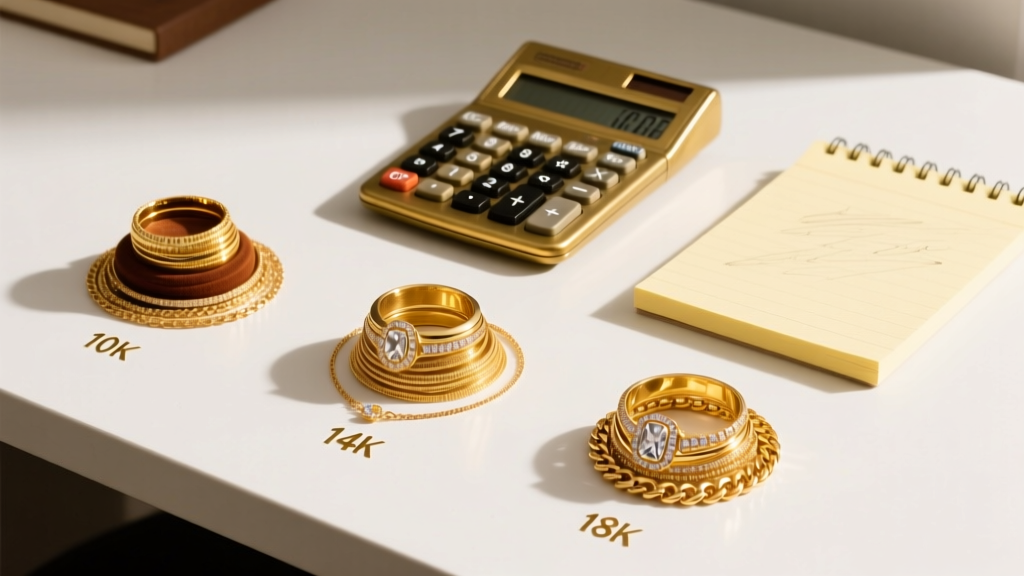
Sorting by Karat and Purity
Gold purity is measured in karats, and buyers will pay vastly different rates depending on the alloy mix. Use a jeweler's loupe (10x magnification) to inspect the hallmarks on your pieces. According to the Gemological Institute of America (GIA), you should look for these specific stamps:
- 10k (417): 41.7% pure gold. Common in durable, everyday US jewelry.
- 14k (585): 58.3% pure gold. The most common standard in the United States.
- 18k (750): 75.0% pure gold. Standard for high-end and European jewelry.
- 24k (999): 99.9% pure gold. Rare in jewelry due to softness; mostly found in coins or bullion.
Troubleshooting Tip: If a piece lacks a stamp, or if the stamp says '14k HGE' (Heavy Gold Electroplate) or '1/20 14k GF' (Gold Filled), it is not solid gold. Most standard gold buyers will reject these items, as the cost of refining exceeds the value of the microscopic gold layer.
Weighing with Precision
Never rely on a buyer's scale without verifying the weight yourself first. Purchase a cheap digital pocket scale calibrated to 0.01 grams. Weigh your sorted piles at home. Be aware that many pawn shops use pennyweights (dwt) to confuse sellers. One pennyweight equals exactly 1.55517 grams. If a buyer quotes you a price per pennyweight, do the math to convert it to grams so you can compare it against the live spot price.

Where to Sell: Comparing Buyer Types and Payout Rates
Not all buyers are created equal. The convenience of a buyer is usually inversely proportional to the payout they offer. Below is a troubleshooting matrix to help you choose the right avenue for your specific needs.
| Buyer Type | Typical Payout (% of Melt) | Pros | Cons |
|---|---|---|---|
| Pawn Shops | 50% - 70% | Immediate cash, walk-in convenience. | Lowest payouts, high pressure tactics. |
| Local Jewelers | 75% - 85% | Transparent testing, professional environment. | May only buy high-karat or gem-set pieces. |
| Online Mail-In Refineries | 85% - 95% | Highest payouts, insured shipping. | Waiting period for payment, requires trust. |
| Private Buyers (Forums) | 90% - 105% | Potential for retail premium on nice pieces. | High scam risk, requires market knowledge. |
Red Flags: How to Avoid Common Gold Selling Scams
The secondary gold market unfortunately attracts predatory operators. The Federal Trade Commission (FTC) regularly fields complaints regarding deceptive gold buying practices. Watch out for these specific troubleshooting red flags:
- The 'Hidden Scale' Trick: The buyer places a piece of paper or a heavy rubber mat on the scale before taring it, or uses a magnetized tray to slightly alter the digital readout. Always ask to see the scale zeroed out with nothing on it.
- The Stone Deduction Scam: Shady buyers will claim they must deduct 15% to 20% of the total weight for 'stones and dirt.' While diamonds and gemstones do add non-gold weight, a 1-carat diamond weighs only 0.2 grams. A 20% deduction on a 10-gram ring is pure theft.
- The Acid Test Sabotage: When using nitric acid to test a scratch mark, a dishonest buyer might apply acid to a naturally porous or dirty part of the chain, causing a false negative reaction, and then offer you a fraction of the 10k price for your 18k gold.
Calculating Your Payout: The Market Formula
To negotiate like a professional, you must know how to calculate your exact melt value based on the daily spot price. You can track the live spot price on authoritative financial sites like Kitco Gold Charts. Here is the exact formula buyers use, which you should use to audit their offers:
Formula: (Weight in Grams ÷ 31.1035) × Spot Price per Ounce × (Karat ÷ 24) = Pure Melt Value
Real-World Example:
Let us say you have 15.5 grams of 14k gold chains. The current spot price is $2,450 per troy ounce.
- Convert to troy ounces: 15.5g ÷ 31.1035 = 0.4983 oz.
- Calculate pure gold value: 0.4983 oz × $2,450 = $1,220.83.
- Adjust for 14k purity (58.3%): $1,220.83 × 0.583 = $711.74 (Total Melt Value).
If a reputable online refinery pays 90% of melt, your expected payout is $640.56. If a local pawn shop offers you $400, you now have the hard data to walk away or negotiate aggressively.
Final Pre-Sale Troubleshooting Checklist
Before you hand over your jewelry and accept payment, run through this final diagnostic checklist:
- Did I separate my gold by karat (10k, 14k, 18k) to prevent it from all being weighed as the lowest karat?
- Did I remove any heavy non-gold attachments, such as thick leather cords or steel clasps?
- Did I verify the buyer's scale is certified and zeroed before weighing?
- Did I check the live spot price on my phone immediately before walking into the shop?
- Did I get the final offer in writing before allowing the buyer to damage the piece with an acid test or file?
By treating the sale of your gold jewelry as a precise financial transaction rather than a casual pawn shop visit, you eliminate the guesswork and protect yourself from predatory pricing. Knowledge, preparation, and a firm grasp of the underlying math are your best tools for maximizing your return.


