Thailand Gold Jewelry: Technical Guide to 96.5% Purity & Alloys
Explore the technical specifications of Thailand gold jewelry, from 96.5% purity standards and alloy compositions to hallmarking and structural care.

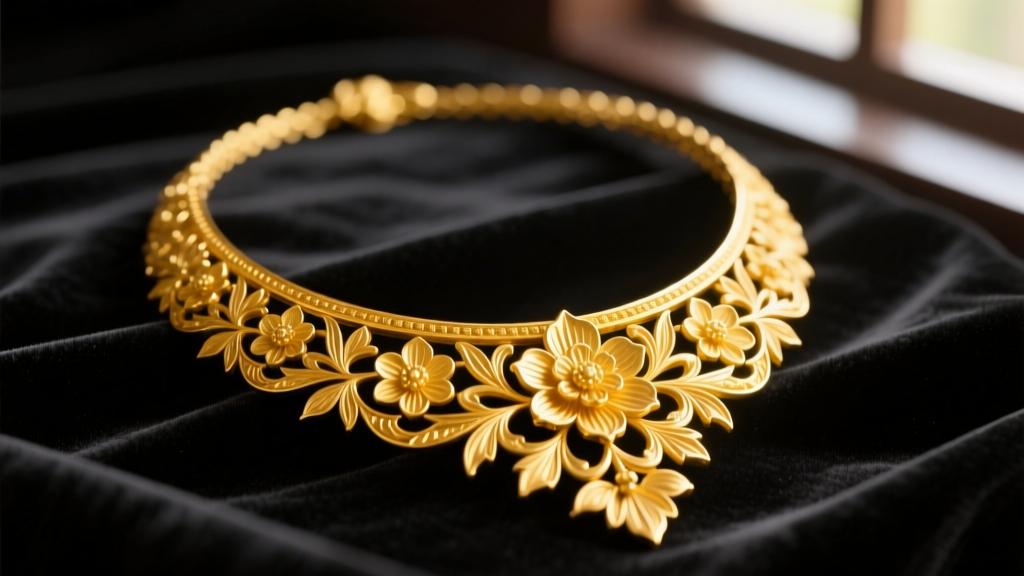
When discussing high-karat gold, the global market typically defaults to the 22k (91.6%) standards of Indian and Middle Eastern jewelry, or the 18k (75%) and 14k (58.3%) standards of Western markets. However, Thailand gold jewelry operates on a highly specific, deeply entrenched metallurgical standard: 96.5% purity. This unique composition, equivalent to approximately 23.16 karats, represents a fascinating intersection of historical weight systems, cultural preference, and modern metallurgical engineering. For jewelers, collectors, and investors, understanding the exact technical parameters of Thai gold is essential for evaluating structural integrity, resale liquidity, and long-term wearability.
The 96.5% Standard: Decoding Thai Gold Purity
The 96.5% purity standard is not arbitrary; it is intrinsically linked to the traditional Thai weight system known as the baht. In Thailand, gold is not merely an ornamental material but a highly liquid financial asset. According to the World Gold Council, Thailand remains one of the most robust markets for gold jewelry that doubles as savings. One baht of gold weighs exactly 15.244 grams.
Historically, Thai assayers determined purity using touchstones and nitric acid, establishing a baseline where 100 parts of the alloy contained 96.5 parts pure gold. This specific ratio was chosen because it provided the absolute maximum gold content possible while retaining just enough alloying metals to allow the gold to be worked into complex, traditional designs without being as prohibitively soft as 99.99% (24k) bullion. Today, this standard is strictly regulated by the Thai Ministry of Commerce, and reputable shops in Bangkok's Yaowarat (Chinatown) district guarantee this exact composition.
Metallurgical Breakdown: The 3.5% Alloy Matrix
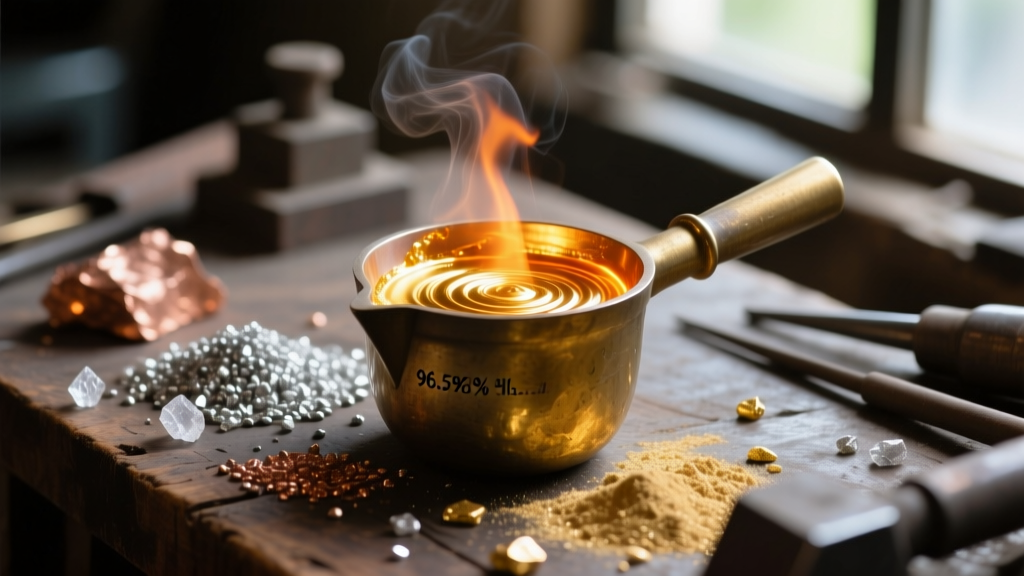
The remaining 3.5% of Thailand gold jewelry is composed of alloying metals, primarily silver (Ag) and copper (Cu). The exact ratio of these secondary metals drastically alters the physical properties and visual characteristics of the final piece.
Copper vs. Silver Ratios
While 24k gold is universally recognized for its distinct, almost orange-yellow hue, 96.5% Thai gold maintains a remarkably similar color profile due to careful alloy balancing.
- High-Silver Matrix (e.g., 2.5% Ag, 1.0% Cu): Increases malleability and ductility, making it ideal for intricate hand-beaten floral motifs and filigree work. However, it slightly lowers the tensile strength.
- High-Copper Matrix (e.g., 1.0% Ag, 2.5% Cu): Increases the Vickers hardness (HV) and tensile strength, making it more suitable for heavier bangles or chain links that require structural rigidity. It also introduces a marginally warmer, reddish undertone to the gold.
Structural Integrity: Hardness and Tensile Data
One of the most critical mistakes Western jewelers make when handling Thailand gold jewelry is treating it like 22k or 18k gold. The Gemological Institute of America (GIA) emphasizes that even a 5% drop in alloy content results in a disproportionate drop in structural hardness. Below is a comparative metallurgical data table illustrating why 96.5% gold requires specialized bench techniques.
| Purity Standard | Karat Equivalent | Vickers Hardness (HV) | Tensile Strength (MPa) | Primary Use Case |
|---|---|---|---|---|
| 99.99% (Bullion) | 24k | 25 - 30 HV | 120 - 130 MPa | Investment bars, coins |
| 96.5% (Thai Std) | ~23.16k | 40 - 48 HV | 160 - 180 MPa | Traditional Thai jewelry, chains |
| 91.6% (Indian Std) | 22k | 55 - 65 HV | 200 - 230 MPa | Heavy bridal sets, bangles |
| 75.0% (Western Std) | 18k | 120 - 135 HV | 350 - 450 MPa | Stone-set rings, prong settings |
As the data indicates, 96.5% gold possesses roughly one-third the hardness of 18k gold. Consequently, it is entirely unsuitable for prong settings, pavé, or any application requiring the metal to grip a gemstone under sustained mechanical stress.
The Economics of Thai Gold: Baht Weight and 'Kam' Fees
Understanding the pricing structure of Thailand gold jewelry is just as important as understanding its metallurgy. In Western markets, jewelry is priced with a massive markup for design, brand, and labor—often 300% to 1000% over the melt value of the gold. In Thailand, the pricing model is radically transparent and highly technical.
The price of a piece is calculated using a simple formula:
Total Price = (Current Spot Price per Baht × Weight in Baht) + Kam (Workmanship Fee)
The Kam (ค่ากำเหน็จ) is the labor charge. For a simple, machine-drawn chain, the Kam might be as low as 150 to 300 THB ($4 to $8 USD). For a master-crafted, hand-beaten floral necklace, the Kam can reach several thousand THB. However, when reselling the jewelry to a Thai gold shop, the buyer will pay the exact spot price for the 15.244g baht weight, minus a small deduction (usually 5% to 10% on jewelry, compared to 0% on bullion). The Kam is entirely lost upon resale, making Thai gold jewelry an exceptional store of intrinsic value compared to Western luxury pieces.
Authentication and Assay Protocols
Because Thailand gold jewelry commands a premium over lower-karat alternatives, verifying the 96.5% claim is a mandatory step for serious buyers and pawnbrokers. Traditional acid testing is largely insufficient for distinguishing between 96.5% and 91.6% (22k) gold due to the narrow margin of error.
Non-Destructive Testing (NDT) Methods
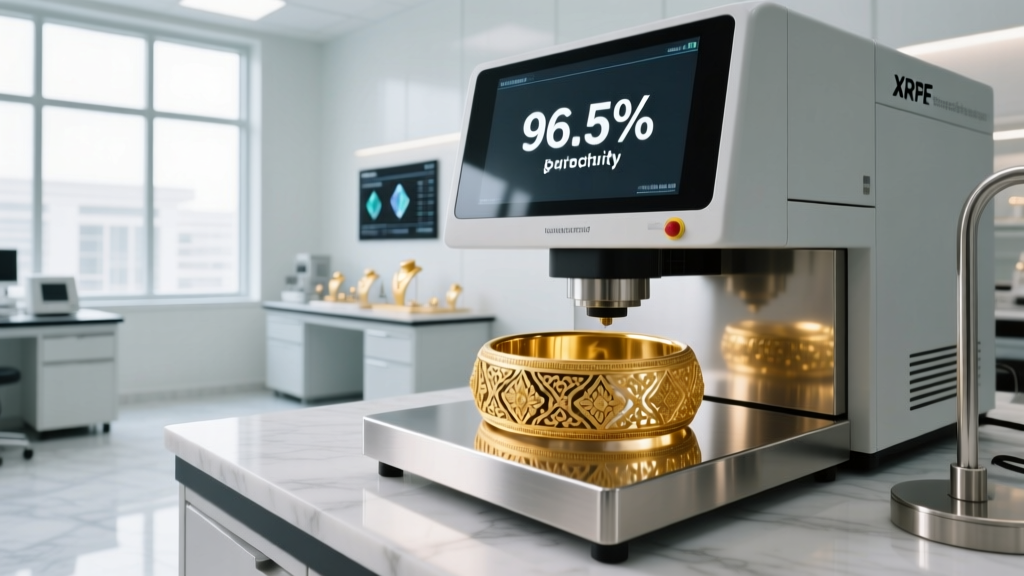
Modern Thai assay offices and high-volume gold shops rely on two primary technical verification methods:
- X-Ray Fluorescence (XRF) Spectrometry: This is the gold standard for surface and near-surface analysis. A calibrated XRF gun will read the exact elemental breakdown, confirming 96.5% Au, alongside the specific Ag/Cu ratios. However, XRF cannot detect tungsten or dense metal inclusions deep within a thick bangle.
- Specific Gravity (SG) Testing: Using the Archimedes principle, jewelers measure the displacement of water. Pure 24k gold has an SG of 19.32. A 96.5% gold alloy with a standard silver/copper mix will yield an SG reading between 18.45 and 18.65 g/cm³. Any significant deviation indicates either lower purity or the presence of dense core metals like tungsten (SG 19.25) or lead (SG 11.34).
Care and Failure Modes of High-Purity Gold
Owning 96.5% Thailand gold jewelry requires an understanding of its specific mechanical failure modes. Because the alloy content is so low, the gold is highly susceptible to creep deformation—the tendency of a solid material to move slowly or deform permanently under the influence of mechanical stresses.
Common Failure Modes:
- Ring Shank Thinning: A 96.5% gold ring worn daily will compress and thin at the palmar side (the bottom of the finger) much faster than an 18k ring. Within 3 to 5 years of daily wear, a 2mm shank can compress to under 1mm, leading to structural snapping.
- Clasp Fatigue: Traditional Thai lobster or spring-ring clasps made from 96.5% gold will lose their spring tension rapidly. High-end Thai jewelers often use internal steel springs encased in the gold clasp, but the external lever mechanisms are prone to bending if snagged.
- Solder Joint Weakness: Repairing Thai gold is technically demanding. To maintain the 96.5% purity standard, the solder used must also be high-karat. High-karat solders have very narrow melting point differentials compared to the parent metal, meaning a jeweler using a standard torch risks melting the entire piece rather than just flowing the solder.
To mitigate these issues, Thailand gold jewelry should be stored separately in soft, individual pouches to prevent surface scratching, and rings should be periodically checked for shank thinning. When designed and worn with an understanding of its metallurgical limits, 96.5% Thai gold remains one of the most beautiful, culturally rich, and financially sound gold standards in the global jewelry market.


