Purple and Gold Jewelry: A Technical Guide to Alloys and Gems
Explore the technical science of purple and gold jewelry, from brittle AuAl2 intermetallic alloys to gemstone setting techniques and care.

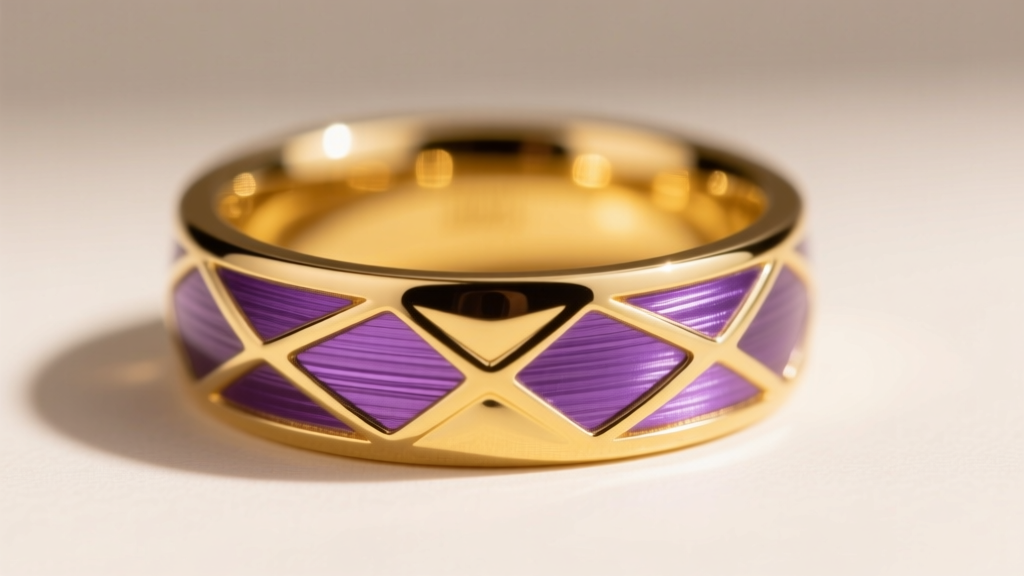
The Dual Nature of Purple and Gold Jewelry
When consumers and collectors search for purple and gold jewelry, they are typically referring to one of two vastly different material categories. The first is the use of traditional gold alloys (yellow, white, or rose) as a setting for purple gemstones like amethyst, tanzanite, or purple sapphire. The second, and far more complex category, is the use of 'purple gold'—a specialized intermetallic compound where the gold itself takes on a distinct violet-purple hue. Understanding the technical distinctions between these two categories is critical for jewelers, appraisers, and informed buyers. This deep dive explores the metallurgy, gemological pairings, and structural vulnerabilities inherent in these striking pieces.
The Metallurgy of Purple Gold (AuAl2)
Unlike standard gold alloys, which are solid solutions where atoms of alloying metals (like copper or silver) randomly replace gold atoms in a face-centered cubic lattice, purple gold is an intermetallic compound. Specifically, it is composed of gold and aluminum in a precise stoichiometric ratio, forming the chemical formula AuAl2. By weight, this compound consists of approximately 79% gold and 21% aluminum. Because it contains 79% pure gold, purple gold technically equates to 18.6 karats. However, its physical behavior is radically different from standard 18k yellow gold.
The defining characteristic of AuAl2 is its fluorite crystal structure. While this lattice produces a stunning, naturally occurring purple coloration without the need for surface plating or oxidation, it comes with a severe mechanical penalty: extreme brittleness. Standard 18k gold is highly malleable and ductile, allowing it to be drawn into wire or hammered into sheet. Purple gold, conversely, has a Vickers hardness of around 250-300 but an incredibly low fracture toughness. If subjected to the lateral pressure of traditional prong-setting, or if dropped onto a hard surface, purple gold will shatter much like glass.
Fabrication and Design Limitations
Because of its brittleness, purple gold cannot be used to fabricate structural jewelry components like ring bands, chain links, or clasp mechanisms. Instead, master jewelers utilize it exclusively as an inlay or a bezel-set cabochon. The purple gold is cast or machined into specific geometric shapes and then set into a supportive matrix of a more ductile metal, such as 18k yellow gold or platinum. This supportive matrix absorbs kinetic shock and prevents the intermetallic compound from fracturing during daily wear.
Gemological Pairings: Traditional Gold and Purple Stones
For the vast majority of purple and gold jewelry on the market, the purple element is derived from gemstones rather than the metal itself. Pairing the correct gold alloy with the appropriate purple gemstone requires an understanding of color theory, refractive indices, and structural durability. According to the Gemological Institute of America (GIA), the market is dominated by three primary purple gemstones, each presenting unique challenges for the bench jeweler.
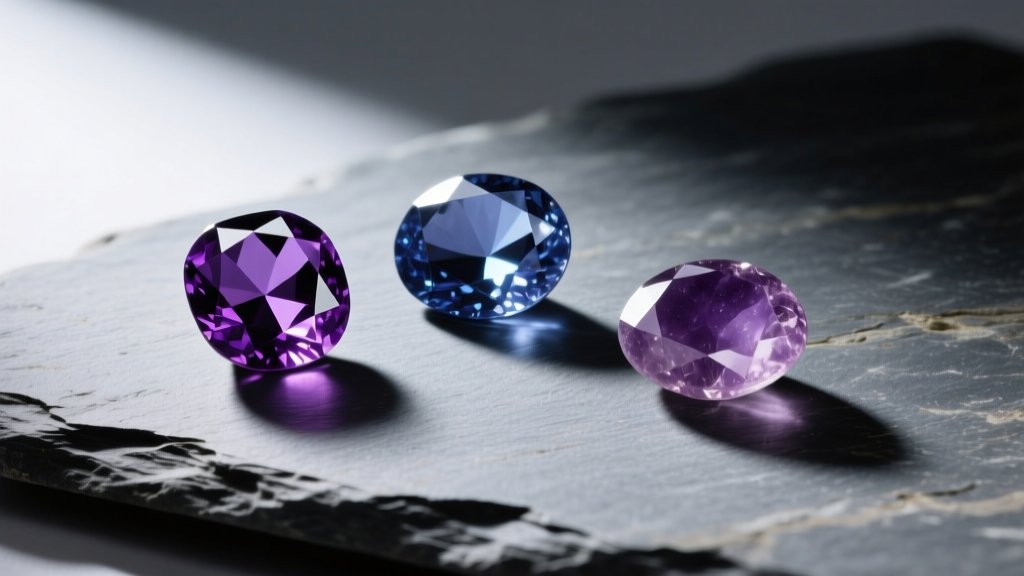
Comparative Gemstone Data
| Gemstone | Mineral Family | Mohs Hardness | Cleavage | Ideal Gold Alloy Pairing | Setting Recommendation |
|---|---|---|---|---|---|
| Amethyst | Quartz | 7 | None | Rose Gold (enhances red flashes) | Prong or Bezel |
| Purple Sapphire | Corundum | 9 | None (Parting) | White Gold (maximizes contrast) | Prong, Tension, or Bezel |
| Tanzanite | Zoisite | 6 - 7 | Perfect (1 direction) | Yellow Gold (warms the stone) | Bezel or Halo (Protective) |
Setting Mechanics and Cleavage Risks
When setting purple gemstones into gold, the jeweler must account for crystallographic cleavage. Amethyst and purple sapphire lack true cleavage planes, meaning they will fracture conchoidally (like glass) rather than splitting along flat planes. This makes them relatively forgiving during the prong-pushing process. Tanzanite, however, possesses perfect cleavage in one direction. If a jeweler applies uneven pressure with a standard pusher, or if the gold prong is too thick and exerts outward tension on the stone's girdle, the tanzanite can cleave cleanly in half. For tanzanite and gold jewelry, custom-fitted bezel settings or protective halos are technically superior to exposed prong settings, mitigating the risk of catastrophic failure from lateral impacts.
Galvanic Corrosion and Chemical Vulnerabilities
The care and maintenance of purple and gold jewelry diverge sharply depending on whether the piece utilizes purple gemstones or purple gold alloy. Standard gold and amethyst jewelry can be safely cleaned in ultrasonic cleaners using mild alkaline solutions. Purple gold (AuAl2), however, requires strict chemical avoidance.
Aluminum is a highly reactive metal. While it forms a protective oxide layer in its pure state, when bound in the AuAl2 intermetallic lattice, it remains vulnerable to both strong acids and strong alkalis. Exposure to household bleach, ammonia-based jewelry cleaners, or even prolonged contact with chlorinated pool water can initiate galvanic corrosion. The aluminum within the compound will oxidize and leach out, leaving behind a porous, weakened gold sponge on the surface that appears dull and brownish. To clean purple gold, jewelers must use only neutral pH surfactants, distilled water, and soft-bristled brushes. Ultrasonic vibration must also be avoided, as the high-frequency cavitation can induce micro-fractures in the brittle fluorite lattice.
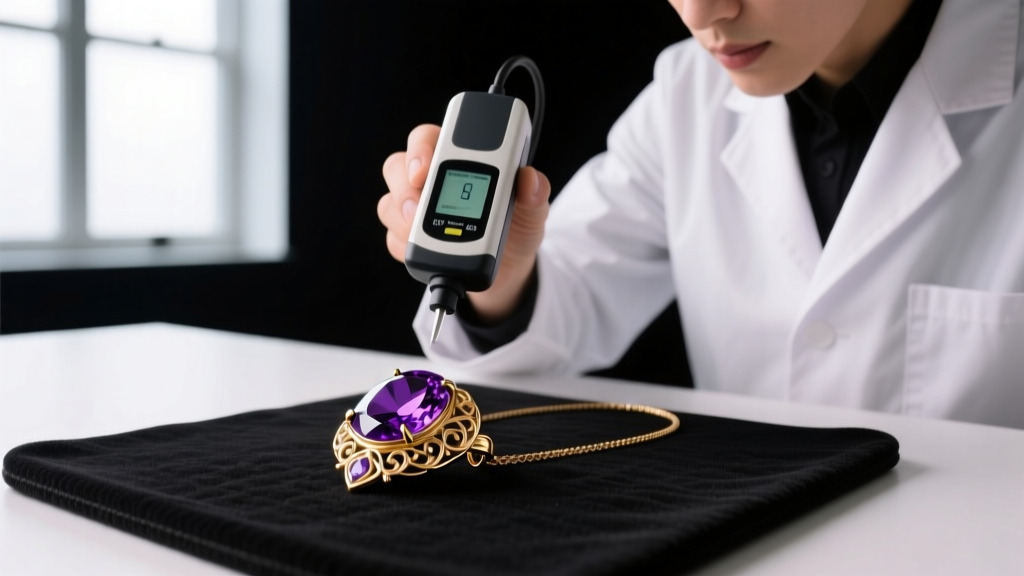
Sourcing and Authenticity Verification
As the demand for unique metallurgical jewelry grows, so does the prevalence of imitation purple gold. Unscrupulous manufacturers may attempt to pass off rhodium-plated white gold, anodized titanium, or oxidized silver alloys as genuine purple gold. Authenticating AuAl2 requires moving beyond traditional acid testing, which will only confirm the presence of 18k gold but cannot verify the aluminum content or the intermetallic structure.
Professional verification relies on X-Ray Fluorescence (XRF) spectrometry. An XRF analyzer will instantly read the elemental composition, confirming the 79/21 gold-to-aluminum ratio. Furthermore, genuine purple gold exhibits a specific gravity of approximately 13.2 g/cm³, which is noticeably lower than standard 18k yellow gold (which sits around 15.2 g/cm³ to 15.9 g/cm³ depending on the alloying metals). Hydrostatic weighing combined with XRF analysis provides an irrefutable chain of authenticity.
Summary for the Technical Buyer
Purple and gold jewelry represents a fascinating intersection of advanced metallurgy and classical gemology. Whether you are evaluating the structural limitations of an AuAl2 intermetallic inlay or engineering a protective setting for a perfectly cleaved tanzanite, success relies on respecting the material science. Treat purple gold as a fragile ceramic rather than a ductile metal, and always tailor your setting mechanics to the specific crystallographic vulnerabilities of the gemstone in question.
For further reading on gemstone durability and setting protocols, consult the GIA Tanzanite Guide and the GIA Sapphire Guide to ensure your technical specifications align with industry best practices.


