Choosing the Right Cleaner for Gold Jewelry: Technical Guide
Discover the science behind choosing the right cleaner for gold jewelry. Compare ultrasonic, chemical, and ionic methods for 10k to 24k gold.

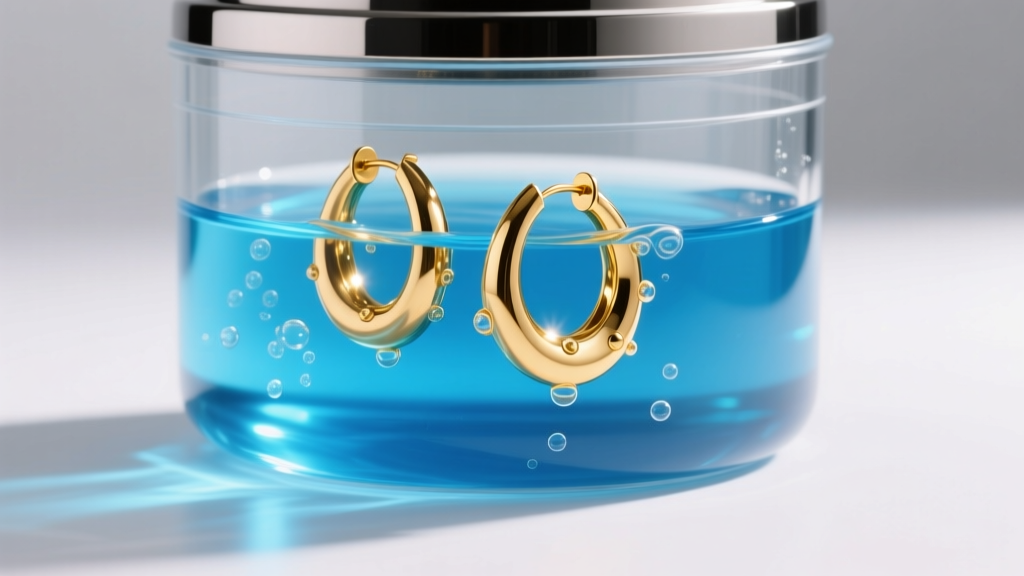
When selecting a cleaner for gold jewelry, the overwhelming majority of consumers rely on generic, one-size-fits-all liquid dips. However, as a domain expert in jewelry metallurgy and gemology, I can tell you that gold is not a monolith. The cleaning protocol required for a 24k pure gold coin is vastly different from the regimen needed for a diamond-encrusted 10k white gold ring. To properly maintain the luster, structural integrity, and value of your pieces, you must understand the underlying physics and chemistry of gold alloys and how different cleaning technologies interact with them.
The Metallurgy of Gold: Why Cleaning Methods Matter
Pure gold (24k) is virtually immune to tarnish and chemical corrosion. It is a noble metal that does not react with oxygen or sulfur. However, pure gold is exceptionally soft, registering a mere 25 on the Vickers Hardness (HV) scale. To create durable jewelry, gold is alloyed with metals like copper, silver, zinc, and nickel.
- 22k Gold (91.6% pure): ~65 HV. Still quite soft, prone to scratching and deformation.
- 18k Gold (75.0% pure): ~130 HV. The luxury standard, balancing purity with durability.
- 14k Gold (58.3% pure): ~150 HV. Highly durable, heavily alloyed, and susceptible to tarnish.
- 10k Gold (41.7% pure): ~170 HV. The most durable, but contains more alloy metals than actual gold, making it highly reactive to environmental chemicals.
The alloy metals—specifically copper and silver—are the culprits behind tarnish and discoloration. Therefore, the ideal cleaning method must remove surface oxidation from these base metals without abrading the gold or compromising the structural integrity of the piece.
The Chemistry of Tarnish and Stress Corrosion
Before applying any cleaner, you must understand what you are removing. Tarnish on 14k and 10k gold is typically copper sulfide or silver sulfide, formed when the alloy metals react with atmospheric sulfur or cosmetics.
"Exposure to chlorine, even in dilute amounts like tap water or swimming pools, can cause stress corrosion cracking (SCC) in karat gold alloys. This invisible damage weakens prongs and clasps, leading to catastrophic gemstone loss." — Gemological Institute of America (GIA)
Because of SCC, you must never use bleach, chlorine-based cleaners, or harsh abrasives on any gold alloy below 22k. The chlorine attacks the copper and zinc grain boundaries, creating microscopic fissures that propagate under mechanical stress.
Chemical Cleaners: Surfactants, Chelators, and pH Levels
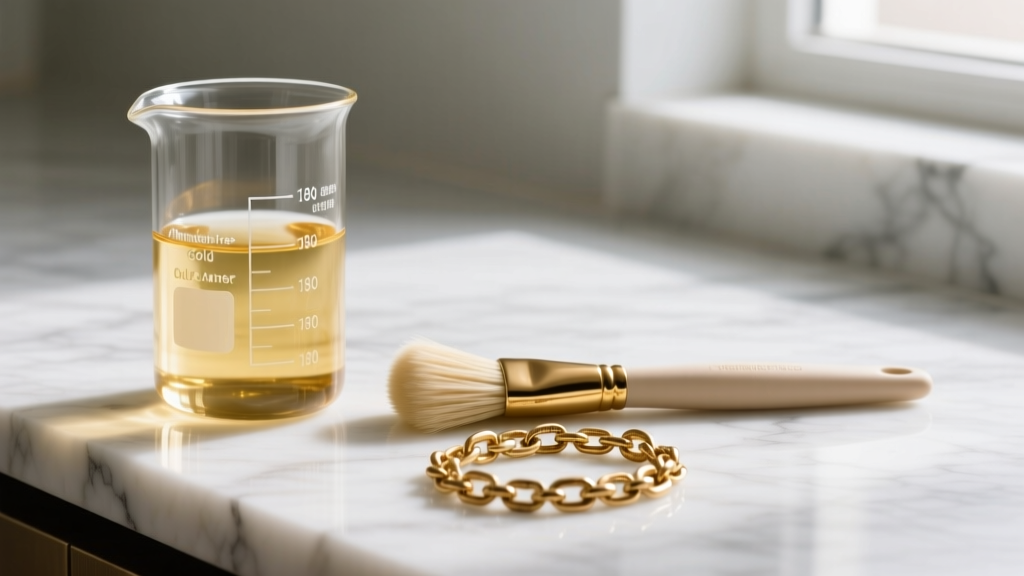
Liquid chemical cleaners rely on a combination of surfactants (to lift oils and sebum) and chelating agents (to bind to and remove metal oxides). The pH level of the solution dictates its safety profile for both the metal and any set gemstones.
Ammonia-Based vs. Non-Ammonia Formulations
Ammonia (ammonium hydroxide) is a highly effective alkaline degreaser. It excels at breaking down the heavy sebum and lotion buildup that dulls diamond and sapphire settings in 14k and 18k gold. However, ammonia is highly toxic to porous gemstones. If your gold jewelry contains pearls, opals, emeralds, or turquoise, ammonia will strip their natural moisture and cause irreversible cracking.
Non-ammonia cleaners utilize milder, neutral-pH surfactants (like sodium lauryl sulfate) combined with gentle chelators like EDTA. These are slower-acting but entirely safe for multi-gemstone pieces and high-karat gold.
| Cleaner Type | Active Chemistry | Best For | Avoid Using On |
|---|---|---|---|
| Ammonia Dip | Alkaline (pH 11-12), Ammonium Hydroxide | 10k-18k gold with diamonds/sapphires | Pearls, opals, 22k+ gold |
| Mild Surfactant | Neutral (pH 7), SLS, EDTA | All karats, porous gems, antique pieces | Heavy, baked-on tarnish |
| Thiourea Dip | Acidic (pH 1-2), Thiourea | Severe silver sulfide tarnish on 10k gold | Any piece with gemstones (acid etches polish) |
Ultrasonic Cleaners: Cavitation Physics and Frequency Specs
Ultrasonic cleaners are the industry standard for professional jewelers. They operate by passing high-frequency sound waves (typically 40kHz to 45kHz) through a liquid medium. This creates millions of microscopic vacuum bubbles that violently collapse against the jewelry—a process known as cavitation.
The Danger of Cavitation Erosion on High-Karat Gold
When a cavitation bubble collapses, it generates a micro-jet of liquid traveling at hundreds of meters per second, accompanied by localized shockwaves and temperatures exceeding 5,000 Kelvin. For 10k and 14k gold (150+ HV), this micro-bombardment easily dislodges dirt from microscopic crevices without damaging the metal.
However, for 22k and 24k gold, the Vickers Hardness is too low. The kinetic energy of the cavitation jets can cause cavitation erosion, resulting in micro-pitting, surface frosting, and the rounding of sharp, hand-engraved edges. Furthermore, the high-frequency vibrations can shake loose gemstones if the prong settings have experienced prior wear or galvanic corrosion.
Ionic Cleaners: Electrolysis for Solid Gold
Ionic cleaners represent a fundamentally different approach. Instead of mechanical force (ultrasonic) or chemical dissolution (dips), ionic cleaners use electrolysis. The jewelry is submerged in a mild electrolyte solution and connected to a low-voltage direct current (DC).
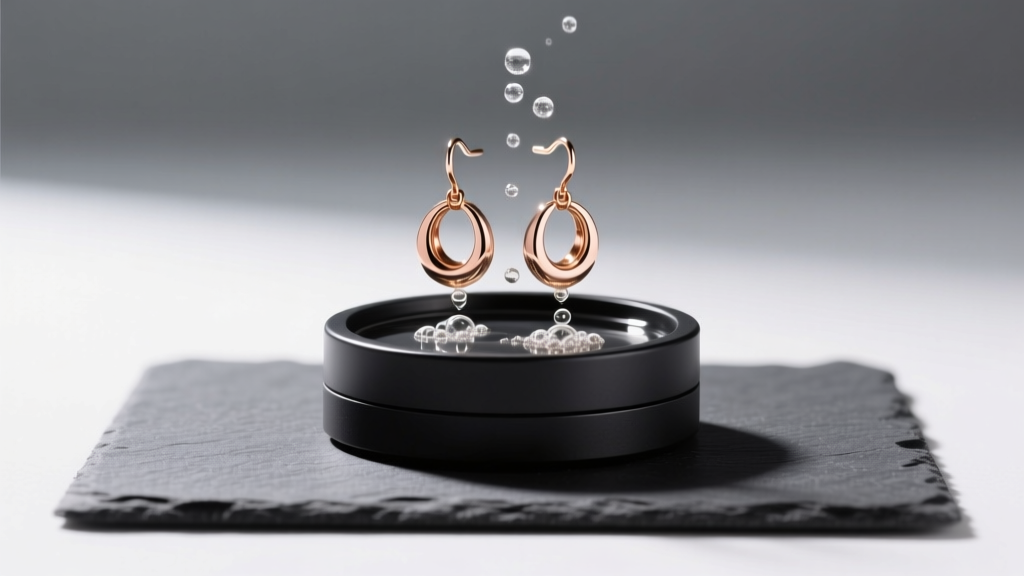
This process reverses the oxidation reaction. The electrical current strips the sulfur and oxygen ions away from the copper and silver alloys, converting the tarnish back into a gas that bubbles to the surface. According to the Jewelers of America, ionic cleaning is exceptionally safe for the metal itself because it involves zero mechanical abrasion. It is the premier choice for heavily tarnished 10k and 14k gold chains, as it reaches deep into the links without the risk of stretching the metal that manual brushing poses.
Expert Decision Matrix: Matching the Cleaner to the Karat
To synthesize these technical parameters into an actionable framework, use the following matrix to select the correct cleaning technology based on your specific jewelry profile:
- 24k & 22k Gold (Coins, High-Purity Bands): Use only warm water, a neutral-pH mild dish soap, and a microfiber cloth. Never use ultrasonic or chemical dips.
- 18k Gold with Porous Gems (Pearls, Emeralds): Use a non-ammonia surfactant dip or an ionic cleaner (ensure the gemstone is not submerged in the electrolyte if it is glued). Soft bristle brushing only.
- 14k & 18k Gold with Diamonds/Sapphires: Ammonia-based chemical dips for quick degreasing, followed by a 40kHz ultrasonic bath for 3-5 minutes to clear the pavilion (underside) of the stones.
- 10k Gold (Heavily Tarnished Chains/Bracelets): Ionic electrolysis is the superior method. It removes deep copper sulfide tarnish from complex link structures without the friction that wears down the gold plating or softens the links.
By aligning your cleaning methodology with the exact metallurgical and gemological properties of your jewelry, you transition from simply 'washing' your pieces to actively preserving their structural engineering and optical brilliance. For further reading on metal durability and care standards, consult the Federal Trade Commission Jewelry Guides, which outline the legal and material definitions of gold alloys in the consumer market.


