How to Know if Your Jewelry is Real Gold: A Beginner's Testing Guide
Learn how to know if your jewelry is real gold with our beginner-friendly guide. Discover hallmark checks, magnet tests, and acid testing methods.


When you inherit a vintage piece, receive a thoughtful gift, or find a bargain at an estate sale, figuring out how to know if your jewelry is real gold is the first step to understanding its true value. In 2026, counterfeit manufacturing and advanced electroplating techniques have made it increasingly difficult for the untrained eye to distinguish between solid gold, gold-filled, and high-quality gold-plated items. However, you do not need a professional gemology degree to perform preliminary verifications. By combining visual inspections, physical property tests, and an understanding of metallurgical standards, you can confidently assess your jewelry at home.
The Anatomy of Gold Hallmarks and Stamps
The most immediate way to verify authenticity is by locating the hallmark. A hallmark is a microscopic stamp applied by the manufacturer or an independent assay office to indicate the metal's purity. Using a 10x or 20x jeweler's loupe, inspect the inner band of rings, the clasp tongues of necklaces, or the back of earring posts.
Decoding the Karat and Millesimal Systems
In the United States, gold purity is typically measured in karats (k), where 24k represents 100% pure gold. In Europe and many international markets, you will more commonly see the millesimal fineness system, which denotes the parts per thousand of pure gold. Here is the definitive translation chart you need to know:
- 10k (417): 41.7% pure gold. The minimum standard to be legally sold as 'gold' in the US. Highly durable but pale in color.
- 14k (585): 58.5% pure gold. The most popular choice for everyday fine jewelry, offering an ideal balance of rich yellow hue and structural integrity.
- 18k (750): 75.0% pure gold. Favored for high-end and luxury pieces, particularly in engagement rings, due to its deep color and hypoallergenic properties.
- 22k (916): 91.6% pure gold. Common in Middle Eastern and South Asian jewelry; very soft and easily scratched.
- 24k (999): 99.9% pure gold. Too malleable for structural jewelry; primarily used in investment bullion or specialized cultural pieces.
Expert Insight: According to the Federal Trade Commission (FTC) Jewelry Guides, a piece stamped 14k in the US may legally contain a slight negative tolerance, meaning it could be 13.5k. However, reputable manufacturers stamp 585 or 14k and adhere strictly to the 58.5% threshold. If a piece lacks a stamp entirely, or features suspicious markings like '14k HGE' (Heavy Gold Electroplate) or '18k GP' (Gold Plated), it is not solid gold.
At-Home Physical Tests (No Chemicals Required)
If the hallmark is missing, worn away, or you suspect it has been fraudulently stamped, physical property testing is your next line of defense. Gold possesses unique physical characteristics that are incredibly difficult and expensive for counterfeiters to replicate perfectly.
The Neodymium Magnet Test
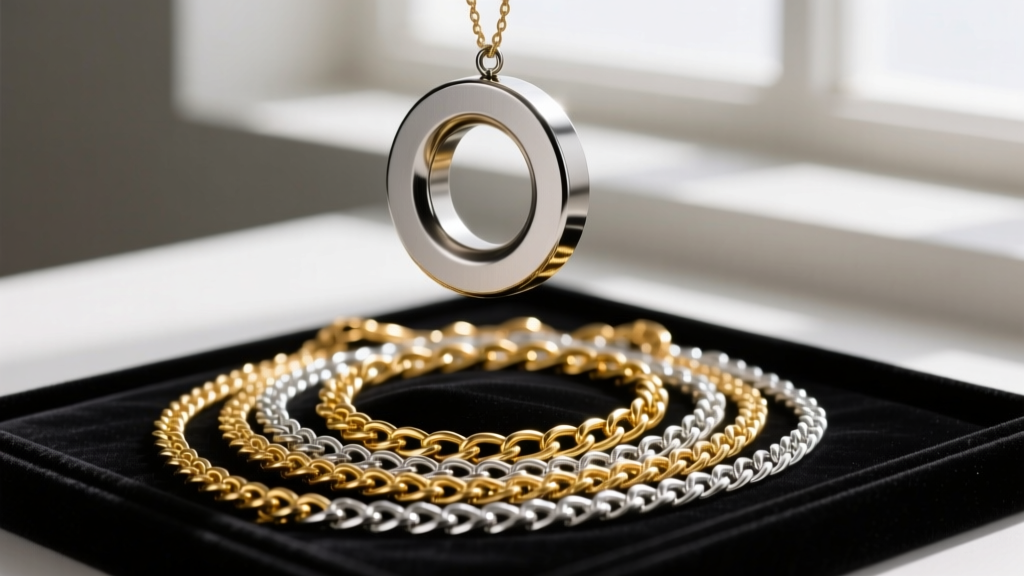
Gold is a diamagnetic metal, meaning it is entirely non-magnetic and will actually repel a magnetic field very slightly. To perform this test, you must use a high-grade N52 neodymium magnet, not a standard refrigerator magnet. Hold the magnet near the jewelry. If the piece snaps to the magnet or shows any magnetic pull, it contains ferromagnetic base metals like iron, steel, or nickel, and is definitively not solid gold. Limitation: Many base metals used in counterfeit gold, such as copper, brass, and aluminum, are also non-magnetic. Therefore, passing the magnet test does not guarantee the piece is real gold; it only eliminates iron-based fakes.
The Specific Gravity (Density) Test
This is the most reliable at-home test for solid gold jewelry, relying on Archimedes' principle of water displacement. Gold is exceptionally dense. To perform this, you need a precise digital pocket scale (accurate to 0.01g) and a cup of water.
- Weigh the dry piece of jewelry on the scale. Record this as Mass 1.
- Place the cup of water on the scale and press the 'Tare' or 'Zero' button.
- Suspend the jewelry in the water using a thin piece of thread (ensure it is fully submerged but not touching the bottom or sides of the cup). Record this submerged weight as Mass 2.
- Calculate the Specific Gravity (SG): SG = Mass 1 / Mass 2.
Compare your result to the known densities of gold alloys:
| Gold Purity | Expected Specific Gravity (g/cm³) |
|---|---|
| 10k Yellow Gold | 11.5 - 11.8 |
| 14k Yellow Gold | 12.9 - 14.6 |
| 18k Yellow Gold | 15.2 - 15.9 |
| 24k Pure Gold | 19.32 |
If your 14k ring yields a specific gravity of 8.5, it is likely brass or copper-plated base metal. The Gemological Institute of America (GIA) notes that specific gravity testing is a cornerstone of non-destructive gemological identification, though it is less effective on hollow jewelry or pieces with large gemstones, which will skew the density calculations.
Advanced Verification: Acid and Electronic Testing
When physical tests yield ambiguous results, chemical and electronic testing provides definitive proof of the metal's composition. These methods are widely used by pawn shops, jewelers, and gold buyers.
The Touchstone and Acid Test
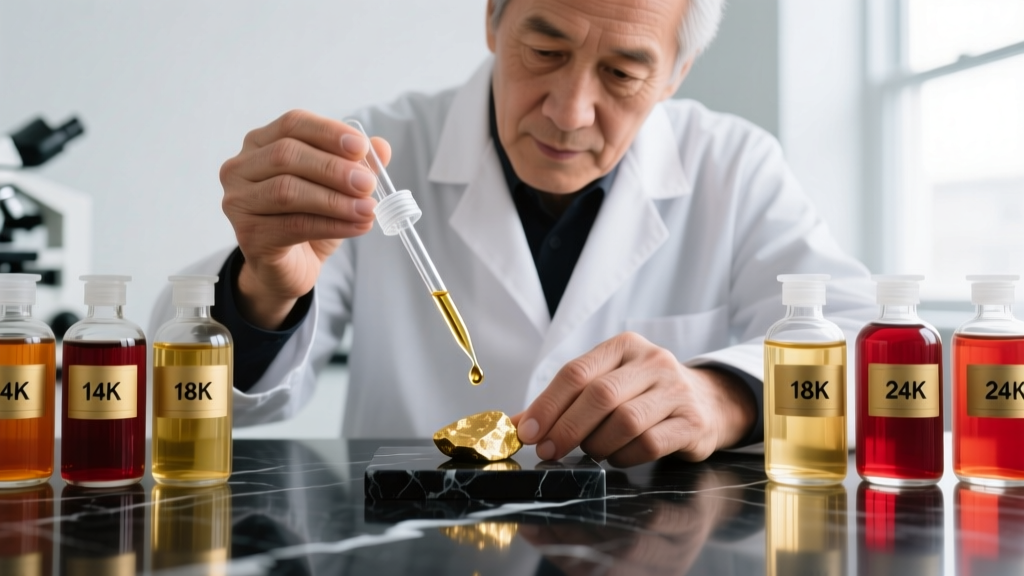
An acid test kit uses bottles of nitric acid and aqua regia (a mix of nitric and hydrochloric acid) formulated to react to specific karat levels. You rub the jewelry against a black siliceous touchstone to leave a visible streak of metal. Then, you apply a drop of acid to the streak. If you apply 14k acid and the streak dissolves immediately, the metal is below 14k. If the streak remains bright and unaffected, the metal is 14k or higher. This test is highly accurate but destructive to the microscopic layer of metal rubbed onto the stone, and it requires careful handling of corrosive chemicals.
Sigma Metalytics Electronic Testers
For high-value items, professionals use electronic gold testers like the Sigma Metalytics Precious Metal Verifier. These devices measure the electrical conductivity and resistivity of the metal, comparing it against a global database of known precious metal signatures. This technology can instantly detect tungsten cores hidden inside thick gold plating—a sophisticated counterfeit method that easily defeats the specific gravity test, as tungsten shares a nearly identical density to pure gold (19.25 g/cm³ vs 19.32 g/cm³).
Understanding Gold Plating vs. Solid Gold
A major hurdle for beginners is confusing gold-plated items with solid gold. Gold plating involves using an electrical current to bond a microscopic layer of gold to a base metal. In the US, standard gold plating can be as thin as 0.175 microns. Even 'Heavy Gold Electroplate' (HGE) only requires a minimum thickness of 2.5 microns. To put this in perspective, a human hair is roughly 70 microns thick. Over time, friction, sweat, and cosmetics will wear away this microscopic layer, revealing the brass or copper beneath, which often causes a green or black discoloration on the skin. Solid gold, conversely, will never wear away to reveal a different metal, and it will not cause skin discoloration unless the wearer has a specific allergy to the copper or nickel alloys mixed into the lower-karat gold.
When to Consult a Professional Gemologist
While at-home testing is an excellent starting point, there are scenarios where professional intervention is mandatory. If you are dealing with antique jewelry featuring complex enameling, hollow-link chains, or pieces heavily encrusted with diamonds and gemstones, at-home density and acid tests will be inaccurate or risk damaging the piece. Furthermore, if you intend to insure, sell, or pass down the jewelry, an official appraisal from a certified gemologist or a recognized assay office is legally and financially required. A professional will utilize X-ray Fluorescence (XRF) spectrometry, which fires X-rays into the metal to read the exact elemental breakdown of the alloy without causing any physical damage to the jewelry.


