Sterling Silver Cleaner Jewelry Guide: Chemical Tarnish Removal
Discover the chemistry behind sterling silver cleaner solutions. Compare dips, polishes, and electrolytic methods for safe 925 tarnish removal.

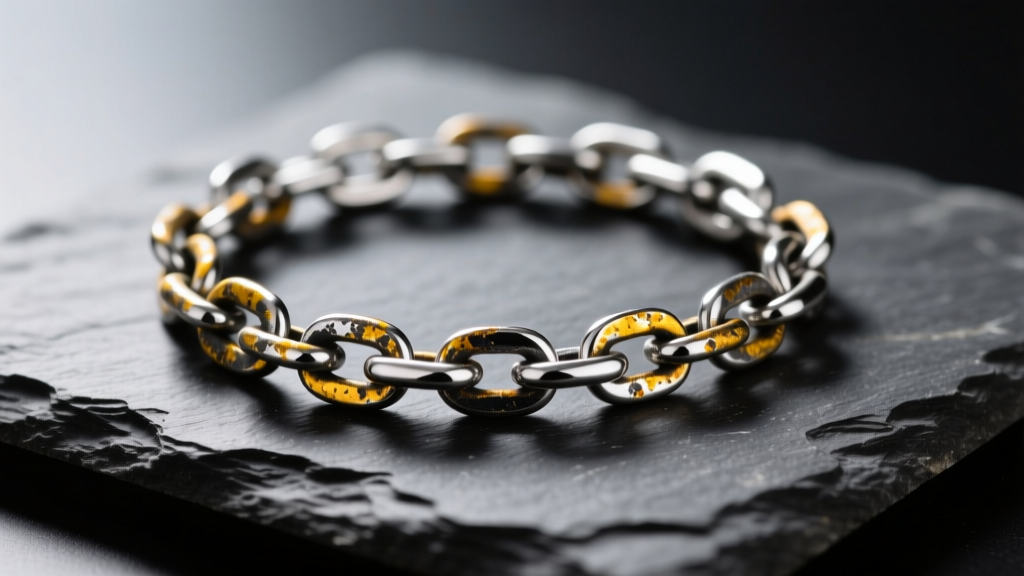
The Metallurgy of Tarnish: Why 925 Silver Reacts
To understand how to properly select a sterling silver cleaner, jewelry collectors and metallurgists must first understand the exact chemical mechanism of tarnish. Pure fine silver (99.9% Ag) is highly resistant to oxidation and sulfurization. However, fine silver is too malleable for structural jewelry. The industry standard, 925 sterling silver, is an alloy comprising 92.5% silver and 7.5% copper. This copper addition provides the necessary tensile strength and hardness (raising the Mohs scale rating to roughly 2.5–3), but it introduces a critical vulnerability: sulfur reactivity.
Tarnish is not rust (iron oxide); it is primarily silver sulfide (Ag2S) and copper sulfide. When airborne hydrogen sulfide (H2S), sulfur dioxide (SO2), or sulfur-containing amino acids in human sweat contact the copper-rich grain boundaries of the alloy, a galvanic micro-cell forms. This catalyzes the rapid conversion of surface silver atoms into silver sulfide, manifesting as a yellowish, then brown, and finally black film. Effective cleaning requires either dissolving this sulfide layer, physically abrading it, or electrochemically reducing it back to elemental silver.
Categorizing Sterling Silver Cleaners
The market is saturated with cleaning solutions, but from a chemical engineering perspective, they fall into three distinct categories. Each interacts with the 925 alloy lattice differently, carrying unique risks for metal loss and gemstone integrity.
1. Chemical Dips (Thiourea-Based Solutions)
Commercial liquid dips rely heavily on thiourea (CS(NH2)2) combined with an alkaline catalyst like ammonium hydroxide. Thiourea is a powerful complexing agent that binds to silver ions in the sulfide layer, dissolving them into the aqueous solution.
- The Mechanism: The thiourea molecule attacks the sulfur-silver bond, stripping the Ag2S layer in seconds.
- The Drawback: These dips are non-selective. They strip away intentional antiquing (oxidized patinas in crevices) and can cause micro-pitting on the silver surface if left for more than 10–15 seconds. This microscopic roughening actually increases the surface area, causing the piece to re-tarnish significantly faster post-cleaning.
- Gemstone Risk: Highly toxic to porous gems. The alkaline ammonia can etch pearls, dissolve the resin in fracture-filled emeralds, and permanently cloud opals.
2. Abrasive Polishes (Suspension Pastes)
Polishing creams and cloths utilize mechanical action to shear the sulfide layer off the surface. The efficacy and safety of a polish depend entirely on the particle size and Mohs hardness of the abrasive medium.
- Precipitated Calcium Carbonate: With a Mohs hardness of 3, it is roughly equal to sterling silver. When milled to sub-10-micron particles, it safely lifts tarnish without incising deep scratches into the metal lattice.
- Hydrated Silica: Often found in aggressive commercial polishes, silica has a Mohs hardness of 7. If the particle size is not strictly controlled, silica will leave micro-scratches (haze) on high-polish silver finishes, requiring professional re-buffing with jeweler's rouge (iron oxide) to restore specular reflection.
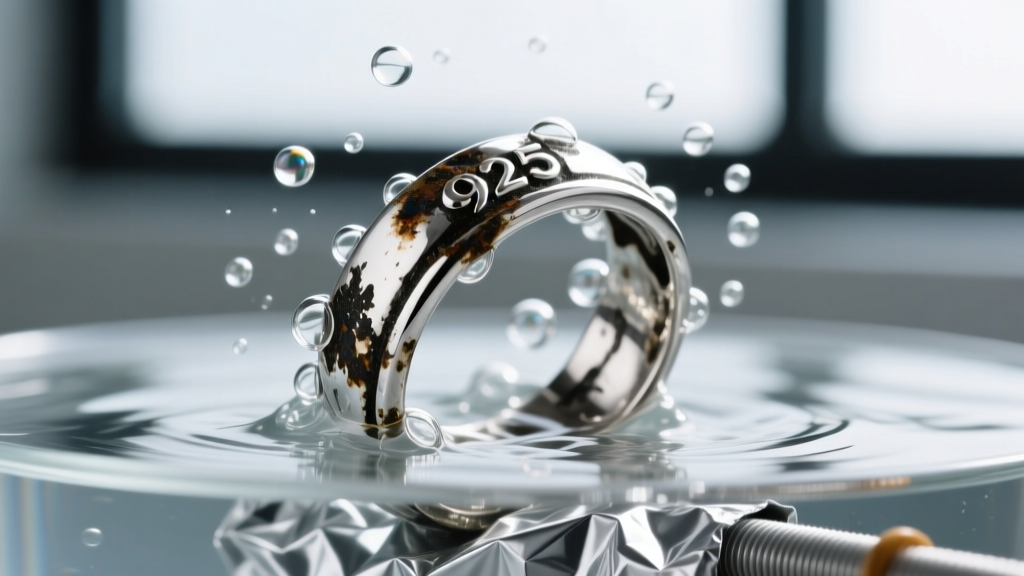
3. Electrolytic Reduction (The Galvanic Method)
Widely regarded by conservationists as the safest method for heavy tarnish, electrolytic cleaning does not remove any base silver. Instead, it reverses the chemical reaction.
By placing the tarnished silver in an aluminum pan (or lining a glass bowl with aluminum foil) and adding hot water and an electrolyte (sodium bicarbonate / baking soda), you create a galvanic cell. Aluminum is more anodic (reactive) than silver. The aluminum sacrifices itself, releasing electrons that travel through the conductive saline solution to the silver sulfide. The sulfide is reduced back to elemental silver, while the sulfur binds to the aluminum, forming aluminum sulfide and releasing trace amounts of hydrogen sulfide gas (the "rotten egg" smell).
Expert Protocol: For electrolytic reduction to work, the silver must physically touch the aluminum. The water must be near boiling (90°C+) to maximize ionic mobility. Never use sodium chloride (table salt) as the electrolyte, as the chloride ions will form silver chloride, creating a stubborn white haze that requires secondary polishing.
Comparative Analysis: Efficacy, Metal Loss, and Safety
| Cleaning Method | Active Mechanism | Base Metal Loss | Effect on Patina/Antiquing | Porous Gemstone Safety |
|---|---|---|---|---|
| Thiourea Dips | Chemical Complexation | High (Micro-pitting) | Strips entirely | Extremely Poor |
| Calcium Carbonate Paste | Mechanical Abrasion | Low (Sub-micron) | Removes surface patina | Moderate (Avoid contact) |
| Electrolytic (Aluminum) | Galvanic Reduction | Zero | Preserves deep crevice patina | Poor (Heat/pH sensitive) |
| Ultrasonic (Detergent) | Acoustic Cavitation | Zero | Preserves entirely | Extremely Poor (Shatters) |
The Ultrasonic Trap: Cavitation and Gemstone Catastrophe
Ultrasonic cleaners operate at high frequencies (typically 40 kHz), generating microscopic vacuum bubbles in the cleaning fluid. When these bubbles collapse against the silver surface—a process called cavitation—they create localized micro-jets of liquid that blast away dirt and light sulfide layers. While excellent for cleaning diamond and platinum settings, ultrasonic waves are highly destructive to many jewelry components.
According to the Gemological Institute of America (GIA), ultrasonic cavitation can easily shatter emeralds, tanzanite, and opals due to internal inclusions and water-content sensitivities. Furthermore, the high-frequency vibrations will rapidly loosen shellac, epoxy, and laser-welded pavé settings common in modern sterling silver jewelry. Ultrasonic cleaners should be strictly reserved for bare, un-stone-set silver chains and bangles.
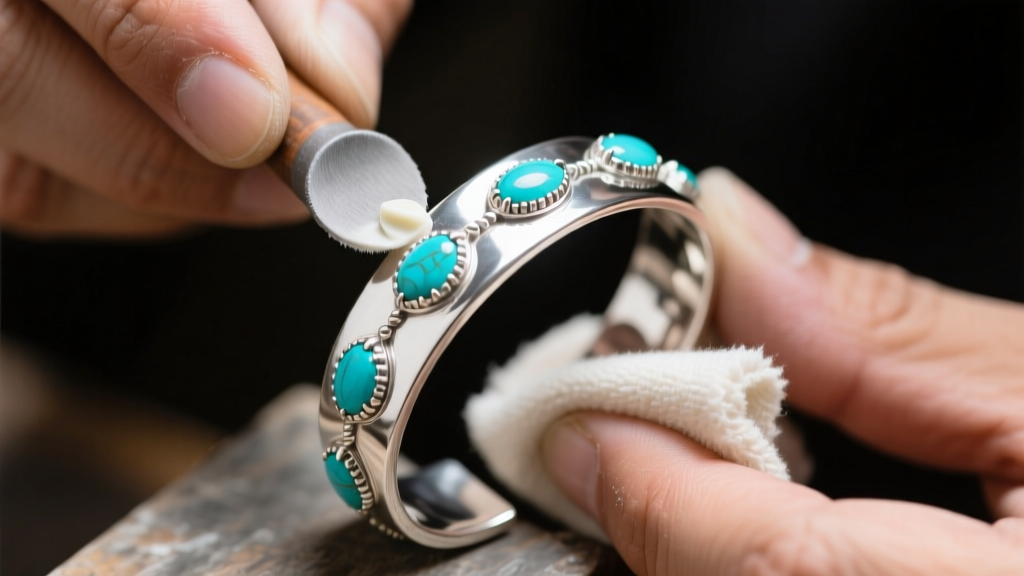
Post-Cleaning Passivation and Storage Protocols
Cleaning is only half the battle. Once the silver sulfide layer is removed, the raw 925 alloy is highly reactive. Professional jewelers employ passivation and environmental control to delay the next sulfidation cycle.
Anti-Tarnish Chemistry
Modern anti-tarnish storage relies on sacrificial metals and gas adsorption. Products like 3M Anti-Tarnish Strips utilize a specialized paper embedded with copper particles. Because copper has a higher affinity for sulfur than silver does, the strips act as a sacrificial anode in a closed environment, absorbing ambient H2S before it can reach your jewelry. Similarly, Pacific Silvercloth embeds microscopic zinc and silver particles into cotton flannel, trapping sulfides within the fabric's weave.
Environmental Controls
Humidity acts as the electrolyte that accelerates the galvanic corrosion of the copper-silver matrix. Storing sterling silver in airtight polyethylene bags (avoiding PVC, which off-gasses chlorine and causes irreversible silver chloride pitting) alongside indicating silica gel packets reduces ambient relative humidity below 40%, effectively halting the tarnish reaction. As noted by the Canadian Conservation Institute, controlling relative humidity and eliminating sulfur-bearing atmospheric pollutants are the most effective long-term preservation strategies for museum-grade silver artifacts.
Rhodium Plating: The Permanent Barrier
For jewelry that requires zero maintenance, many manufacturers apply a 0.5 to 1.0-micron layer of rhodium (a platinum group metal) over the sterling silver. While this prevents tarnish entirely, it alters the optical properties of the piece, giving it the cooler, darker reflectivity of white gold or platinum, rather than the warm, bright luster of bare polished silver. If you purchase rhodium-plated silver, never use abrasive polishes, as you will strip the plating down to the base alloy in seconds.
Final Troubleshooting Matrix
- White, chalky haze after cleaning: Caused by chloride contamination (table salt or tap water). Fix by polishing gently with a calcium carbonate paste and distilled water.
- Stubborn black spots: Often not sulfide, but copper oxide or fire scale from the manufacturing process. Chemical dips will not remove this; it requires professional mechanical buffing or a mild acid pickle (sulfuric acid/citric acid) used by bench jewelers.
- Matte, frosty appearance after a dip: The thiourea has etched the surface. Restore the mirror finish using a jeweler's polishing cloth impregnated with rouge (iron oxide).
By understanding the underlying chemistry of 925 sterling silver, collectors can move beyond trial-and-error and select the precise mechanical or chemical intervention required to preserve both the metallurgical integrity and the gemological value of their jewelry.


