How to Clean Titanium Jewelry: The Ultimate Care Guide
Learn how to clean titanium jewelry safely with our expert guide. Discover safe solutions, polishing tips, and maintenance for Grade 2 and 5 Ti.

Titanium has revolutionized modern jewelry, offering an unparalleled strength-to-weight ratio, exceptional hypoallergenic properties, and a sleek, contemporary aesthetic. Whether you wear a Grade 2 commercially pure titanium septum clicker or a Grade 5 (Ti-6Al-4V) aerospace-alloy wedding band, maintaining its pristine appearance requires specific knowledge. While titanium is famously low-maintenance compared to sterling silver or brass, it is not entirely immune to environmental buildup. In this comprehensive guide, we break down exactly how to clean titanium jewelry, preserve specialized finishes, and avoid catastrophic chemical damage.
The Metallurgy of Titanium Tarnish (Or Lack Thereof)
To properly care for titanium, you must first understand its surface chemistry. Unlike copper or silver, titanium does not tarnish or oxidize in a way that degrades the metal. According to the Gemological Institute of America (GIA), titanium instantly forms a passive, microscopic layer of titanium dioxide (TiO2) when exposed to oxygen. This oxide layer is what makes the metal completely hypoallergenic and highly resistant to corrosion.
Therefore, when your titanium ring looks "dirty" or dull, you are not looking at tarnish. You are looking at a buildup of sebum (skin oils), dead skin cells, lotions, and environmental dust trapped against the oxide layer. Because the metal itself is not degrading, cleaning titanium is purely about removing this organic and environmental film without scratching the underlying surface or damaging secondary treatments like anodization.
Step-by-Step: How to Clean Titanium Jewelry at Home
The Warm Soap Soak Method (Grade 2 & Grade 5)
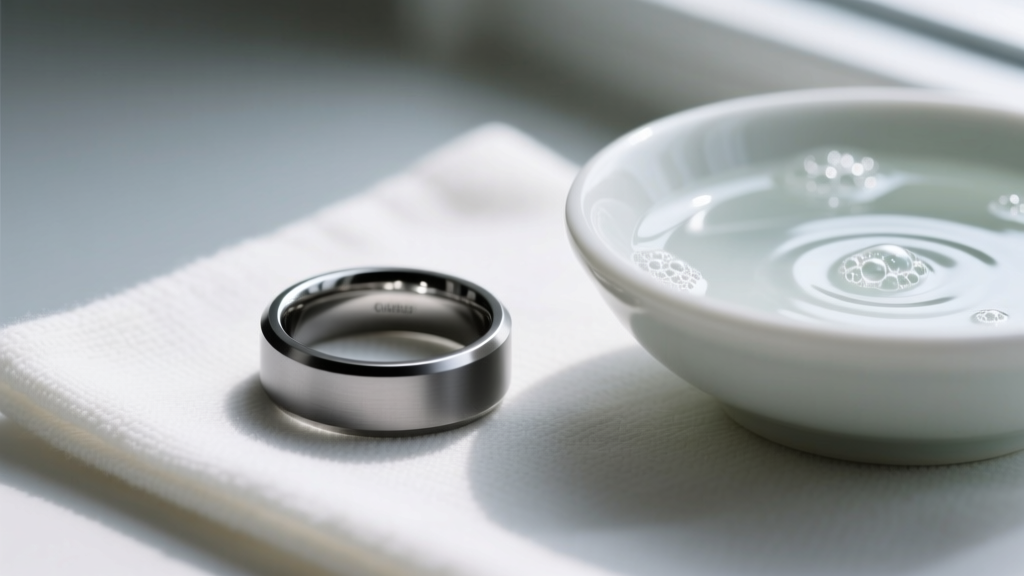
For standard brushed, matte, or mirror-polished titanium without gemstone inlays, the warm soap soak is the gold standard. This method safely breaks down lipid bonds (oils) without risking micro-scratches.
- Prepare the Solution: Fill a small glass bowl with warm (not hot) water. Add 3-4 drops of a mild, lotion-free dishwashing liquid (such as original blue Dawn). Avoid soaps with heavy moisturizers, as they leave a secondary film.
- Soak: Submerge the titanium jewelry for 15 to 20 minutes. This dwell time is crucial for softening hardened sebum in textured areas or milgrain detailing.
- Agitate Gently: Use a brand-new, ultra-soft baby toothbrush to gently sweep across the surface. Pay special attention to the inner band (the shank), where soap and skin cells accumulate most heavily.
- Rinse and Dry: Rinse thoroughly under lukewarm running water. Pat dry with a lint-free microfiber cloth. Avoid paper towels, as their wood-pulp fibers can leave microscopic scratches on high-polish finishes.
Tackling Anodized Titanium (Color Preservation)
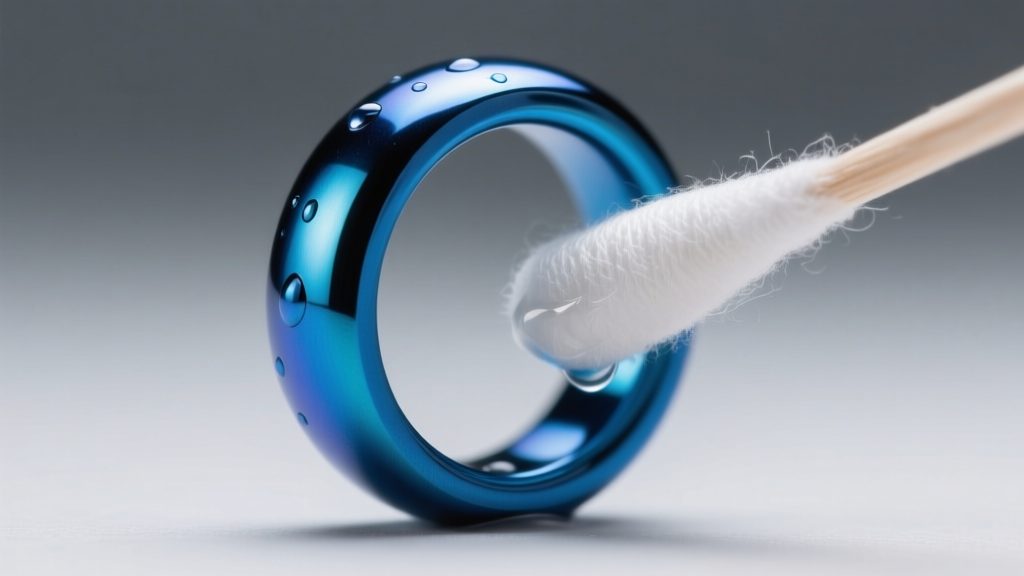
Anodized titanium achieves its vibrant colors (blues, purples, golds) not through dyes, but through light interference. By applying a specific voltage to the metal in an electrolytic bath, jewelers thicken the transparent TiO2 layer. The thickness of this layer dictates the color reflected. Because this color is purely structural, abrasive cleaning will literally scrub the color away, reverting the metal to its natural gunmetal grey.
How to clean anodized titanium: Never use a toothbrush, polishing cloth, or ultrasonic cleaner on anodized pieces. Instead, soak the piece in the warm soapy solution mentioned above, then simply rinse it and let it air dry on a soft towel. If a spot persists, gently wipe it with a damp, lint-free cotton swab.
Chemical Resistance: What to Avoid
Titanium is virtually impervious to most household chemicals, which is why it is used in medical implants and chemical processing plants. However, jewelers and wearers must be aware of the few exceptions that can compromise the metal's finish or damage secondary elements like tension-set gemstones.
| Chemical Agent | Effect on Titanium | Effect on Anodized Colors | Verdict |
|---|---|---|---|
| Chlorine (Pools/Spas) | None | None | Safe |
| Acetone (Nail Polish Remover) | None | None | Safe |
| Bleach (Sodium Hypochlorite) | None | May cause slight dulling over prolonged exposure | Safe, but rinse after |
| Hydrofluoric Acid | Rapidly dissolves the metal and oxide layer | Destroys color instantly | EXTREME DANGER |
| Harsh Abrasive Pastes | Micro-scratches mirror finishes | Strips anodized layer completely | Avoid |
While you are unlikely to encounter hydrofluoric acid in daily life, it is a critical point of metallurgical data: it is one of the only substances that actively eats through titanium. For everyday wear, your titanium jewelry is safe in swimming pools, hot tubs, and while using household cleaning supplies, though Jewelers of America generally recommends removing all fine jewelry before heavy chemical exposure to protect secondary gemstone settings.
Polishing Scratches on Mirror-Finish Titanium
If you own a mirror-polished Grade 5 titanium ring, you will inevitably notice fine surface scratches. Grade 5 titanium has a Vickers hardness of roughly 350 HV (compared to Grade 2 at 150 HV), making it highly scratch-resistant, but not scratch-proof. Because of its hardness, traditional jeweler's rouge (used for gold and silver) is entirely ineffective on titanium.
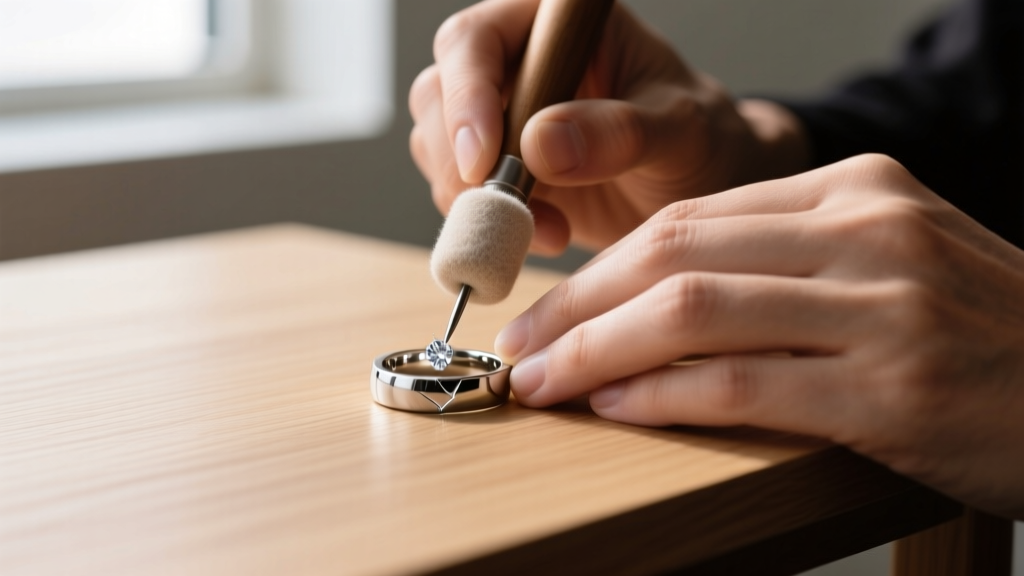
To remove light scratches at home, you must use diamond abrasives. Apply a micro-drop of 1-micron diamond polishing paste to a soft felt buffing wheel or a dedicated jewelry polishing cloth. Rub the scratched area in a single, consistent direction (never in circles, which create visible swirl marks). For deeper scratches, a professional jeweler will need to use a motorized buffing lathe with specialized titanium compounds, stepping down from 6-micron to 0.25-micron diamond pastes to restore the optical clarity of the mirror finish.
Ultrasonic Cleaners: Safe or Risky?
Ultrasonic cleaners use high-frequency sound waves (typically 40kHz) to create microscopic cavitation bubbles in a liquid solution, which violently implode and blast dirt away from the jewelry.
For plain, un-anodized titanium: Ultrasonic cleaners are incredibly safe and highly effective at removing debris from textured surfaces, knurled edges, and complex geometric designs.
For anodized titanium: Avoid ultrasonics. The intense cavitation can create micro-pitting in the delicate oxide layer, causing the vibrant colors to look cloudy or uneven.
For titanium with gemstone inlays: Proceed with caution. While the titanium itself will not be harmed by the vibrations, the shockwaves can shatter brittle stones like opals, emeralds, or tension-set diamonds if the setting has loosened over time.
Expert Maintenance Schedule
To keep your titanium jewelry looking factory-new, adopt this simple maintenance framework:
- Daily: Rinse your rings or body jewelry under warm water while showering to prevent the daily accumulation of lotions and sebum.
- Monthly: Perform the warm soap soak and soft-bristle brush cleaning detailed above. This is especially critical for body jewelry (like dermal anchors or barbells) where skin flora can accumulate near the threading.
- Annually: If you wear a high-polish Grade 5 titanium wedding band, have it professionally inspected and lightly polished by a jeweler who possesses diamond-compound lapping equipment. Standard bench jewelers without titanium-specific tools may struggle to achieve a true mirror finish on this aerospace-grade alloy.
By understanding the unique properties of titanium and avoiding abrasive shortcuts, your jewelry will retain its structural integrity and modern aesthetic for a lifetime.


